All ages
Kinesisk filosofi
Follow Chinese philosophy from Confucius and Laozi, through the rival schools, Buddhism in China and Wang Yangming, to Mao and contemporary thinkers. You'll explore the questions it asks: Is human nature good? What is the Way? Can universal love be a political programme? Along the way, you'll weigh each school's arguments alongside the critiques it drew, and make up your own mind.
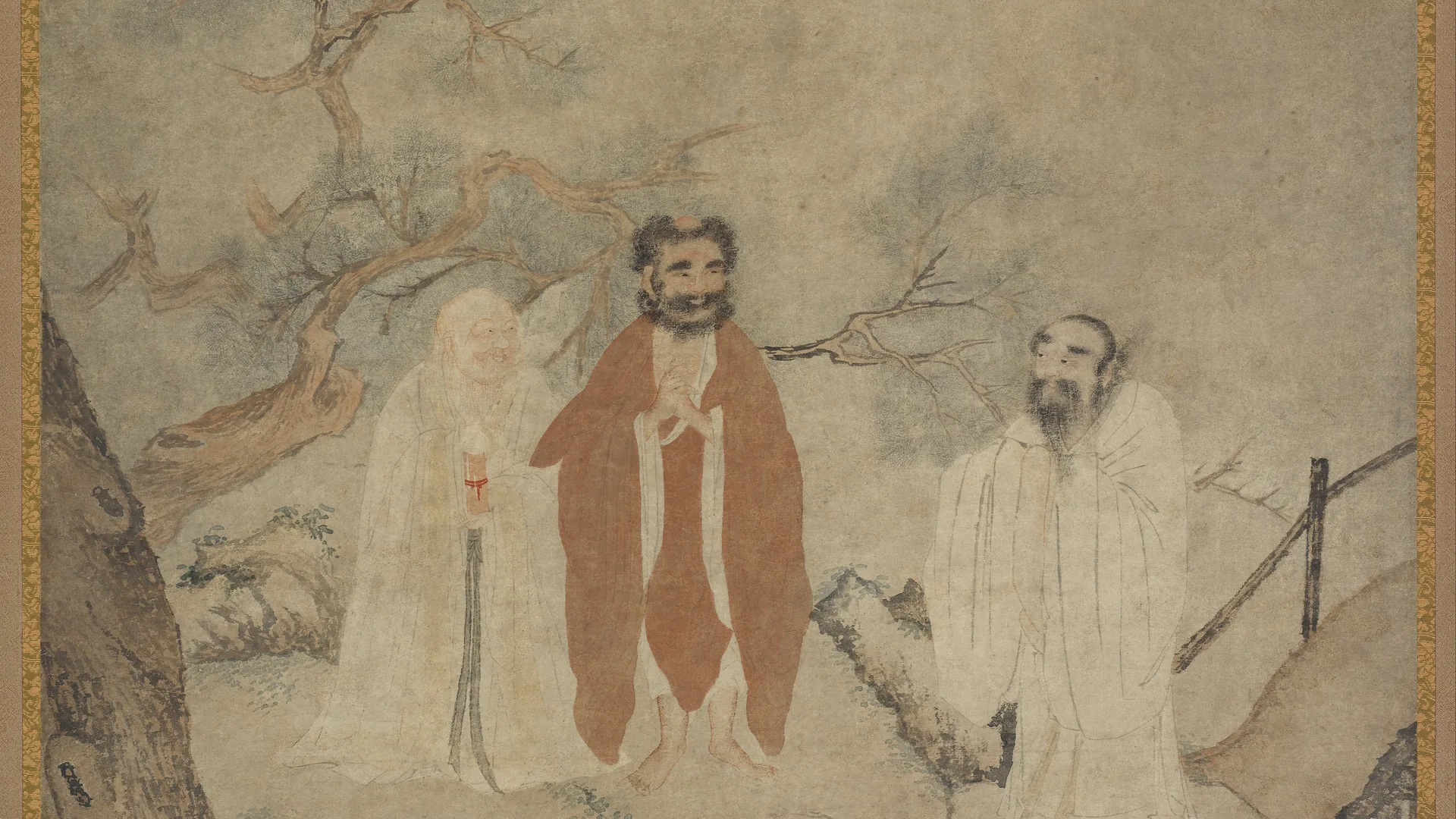
The Buddha, Laozi and Confucius together, a Ming dynasty painting from about 1500.
Freer Gallery of Art · Allmän egendom
Filosofi
6 kurser
- Klassisk kinesisk filosofi I — Konfucianism Utforska hur Konfucius och hans efterföljare svarade på kaos och samhällskollaps genom att utveckla en filosofi centrerad kring mänsklig dygd och ritual. Du undersöker ren (mänsklighet) och li (rituell anständighet) som lösningar på oordning, och ser varför dessa idéer format östasiatiskt tänkande i årtusenden.
- Klassisk kinesisk filosofi II — Taoism Utforska hur forntida taoistiska tänkare svarade på kaos och konflikt genom att föreslå att den djupaste kraften kommer från icke-handlande och anpassning till naturens flöde. Du undersöker Tao självt — den namnlösa kraft som ligger till grund för verkligheten — och lär dig hur dygd (de) uppstår inte genom kraft utan genom spontan, ansträngningsfri handling (wu wei).
- De rivaliserande skolorna — Mohism, legalism och kosmologi Explore the schools that rivalled Confucianism in ancient China, beginning with Mozi, an artisan-philosopher who built a movement around universal love and rigorous logic to oppose aggressive warfare and injustice. You'll meet the School of Names and its paradoxes, such as "a white horse is not a horse", and the Legalists, whose ideas of law, technique and power drove the Qin unification. You'll also discover the cosmology of yin-yang, the Five Phases and the Yijing, and how Han thinkers drew these rival ideas together.
- Buddhism i Kina Explore how Buddhism traveled the Silk Road into China, where translators grappled with rendering Sanskrit concepts into Chinese and monks navigated tensions with Confucian values like filial piety. You'll follow its growth into distinctly Chinese schools, from Tiantai, Huayan and Pure Land to Chan with its koans and sudden awakening, and its spread as Zen, Seon and Thien across East Asia. Along the way you'll see how emperors patronized and persecuted it, how it shaped art and everyday life, and how it was reformed in modern times.
- Nykonfucianism Explore how Confucianism reinvented itself from the Song dynasty onward to compete with Buddhism and Taoism. You'll trace its foundations in thinkers like Zhou Dunyi and Zhang Zai, Zhu Xi's great system of principle (li) and material force (qi), and Wang Yangming's teaching of innate moral knowing and the unity of knowledge and action, along with the famous debate between them. You'll also follow its spread to Korea, Japan and Vietnam, and the Qing scholars who criticized it.
- Modern kinesisk filosofi When China collided with Western power in the 1800s, its thinkers grappled with an urgent question: how to survive modernization without losing their identity? Explore how philosophers like Kang Youwei and Liang Qichao reimagined Confucianism, nationalism and citizenship, and how the answers kept changing through the May Fourth Movement, Marxism and Mao, the Cultural Revolution and the New Confucians. You'll follow the debate to the present, from post-Mao liberalism and the New Left to today's arguments over Tianxia, Confucian constitutionalism and feminism.
Redo att börja lära dig?
Börja gratis