All ages
Indisk filosofi
From the Vedic hymns to Ambedkar's critique of caste, follow Indian philosophical thought from its earliest texts to the modern day. You'll explore Brahman and Atman, the heterodox challengers (Buddhism, Jainism), the six orthodox schools, the Vedanta debates of Shankara, Ramanuja and Madhva, the devotional poetry of Mirabai and Kabir, and the modern thinkers who brought Indian philosophy into dialogue with the world.
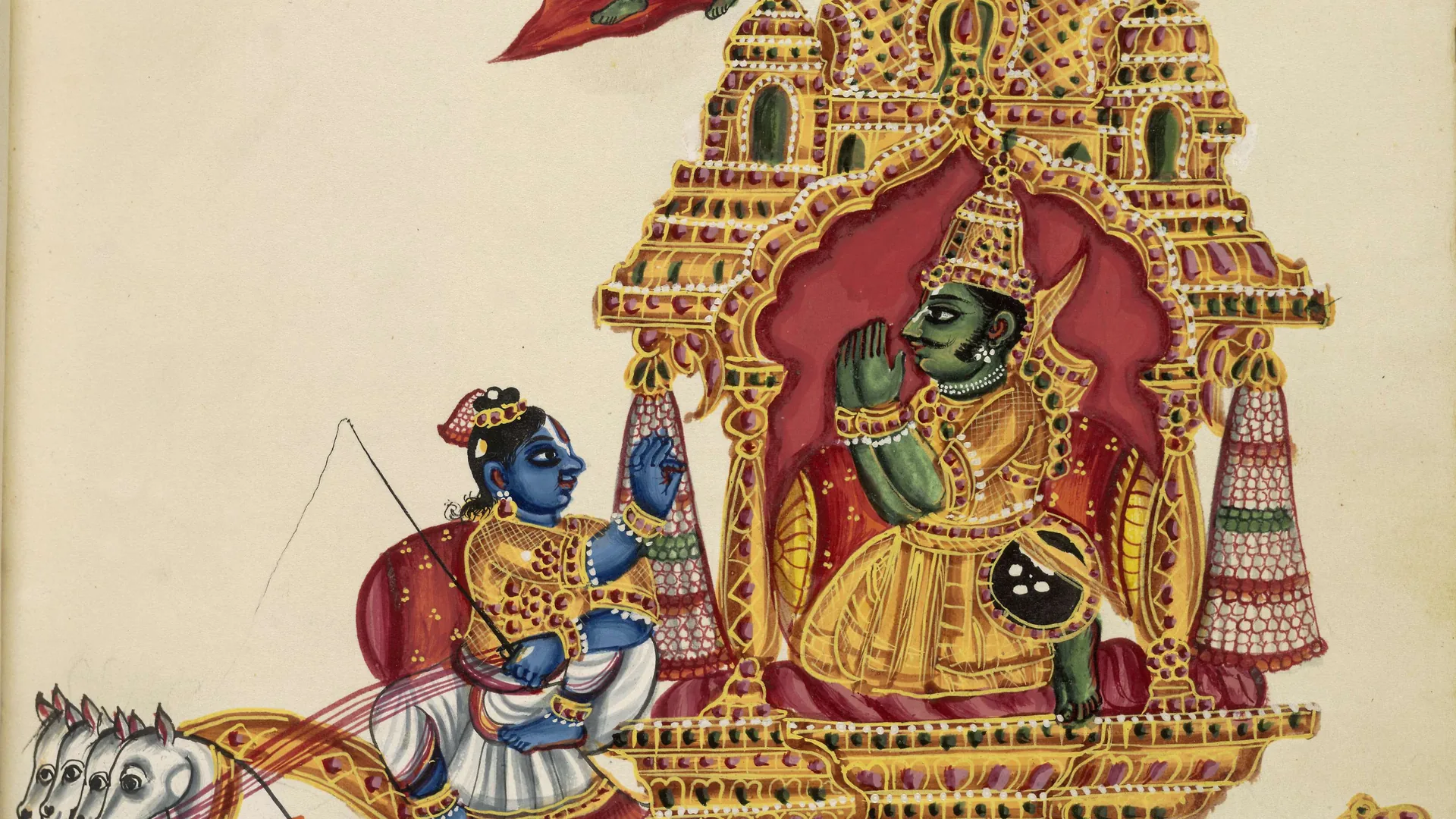
Krishna instructs Arjuna before battle, the scene of the Bhagavad Gita. Painted around 1830.
British Museum · Allmän egendom
Filosofi
6 kurser
- Indisk filosofi I: Den vediska världen Explore the foundational texts and ideas that shaped Indian thought for millennia. You'll start with the Rigveda's questions about creation and the ritual world of the Vedas, then the Upanishads' Brahman and Atman, maya, karma and moksha and Nachiketa's conversation with Death, before turning to later frameworks such as Samkhya's Purusha and Prakriti, dharma and the four paths of yoga.
- Indisk filosofi II: De heterodoxa skolorna Explore the schools that challenged Vedic authority: Buddhism, Jainism and India's materialists. You'll examine the Four Noble Truths, the idea of the self as a bundle of changing parts set against the Upanishadic Atman, Nagarjuna's emptiness, Jain many-sidedness and non-violence, and how these challenges changed Brahmanical thought.
- Indisk filosofi III: De sex ortodoxa skolorna Explore how classical Indian philosophers built careful arguments about knowledge, reality and God's existence. You'll see how the six orthodox schools answer each other: Nyaya's logic and sources of knowledge, Vaisheshika's atoms, Samkhya's spirit and matter, Patanjali's Yoga, Mimamsa's eternal Veda, and Vedanta.
- Indisk filosofi IV: Vedanta Explore Vedanta through its great rival readings of reality. You'll examine Shankara's view that Brahman alone is ultimately real and the world its appearance, Ramanuja's qualified non-dualism and Madhva's dualism, follow the debates between them about God, the self and liberation, and compare them with the rival non-dualism of Kashmir Shaivism.
- Indisk filosofi V: Bhakti, tantra och medeltida syntes Explore how medieval Indian poets and thinkers put devotion, emotion and direct experience of the divine at the centre of spiritual life. From the Tamil saints to Kabir and Mirabai, see how bhakti challenged caste, then discover Tantra's ideas of Shakti, the subtle body and mantra, and how Sufi, Hindu and other traditions met and argued.
- Indisk filosofi VI: Modern indisk filosofi Explore how Indian thinkers of the 19th and 20th centuries answered modernity, colonial rule and caste. From Ram Mohan Roy and Vivekananda to Aurobindo, Radhakrishnan, Gandhi and Ambedkar, see how some renewed ancient ideas while others, like Ambedkar and Krishnamurti, broke with them.
Redo att börja lära dig?
Börja gratis