Islamisk filosofi
Islamic philosophy from the Quran and early theology to today's feminist and decolonial thought, through its great debates: can reason show that God exists, does al-Ghazali's Incoherence of the Philosophers refute Aristotelian philosophy (and how did Averroes answer him), and what does Avicenna's Flying Man reveal about self-awareness? You'll meet Sufi and illuminationist mystics, Mulla Sadra, and Ibn Khaldun's new science of civilization, follow Averroes into medieval Europe, and explore political philosophy and dialogue with other traditions. The thinkers range across the Arab world, Persia, al-Andalus, the Ottoman lands, South Asia and West Africa.
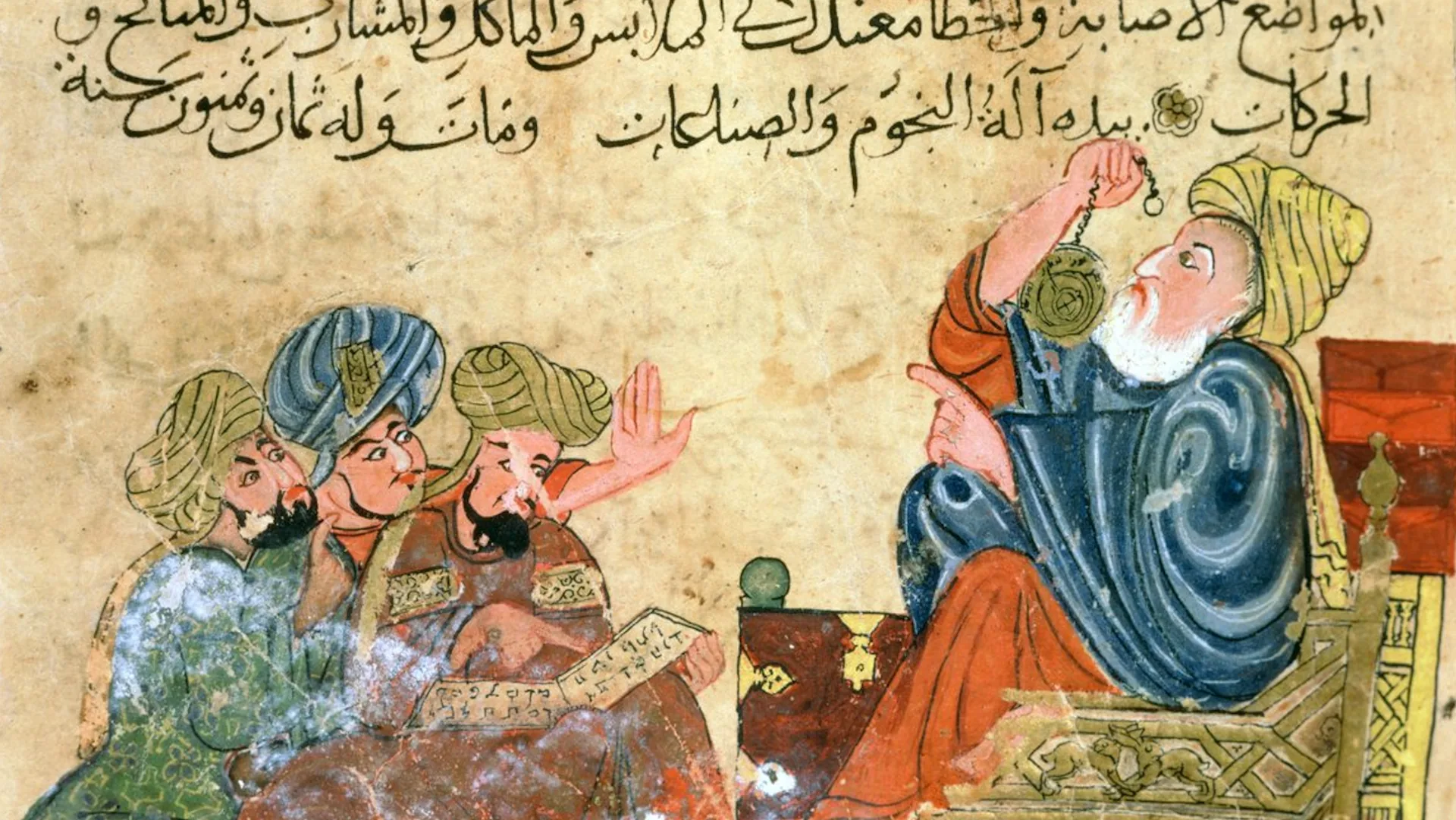
Aristotle teaching, from an Arabic collection of the sayings of Greek philosophers, early 13th century.
Topkapı Palace Library · Allmän egendom
Filosofi
6 kurser
- Islamisk filosofi I Spårar den islamiska filosofins framväxt från dess förislamiska rötter genom den abbasidiska översättningsrörelsen och den första generationen muslimska filosofer. Täcker kalams teologiska rationalism, den arabiska mottagningen av Aristoteles och Platon, och pionjärarbetet av al-Kindi och al-Farabi. Utforskar frågor som: Vad är förhållandet mellan förnuft och uppenbarelse? Kan filosofi och islam förenas?
- Islamisk filosofi II An in-depth study of Ibn Sina (Avicenna, born 980 CE): his life at court, his metaphysics of existence, essence and the Necessary Being, the Flying Man argument for the soul, his logic and theory of knowledge through the Active Intellect, and his physics, medicine and cosmology. It then follows his legacy among his disciples and critics and in Jewish and Latin thought. Explores questions like: What is the difference between existence and essence? How can we know that we exist?
- Islamisk filosofi III Examines the pivotal crisis in Islamic philosophy triggered by al-Ghazali's Incoherence of the Philosophers and Averroes' reply in defense of philosophy, and how later thinkers such as Fakhr al-Din al-Razi brought theology and philosophy together. Covers the philosophers of al-Andalus, the Latin reception of Averroes from Toledo to Aquinas, and Sufi mysticism and its philosophy of knowledge. Explores questions like: Did al-Ghazali destroy Islamic philosophy? How did Islamic thought shape European scholasticism?
- Islamisk filosofi IV Explores the rich tradition of Islamic mystical philosophy: Suhrawardi's Illuminationist philosophy of light, Ibn Arabi's doctrine of the Unity of Being, Rumi's philosophical poetry, and Mulla Sadra's Transcendent Wisdom. Examines Sufi ethics, the Sufi orders as communities of practice from Persia to South Asia, Mulla Sadra's heirs such as Sabzavari, and modern debates over mystical philosophy. Asks questions like: What is the relationship between light and being? Can love be a form of philosophical knowledge?
- Islamisk filosofi V Undersöker islamiska teorier om styrning, rättvisa, och politisk ordning, från Ibn Khalduns banbrytande historiefilosofi genom osmanskt politiskt tänkande, modern politisk islam, och samtida debatter om mänskliga rättigheter och demokrati. Utforskar frågor som: Vad driver civilisationers uppgång och fall? Kan islamisk politisk filosofi stödja demokratiskt styre?
- Islamisk filosofi VI Ger en översikt över samtida islamiska filosofiska rörelser: nytraditionalistisk och perennialistisk filosofi, islamiskt feministiskt tänkande, interreligiös filosofisk dialog, tillämpad etik inom bioetik och AI, och dekolonial islamisk kunskapsteori. Återupptäcker försummade röster, inklusive västafrikansk och sydasiatisk islamisk filosofi. Utforskar frågor som: Vad bidrar islamisk feminism med till global filosofi? Hur bemöter traditionen artificiell intelligens?
Redo att börja lära dig?
Börja gratis