All ages
Animal Minds
What is it like inside the head of an octopus, a crow or a bee, and how could anyone find out? Work it out with your tutor, one clue at a time: meet animals that make tools, plan ahead, play and seem to call each other by name, and learn how scientists test a mind fairly without fooling themselves. From whale song and chimpanzee cultures to who can feel pain, how animals find their way home and what cats, pigs and parrots understand, find out what scientists know, what they suspect and what is still open. No science background needed.
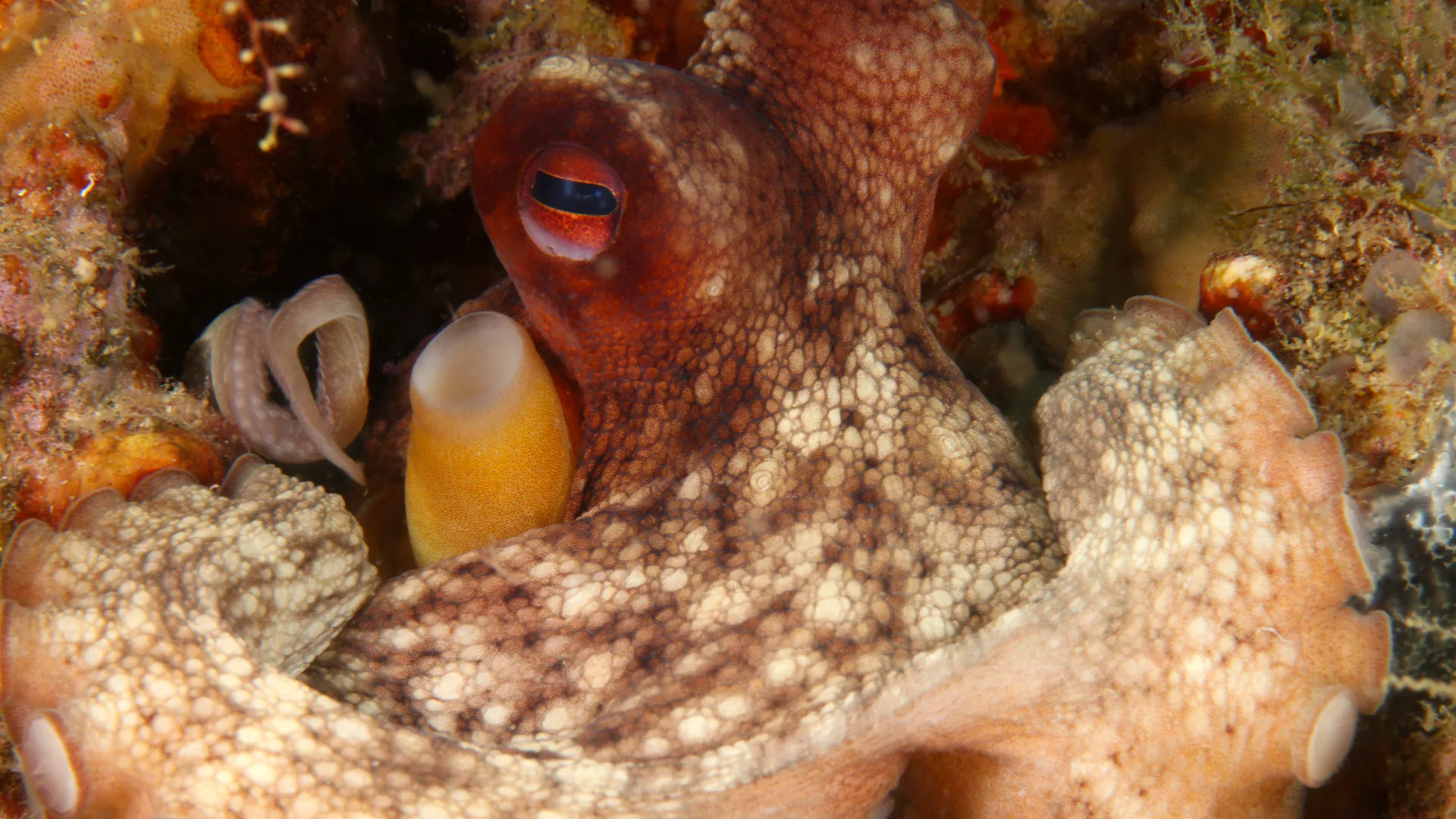
A common octopus in Gray's Reef National Marine Sanctuary, off the coast of Georgia, USA, photographed in 2015.
National Marine Sanctuaries (NOAA) · Allmän egendom
Naturvetenskap
5 kurser
- Animal Talk: Songs, Names, Cultures and Social Minds What would count as language in an animal, and could AI ever translate one? Follow humpback songs that spread across the South Pacific, sperm whale clans with their own click codes, and honeybees whose waggle dance gives directions to food. Find out why vervet monkeys give different alarm calls for leopards, eagles and snakes, how each dolphin has a whistle of its own, and why researchers suspect wild elephants may call each other by name. Meet chimpanzee groups with their own toolkits, capuchins that refuse cucumber when a partner gets a grape, and rats that free a trapped companion. Then weigh a question still argued over: do apes know what others know?
- Clever Animals: Octopuses, Crows, Apes and Dogs Where does an octopus think, when about two thirds of its neurons are in its arms? Meet octopuses that carry coconut shells to shelter in, a captive crow called Betty who bent wire into a hook, and chimpanzees fishing for termites with twigs. Find out how wild crows in Seattle kept scolding, for years, a mask worn by the people who had trapped them. Learn the lesson of Clever Hans, the horse who seemed to count but was reading the faces around him, and how scientists now design fair tests for animals with very different bodies. Then ask how honeybees with under a million neurons learn so much, and why some scientists call "Which animal is smartest?" the wrong question.
- Do Animals Feel? Emotion, Pain and Consciousness Do animals feel joy, grief or pain, and how could anyone tell from the outside? Discover rats that make ultrasonic calls when tickled, and mood tests that ask whether an animal treats an uncertain signal as good news or bad. Weigh the evidence for pain in fish, hermit crabs, octopuses and bees, one experiment at a time, and find out which animals pass the mirror test and what the test can miss. Explore senses we lack, from bat sonar to ultraviolet vision. Then face the hardest question, whether anyone is home inside, and learn what the 2012 and 2024 declarations on animal consciousness are, and why a declaration is not a discovery.
- How Minds Evolve: Brains, Navigation, Personality and the Edge of Mind Why do some animals evolve clever brains, and is a bigger brain even a better one? Weigh the rival ideas, from living in groups to finding food and learning from others. Compare brains by size and by neurons, from about 257 billion in an elephant to about 199,000 in a fruit fly, and find out what guppies bred for bigger brains gave up in return. Meet a jumping spider that plans a detour to prey it can no longer see, wasps that know each other's faces, and desert ants that count their steps home. Find out why evolution keeps both bold and shy animals. Then ask where a mind ends. Plants send electrical signals and a Venus flytrap counts touches, but whether a plant can be said to think is disputed.
- The Animals Next to Us: Pets, Farm Animals and City Wildlife What do the animals we live alongside really understand? Find out how scientists test cats that would rather walk away, whether pigs can use a mirror as a tool, how sheep tell familiar faces from strangers, and how newly hatched chicks seem to compare amounts. Meet Alex the Grey parrot, Goffin's cockatoos that opened a box sealed with five interlocking locks, and Sydney's cockatoos, which spread the trick of opening wheelie bins from suburb to suburb. Ask whether horses remember an angry face and what a cat's slow blink may mean. Then see how scientists measure how an animal is faring, from choice tests to grimace scales, and what those tests can and cannot tell us.
Redo att börja lära dig?
Börja gratis