All ages
World War I
Nineteen fourteen to nineteen nineteen: five years that shattered the old world and made the new one. Trace the arc from the alliance rivalries and nationalist crises that sparked the conflict to the trenches of Verdun, the Russian Revolution, America's entry, and the fateful peace at Versailles — and understand how this war planted the seeds of the next. Covers all fronts, the home front, and the cultural revolution that industrial killing forced on an entire civilization.
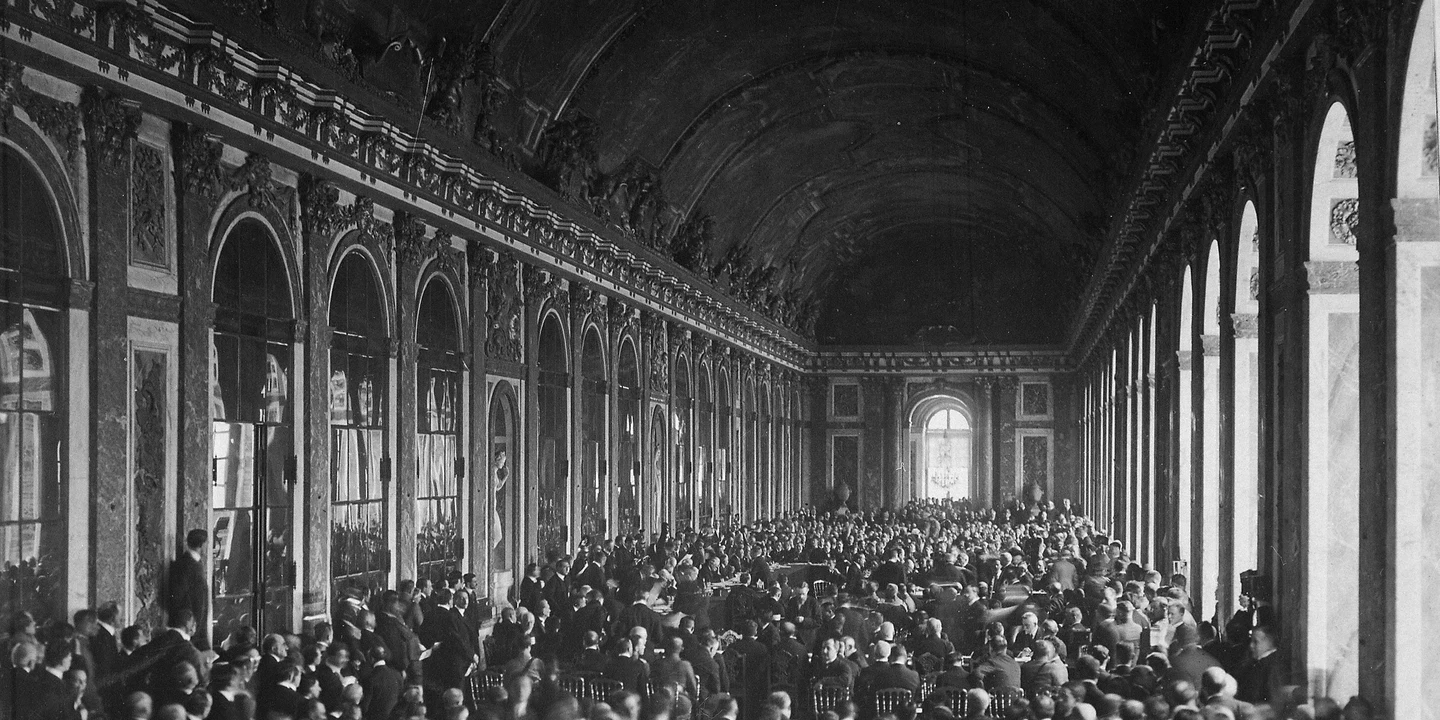
The signing of the Treaty of Versailles in the Hall of Mirrors, 28 June 1919.
Kirtland · Public domain
History
- Global War — The Grinding Years (1915–1916) Verdun and the Somme became synonymous with industrial slaughter — yet the war also extended to Gallipoli, Mesopotamia, East Africa, and the Atlantic. Examines how a European conflict became a global one, and why neither side could break the stalemate despite catastrophic losses.
- Home Fronts, Society, and the Meaning of Total War Total war transformed the home front as fundamentally as the battlefield. Women entered factories and challenged gender norms, states mobilised entire economies, propaganda reshaped public consent, and the treatment of civilians and prisoners revealed the war's darkest dimensions.
- The End of the War and the Peace Settlement (1918–1919) The Hundred Days offensive shattered the German army, the armistice came in November 1918, and the Paris Peace Conference redrew the map of the world. Asks whether the peace that followed the Great War made the next one inevitable — and what the war's legacy means today.
- The Opening Campaigns — The War Nobody Expected (1914) Armies marched to war in August 1914 expecting victory by Christmas. Instead, the Schlieffen Plan collapsed at the Marne, Russia mobilised faster than anyone expected, and four years of gruelling attritional war began. Explore the opening campaigns that shaped everything that followed.
- The Road to War — Europe in Crisis (1871–1914) Why did a single assassination in Sarajevo ignite a world war? Trace the web of alliances, imperial rivalries, and nationalist movements that made Europe a powder keg by 1914 — from Bismarck's alliance system to the July Crisis that proved impossible to stop.
- The Turning Point (1917) 1917 was the year everything changed. America entered the war, Russia collapsed into revolution, mutinies spread through the French army, and new tactics — tanks, infiltration assault, unrestricted submarine warfare — pointed toward a different kind of conflict.
Ready to start learning?
Start for free