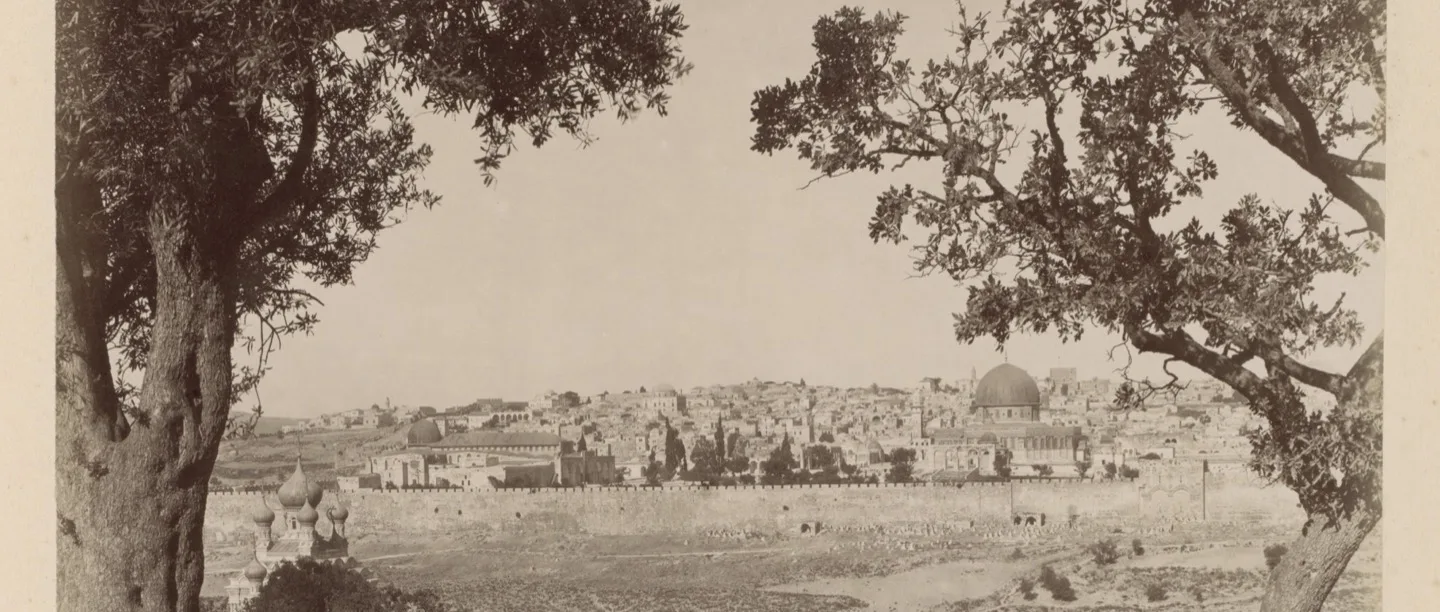
Ancient and medieval history of Palestine
The history of Palestine begins thousands of years before the modern era. The region known historically as Palestine corresponds roughly to the area between the Mediterranean Sea and the Jordan River, encompassing modern-day Israel, the West Bank, and the Gaza Strip. Archaeological evidence places permanent human settlement in the area as far back as the Neolithic period, around 8,500 BCE. The Canaanites established city-states here during the Bronze Age, and the region came under Egyptian influence during the New Kingdom period (c. 1550–1070 BCE).
In subsequent centuries, the area was conquered by a series of major powers. The Assyrians controlled it in the 8th century BCE; the Babylonians followed; then the Persians under Cyrus the Great, who permitted the return of Jewish exiles from Babylon. Alexander the Great's conquests brought Hellenistic rule in 332 BCE, followed by Roman rule from 63 BCE. During the Roman period, the region was known as Judaea; after the Jewish revolts of 66–73 CE and 132–135 CE, Rome renamed it Syria Palaestina — the origin of the modern name Palestine.
Following the fall of the Western Roman Empire, the region passed to the Byzantine Empire. In 636–637 CE, Arab Muslim armies under the second caliph, Umar ibn al-Khattab, defeated the Byzantines and incorporated Palestine into the Islamic caliphate. The Arab conquest transformed the demographic and cultural character of the region over the following centuries, and Arabic became the dominant language.
The Crusades brought European Christian forces to Palestine between 1095 and 1291, including the famous recapture of Jerusalem by Saladin in 1187. After the Crusader states were finally expelled, the Mamluk sultanate governed the region until the Ottoman conquest in 1517.
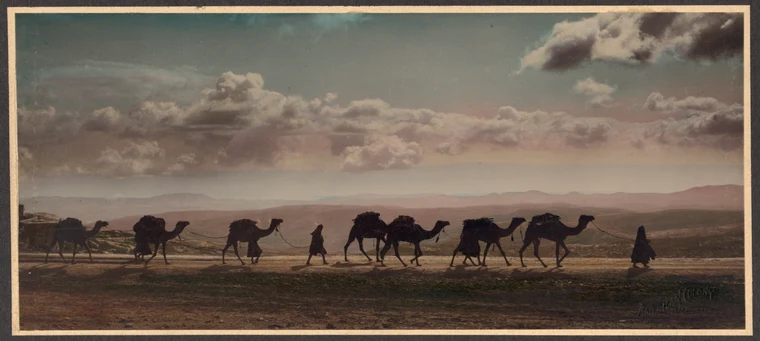
A Palestinian man from Ramallah spinning wool by hand, photographed between 1900 and 1920. The image documents the rural agricultural life that characterised Palestinian society during the late Ottoman period.. Image: American Colony Photographers, Library of Congress, via Wikimedia Commons (Public domain)
The Ottoman period and the origins of the modern conflict
The history of Palestine's modern era begins during four centuries of Ottoman rule (1517–1917). Under the Ottomans, the region was divided into administrative provinces and had a predominantly Arab Muslim population, with Jewish and Christian minorities present in significant numbers in cities such as Jerusalem, Hebron, Safed, and Tiberias.
The rise of Zionism
In the late 19th century, Theodor Herzl founded the Zionist movement, advocating for the establishment of a Jewish homeland in response to European antisemitism. Palestine was identified as the preferred location, and Jewish immigration began to increase. Between 1882 and 1914, approximately 60,000–80,000 Jewish immigrants arrived in a region that then had a population of around 600,000, the vast majority of whom were Arab.
The Balfour Declaration and World War One
Britain's involvement began during World War One. In 1917, Foreign Secretary Arthur James Balfour wrote a letter — the Balfour Declaration — expressing British support for 'the establishment in Palestine of a national home for the Jewish people', while stipulating that 'nothing shall be done which may prejudice the civil and religious rights of existing non-Jewish communities in Palestine.' The declaration was welcomed by the Zionist movement and deeply opposed by Arab leaders, who viewed it as contradicting British promises of Arab independence made in earlier negotiations.
In 1917, British and Commonwealth forces under General Allenby defeated the Ottomans and occupied Palestine. The Ottoman Empire was formally dissolved after the war, and the British Mandate for Palestine was confirmed by the League of Nations in 1922.
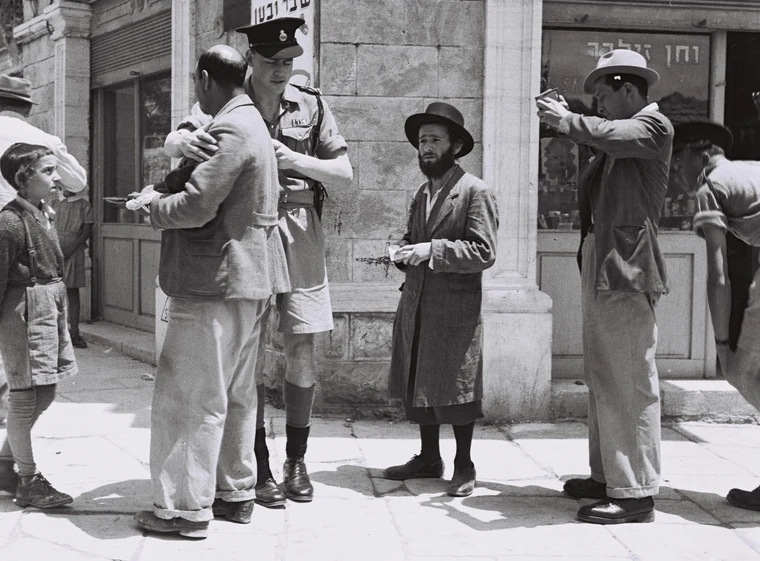
A British policeman checks identity papers on a Jerusalem street in 1947, during the final year of the British Mandate. Checkpoints and security measures became routine as tensions escalated between Arab and Jewish communities.. Image: Hans Pinn, via Wikimedia Commons (Public domain)
The British Mandate and the 1948 war
The British Mandate period (1920–1948) saw escalating tensions between the Arab and Jewish communities. Jewish immigration increased sharply in the 1930s as Jews fled persecution in Europe, particularly after the rise of the Nazi regime in Germany. Arab leaders opposed this immigration and the land purchases that accompanied it, leading to the Arab Revolt of 1936–1939.
The UN Partition Plan
Following World War Two and the Holocaust — in which approximately six million European Jews were murdered — international pressure to resolve the Palestine question intensified. In November 1947, the United Nations General Assembly passed Resolution 181, proposing the partition of Mandatory Palestine into an Arab state and a Jewish state, with Jerusalem under international administration. Jewish leaders accepted the plan; Arab leaders rejected it.
1948 and its consequences
When Britain withdrew from Palestine in May 1948, the Jewish leadership declared the establishment of the State of Israel. The following day, Egypt, Jordan, Syria, Iraq, and Lebanon declared war. The conflict, known in Israel as the War of Independence and among Palestinians as the Nakba (catastrophe), resulted in Israel controlling significantly more territory than the UN partition plan had allocated. Approximately 700,000 Palestinian Arabs fled or were expelled from their homes — a displacement that remains central to the conflict today.
The 1949 armistice lines left Jordan controlling the West Bank and Egypt controlling the Gaza Strip. No independent Palestinian state was established. In 1967, Israel captured both territories, along with the Sinai Peninsula and the Golan Heights, during the Six-Day War. This occupation, and the question of Palestinian self-determination, has been the central issue in the conflict since.
For structured learning in modern world history, explore Epivo's International curriculum or visit For parents.
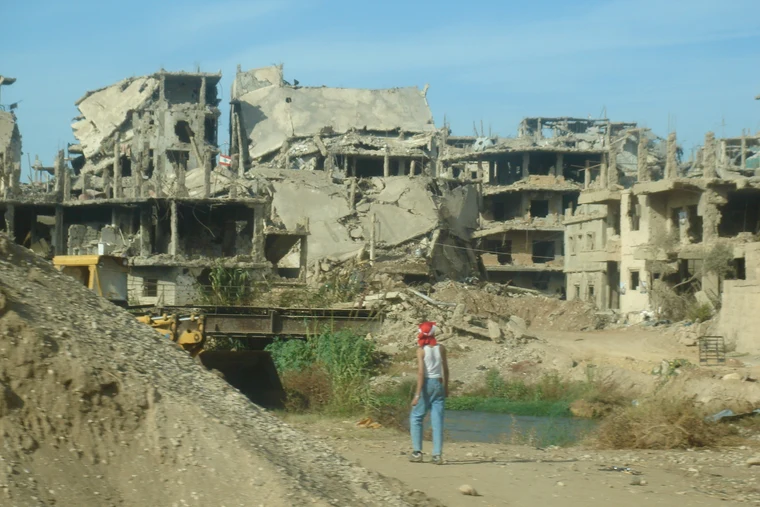
Palestinian refugees at the Nahr el-Bared camp in northern Lebanon, 1952. The camp was established in 1949 to house Palestinians displaced during the 1948 war, and remains in operation today.. Image: S. Madver / UNRWA Photo Archives, via Wikimedia Commons (Public domain)
Did you know?
-
The Balfour Declaration of 1917 expressed British support for a Jewish homeland in Palestine while stating that 'nothing shall be done which may prejudice the civil and religious rights of existing non-Jewish communities' — a dual commitment that proved impossible to fulfil simultaneously.
Balfour Declaration — UK National Archives -
UN General Assembly Resolution 181 (1947) proposed dividing Mandatory Palestine into separate Arab and Jewish states. Jewish leaders accepted the plan; Arab leaders rejected it. The 1948 war produced a different territorial outcome than the partition plan had envisaged.
UN Resolution 181 — UNISPAL -
The 1967 Six-Day War resulted in Israel occupying the West Bank, Gaza Strip, Sinai Peninsula, and Golan Heights. UN Security Council Resolution 242 called for Israeli withdrawal from occupied territories and recognition of all states in the region.
UN Security Council Resolution 242
The peace process and the present
Understanding the history of Palestine in its full scope requires following events from the ancient world through the present. The decades following 1967 brought further conflict and periodic peace efforts. The 1973 Yom Kippur War was followed by the Camp David Accords (1978), leading to a peace treaty between Israel and Egypt in 1979. The Palestine Liberation Organisation (PLO), founded in 1964, was recognised by the Arab League as the sole legitimate representative of the Palestinian people in 1974, and gained observer status at the United Nations.
The Oslo Accords of 1993 marked a significant turning point: the PLO recognised Israel's right to exist, and Israel recognised the PLO as the representative of the Palestinian people. The Palestinian Authority was established to administer parts of the West Bank and Gaza Strip. However, final-status issues — including the borders of a Palestinian state, the status of Jerusalem, the future of Israeli settlements in the West Bank, and the right of return for Palestinian refugees — were not resolved.
Subsequent peace efforts, including the Camp David Summit in 2000 and the Annapolis Conference in 2007, failed to produce a comprehensive agreement. The Gaza Strip came under Hamas control in 2007 after an internal Palestinian conflict, and has been subject to an Israeli blockade since then. Negotiations between Israel and the Palestinian Authority have been intermittent since, and a two-state solution — supported by most of the international community as the framework for a settlement — has not been achieved.
The United Nations continues to document and monitor developments in the region, and the history of Palestine remains central to understanding contemporary international affairs.
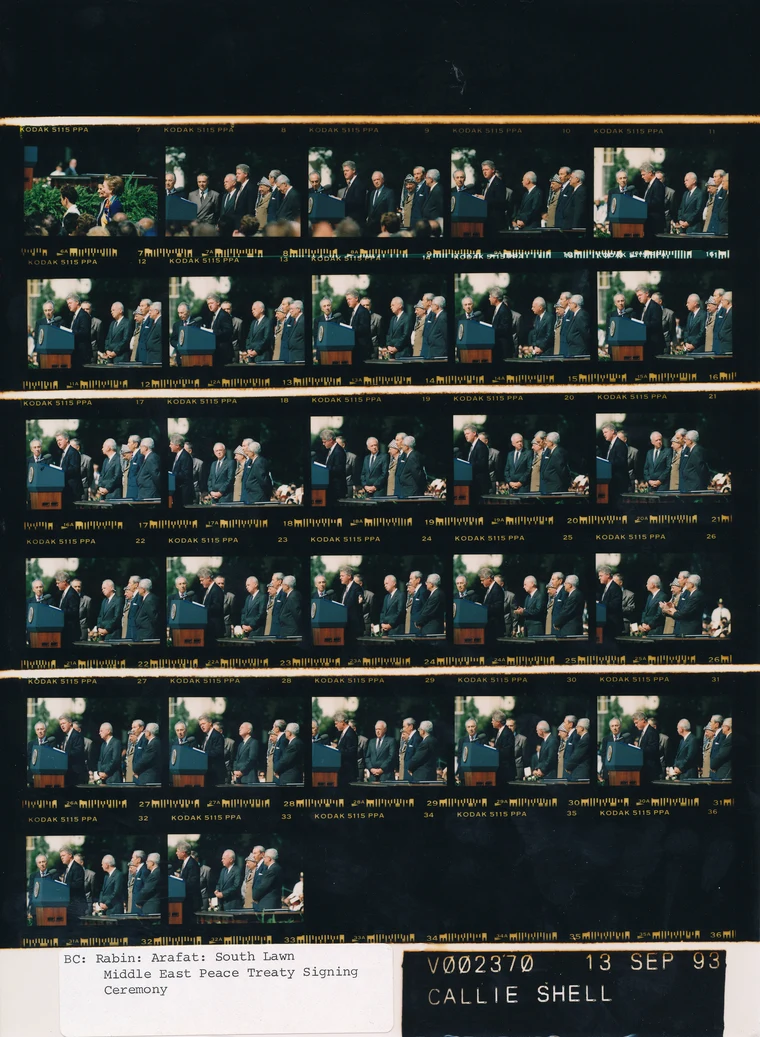
Israeli Prime Minister Yitzhak Rabin and PLO Chairman Yasser Arafat shake hands at the White House on 13 September 1993, with President Bill Clinton presiding over the signing of the Oslo Accords.. Image: Vince Musi / The White House, via Wikimedia Commons (Public domain)
Frequently asked questions
- How old is the history of Palestine?
- Archaeological evidence shows permanent human settlement in the region that is now Palestine from at least 8,500 BCE. The name 'Palestine' derives from the Roman name Syria Palaestina, given after the suppression of Jewish revolts in 135 CE. The region has been inhabited and contested across thousands of years of recorded history.
- Who controlled Palestine before 1948?
- Before 1948, Palestine was under British Mandate administration, which had been confirmed by the League of Nations in 1922 following the British occupation of the region during World War One. Before British control, Palestine was part of the Ottoman Empire for approximately 400 years, from 1517 to 1917.
- What was the UN Partition Plan for Palestine?
- UN General Assembly Resolution 181 (November 1947) proposed dividing Mandatory Palestine into a Jewish state, an Arab state, and an international zone for Jerusalem. Jewish leaders accepted the plan; Arab leaders rejected it. When war broke out in 1948, the resulting territorial boundaries differed significantly from those the partition plan had proposed.
- When did the modern conflict over Palestine begin?
- The roots of the modern conflict are most commonly traced to the late 19th century, when both Jewish Zionism and Arab nationalism emerged as political movements asserting competing claims to Palestine. The Balfour Declaration (1917), the British Mandate (1920–1948), and the 1948 war all contributed to establishing the core disputes that have persisted since.
- What is the two-state solution?
- The two-state solution is the most widely supported international framework for resolving the conflict. It envisions an independent Palestinian state in the West Bank and Gaza Strip (with East Jerusalem as its capital) existing alongside Israel within internationally recognised borders. Final-status issues — including settlements, refugees, and Jerusalem — remain unresolved.