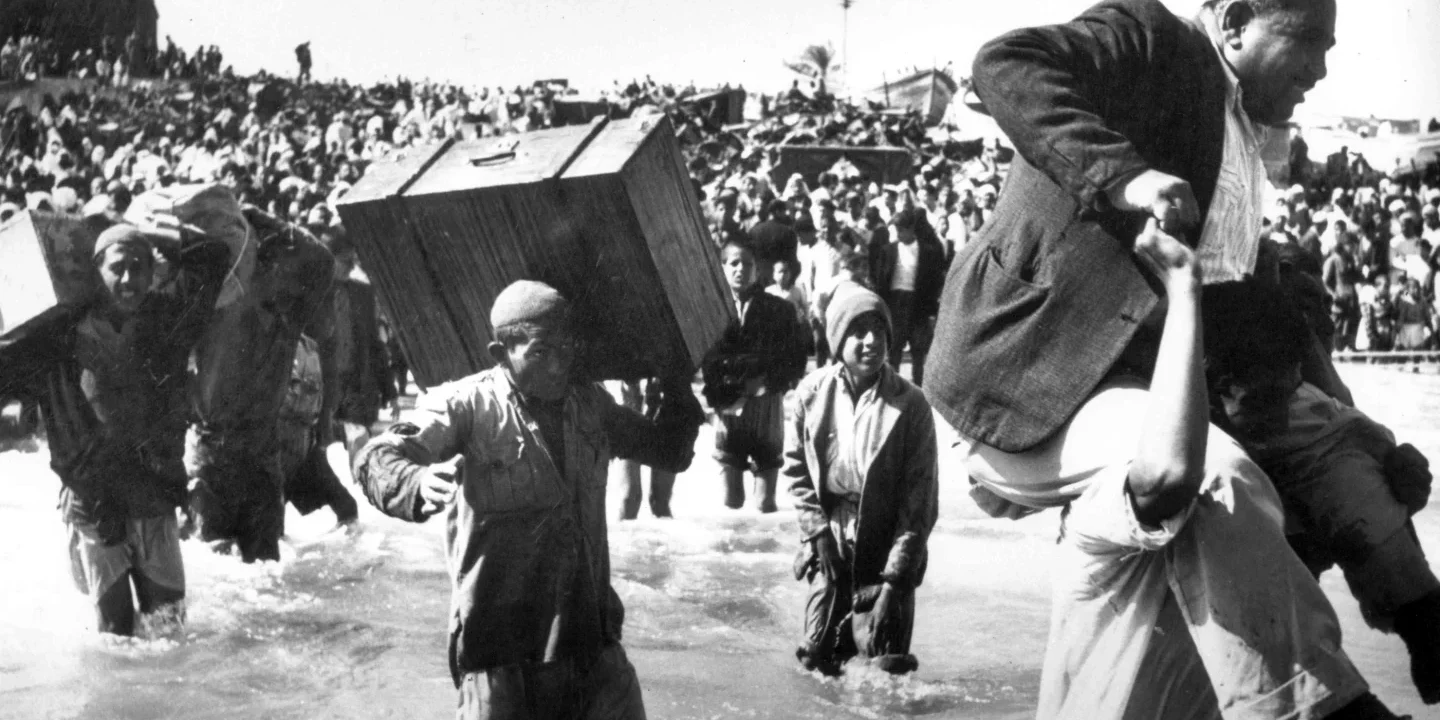
What is the Nakba — definition and historical context
The Nakba (Arabic: النكبة) means 'catastrophe' or 'disaster.' Among Palestinians, the term refers specifically to the mass displacement of approximately 700,000 Palestinian Arabs that occurred during and after the 1948 Arab-Israeli War — known in Israel as the War of Independence.
The Nakba unfolded in the context of the end of the British Mandate for Palestine, the declaration of Israeli statehood on 14 May 1948, and the subsequent war between the newly declared State of Israel and Arab armies from Egypt, Jordan, Syria, Iraq, and Lebanon. During the fighting, which lasted until armistice agreements were signed in 1949, the majority of the Arab population of Mandatory Palestine fled or was expelled.
The scale of the displacement was vast. According to UNRWA, approximately 711,000 Palestinians became refugees by the war's end. More than 500 Palestinian villages were depopulated; many were physically destroyed. The refugees and their descendants were not permitted to return. Today, after seven decades, their descendants — numbering approximately 5.9 million registered with UNRWA — remain in refugee camps and communities across the region and the world.
The term Nakba was popularised by Syrian-Palestinian historian Constantin Zureiq in 1948, who used it to describe the defeat of Arab armies and the Palestinian displacement as a civilisational catastrophe requiring critical self-examination.
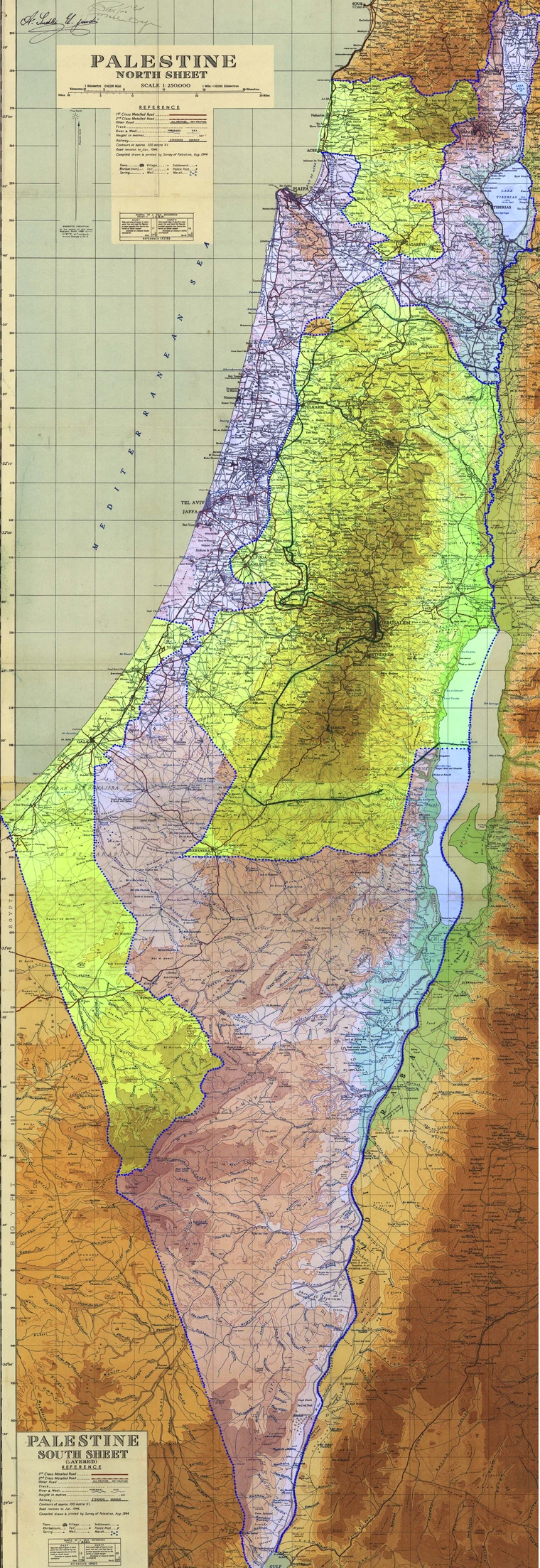
The official UN Partition Plan map from November 1947, proposing the division of Mandatory Palestine into separate Arab and Jewish states. The plan was accepted by Jewish leaders but rejected by Arab leaders, setting the stage for the 1948 war.. Image: United Nations, via Wikimedia Commons (Public domain)
What caused the Nakba — events and contested interpretations
The causes of the Nakba are one of the most extensively studied and debated questions in Middle Eastern history. Scholars agree on the broad facts — approximately 700,000 Palestinians were displaced and not permitted to return — but differ on the relative weight of the various causes.
The military operations
Israeli military operations during the war involved the expulsion or flight of Arab residents from towns and villages across the territory that became Israel. Operation Dalet, launched in April 1948, aimed to secure the territory allocated to the Jewish state by the UN Partition Plan and the roads connecting it. Historians including Benny Morris — who extensively analysed newly declassified Israeli military archives in the 1980s and 1990s — documented both voluntary flight and deliberate expulsions by Israeli forces in different locations.
Contested causes
The relative weight of different causes is contested. Israeli historians traditionally emphasised that many Palestinians left in response to calls from Arab leaders to evacuate temporarily until Arab armies defeated Israel — though the evidence for widespread such calls has been questioned by later scholarship. Palestinian and many Western historians emphasise the role of military operations, deliberate expulsions, and the psychology of fear created by violent incidents such as the attack on Deir Yassin in April 1948, in which over 100 Palestinian villagers were killed by Jewish paramilitary forces.
Benny Morris concluded that both causes operated simultaneously in different places: 'There was no blanket policy of expulsion. But there was the feeling among most Israeli military commanders that it was best if the Arabs left. And the troops acted accordingly — sometimes expelling Arabs, sometimes facilitating their flight, sometimes pressuring them to go.'
International recognition
In 2021, the UN Special Committee on Decolonisation adopted a resolution explicitly recognising the Nakba, as it has done annually since 1998. The United Nations continues to document its humanitarian consequences.
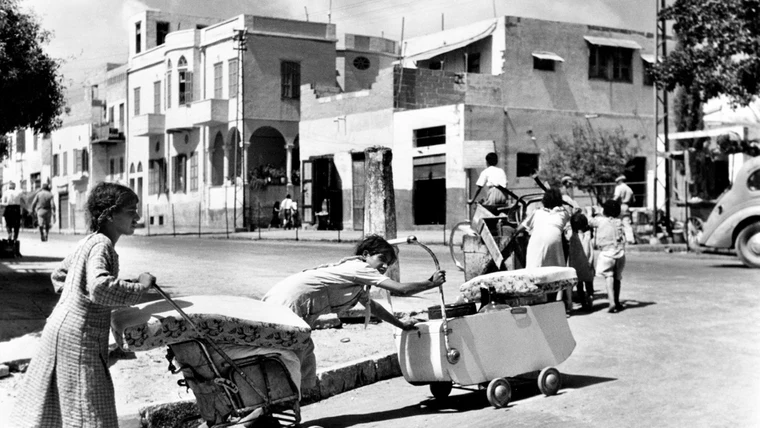
Palestinian families flee the port city of Jaffa in 1948, carrying their belongings in prams and carts. Jaffa, once the largest Arab city in Palestine, saw the vast majority of its approximately 70,000 Arab residents displaced during the war.. Image: Unknown photographer, 1948 UN Archives, via Wikimedia Commons (Public domain)
The right of return and UN Resolution 194
The Palestinian right of return — the principle that Palestinians displaced in 1948 and their descendants have the right to return to their original homes — is one of the most legally and politically contested issues in the conflict.
UN General Assembly Resolution 194, passed on 11 December 1948, stated that 'refugees wishing to return to their homes and live at peace with their neighbours should be permitted to do so at the earliest practicable date.' Israel was admitted to the United Nations in 1949 on the condition that it implement Resolution 194, though Israel disputes this interpretation and has never permitted the return.
Israeli governments have consistently opposed a right of return on the grounds that it would fundamentally alter Israel's Jewish demographic character. Palestinian leaders have consistently demanded it as a matter of justice and international law. The right of return is therefore one of the most significant unresolved issues in any potential peace agreement.
The Palestinian diaspora holds the iron key — a symbol of the homes left behind in 1948 — as a powerful emblem of this claim. For many Palestinian families, preserving the deeds and keys of their original properties across generations is a way of maintaining both identity and a claim to return.
For structured learning about this history, explore Epivo's International curriculum or visit For parents for information on how Epivo approaches complex and sensitive historical topics.
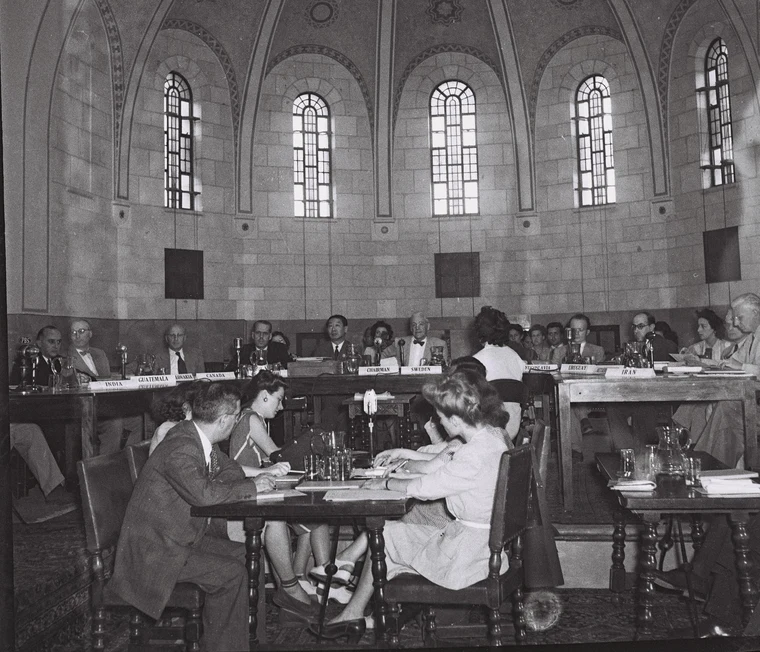
Members of UNSCOP (the United Nations Special Committee on Palestine) in session at the YMCA in Jerusalem, 1947. The committee's findings led to the UN Partition Plan that preceded the 1948 war and the Nakba.. Image: Hans Pinn, via Wikimedia Commons (Public domain)
Did you know?
-
Approximately 700,000–750,000 Palestinian Arabs fled or were expelled during the 1948 Arab-Israeli War. According to UNRWA, their descendants now number approximately 5.9 million registered refugees — one of the world's largest and longest-standing refugee populations.
UNRWA — Palestine Refugees -
UN General Assembly Resolution 194 (1948) stated that refugees wishing to return to their homes 'and live at peace with their neighbours should be permitted to do so at the earliest practicable date.' The resolution is passed annually and remains unimplemented.
UN Resolution 194 — UNISPAL -
Historian Benny Morris's research in Israeli military archives found that Palestinian displacement in 1948 resulted from a combination of voluntary flight and deliberate expulsion by Israeli forces — with the pattern varying significantly by location.
The Birth of the Palestinian Refugee Problem Revisited — Benny Morris
Nakba Day and the politics of commemoration
Palestinians observe Nakba Day annually on 15 May — the day after Israeli Independence Day — to commemorate the 1948 displacement. The observance includes marches, ceremonies at destroyed village sites inside Israel, and cultural events across the Palestinian diaspora. In recent years, Nakba Day has gained wider international recognition, with commemorative events held at the United Nations headquarters in New York.
The politics of commemorating the Nakba remain contested within Israel. In 2011, Israel passed the 'Nakba Law', which allows the state to withdraw funding from institutions that commemorate Israel's Independence Day as a day of mourning. Critics argued the law restricted freedom of expression; supporters argued that state funds should not be used to undermine Israeli statehood.
For many Palestinians, the Nakba is not simply a historical event but an ongoing condition — expressed through the continued displacement of refugees, the status of Palestinians in the West Bank and Gaza, and the unresolved political questions surrounding Palestinian statehood and rights. Understanding the Nakba is therefore essential to understanding contemporary Palestinian identity, politics, and the aspirations that continue to shape the conflict.
For historical context, the United Nations Information System on the Question of Palestine (UNISPAL) is the most comprehensive archive of primary documents, resolutions, and reports on this history.

Palestinians gather at Al-Arroub refugee camp in the West Bank on 14 May 2011 to mark Nakba Day. The annual commemoration, held every 15 May, honours the memory of the 1948 displacement.. Image: Palestine Solidarity Project, via Wikimedia Commons (CC BY-SA 2.0)
Frequently asked questions
- What does Nakba mean?
- Nakba is an Arabic word meaning 'catastrophe' or 'disaster.' Among Palestinians, it refers specifically to the mass displacement of approximately 700,000 Palestinians during the 1948 Arab-Israeli War. The term was first used in this context by Syrian-Palestinian historian Constantin Zureiq in 1948.
- How many Palestinians were displaced in the Nakba?
- Approximately 700,000–750,000 Palestinian Arabs fled or were expelled during the 1948 war. More than 500 Palestinian villages were depopulated. Their descendants, now numbering approximately 5.9 million registered with UNRWA, have not been permitted to return to the homes and lands their families left.
- Why were Palestinians displaced in 1948?
- Historians agree on the broad fact of displacement but debate its causes. Research — including Benny Morris's study of Israeli military archives — shows the displacement resulted from a combination of fear and flight, military operations, and in some cases deliberate expulsion by Israeli forces. The relative weight of these causes varied by location.
- What is the Palestinian right of return?
- The right of return is the principle that Palestinian refugees displaced in 1948 and their descendants have the right to return to their original homes. UN Resolution 194 (1948) supports this right. Israel has not permitted returns. The right of return remains one of the central unresolved issues in any potential peace agreement.
- When is Nakba Day?
- Nakba Day is observed annually on 15 May — the day after Israeli Independence Day. Palestinians mark the occasion with marches, ceremonies at destroyed village sites, and cultural events. Since 2022, the United Nations has also held Nakba commemorations at its headquarters in New York.