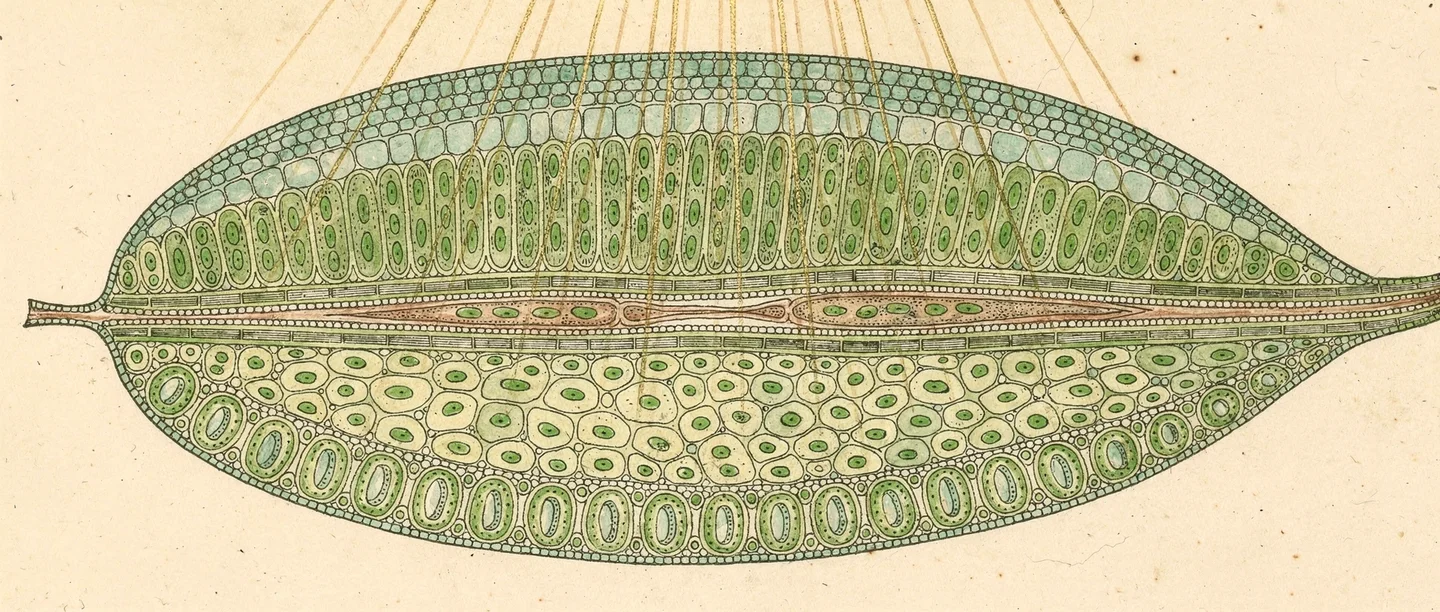
What is photosynthesis — the definition
Photosynthesis is the process by which plants, algae, and some bacteria convert sunlight into food. They use solar energy to turn carbon dioxide and water into glucose and oxygen.
The overall chemical equation is often written as:
6CO₂ + 6H₂O + light energy → C₆H₁₂O₆ + 6O₂
In plain language: sunlight powers a reaction that converts carbon dioxide and water into glucose and oxygen.
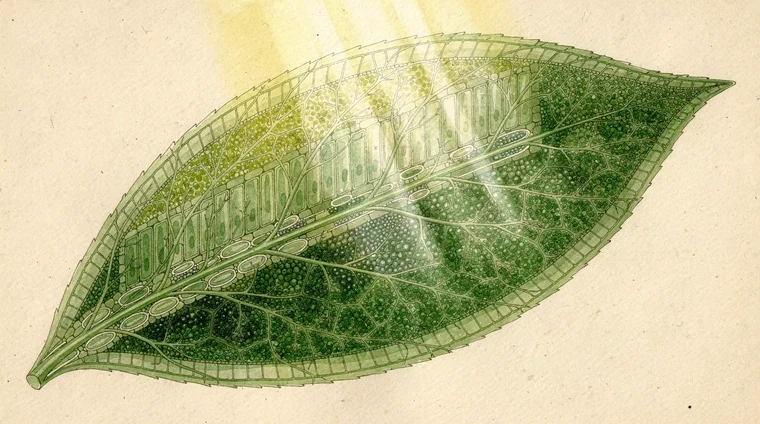
Photosynthesis takes place mainly in the leaves, inside tiny structures called chloroplasts. Chloroplasts contain a green pigment called chlorophyll. It absorbs light energy — mostly red and blue wavelengths — and reflects green, which is why plants appear green.
Plants take in carbon dioxide through tiny pores called stomata. They draw water up from the soil through their roots. The glucose produced is used to fuel the plant's growth and other life processes. The oxygen is released into the air as a by-product — the oxygen that animals and humans breathe.
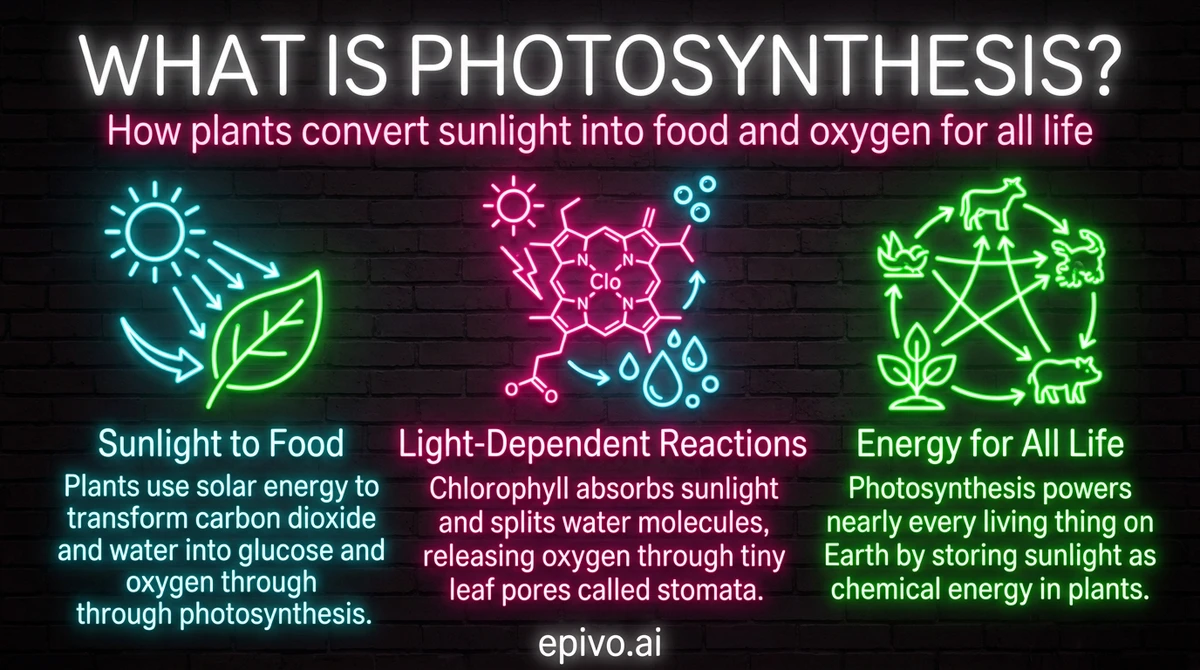
The two stages of photosynthesis
The light-dependent reactions
In the first stage, chlorophyll absorbs sunlight and uses that energy to split water molecules into hydrogen and oxygen. The oxygen is released through the stomata. The energy captured is stored in temporary molecules that carry it to the next stage.
The Calvin cycle (light-independent reactions)
In the second stage, the stored energy is used to convert carbon dioxide from the air into glucose. This stage requires no direct sunlight — hence "light-independent" — but depends on energy from the first stage.
Together, these two stages form what is photosynthesis: a two-part energy conversion system running continuously in sunlit leaves.
Three factors affect efficiency: light intensity (brighter light speeds it up), CO₂ concentration (more CO₂ means more glucose), and temperature (enzymes work best around 25–35°C). Plants grow faster in warm, bright, well-ventilated conditions.
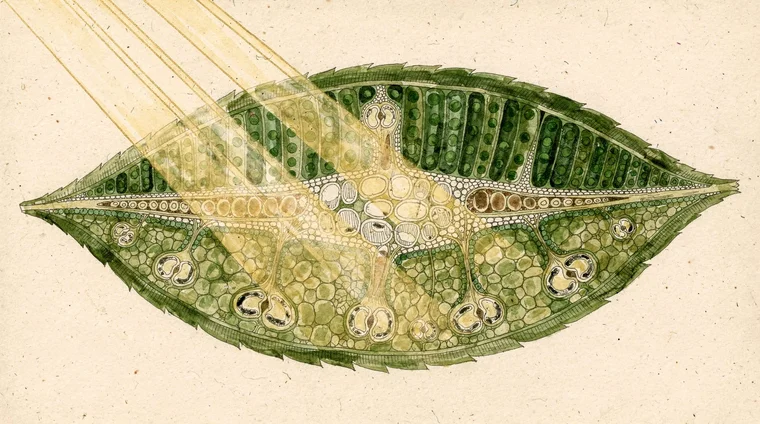
Why photosynthesis matters — for life and the planet
Photosynthesis is the primary source of energy for nearly all living things on Earth. Plants, grasses, algae and phytoplankton capture sunlight and store it as chemical energy in glucose. Every animal that eats a plant — and every animal that eats those animals — runs on energy that photosynthesis captured from the Sun.
Beyond food, photosynthesis is also the planet's main mechanism for removing carbon dioxide from the atmosphere. Forests, grasslands, and ocean phytoplankton absorb billions of tonnes of CO₂ each year, slowing the buildup of greenhouse gases. This is why protecting forests is a climate priority. Deforestation releases stored carbon and removes the capacity to absorb future emissions.
The oxygen in Earth's atmosphere — around 21% of every breath you take — was produced by photosynthesis over billions of years. Without it, aerobic life as we know it would not exist.
For students, it unlocks much of biology, ecology, and environmental science. It connects the chemistry of plants to the health of ecosystems and the stability of the global climate. Visit the For parents guide for tips on exploring plant science at home.
Frequently asked questions
- Do all plants use photosynthesis?
- Almost all plants use photosynthesis to make food. The exceptions are a small number of parasitic plants, such as dodder, that steal nutrients from other plants and have lost the ability to photosynthesize. Algae and cyanobacteria (blue-green bacteria) also carry out photosynthesis.
- Can photosynthesis happen indoors with artificial light?
- Yes. Plants can photosynthesize under artificial lighting, provided the light contains the right wavelengths — primarily red and blue. Grow lights used in indoor farming are designed to deliver exactly these wavelengths efficiently. The rate of photosynthesis may be slower than under full sunlight.
- What happens to photosynthesis at night?
- The light-dependent stage of photosynthesis stops at night because there is no sunlight to drive it. However, plants continue to respire — using stored glucose and oxygen to release energy — which is why they release a small amount of CO₂ at night rather than absorbing it.
- How is photosynthesis related to climate change?
- Plants absorb carbon dioxide during this process, removing it from the atmosphere. When forests are burned or cut down, the stored carbon is released back as CO₂. Protecting and restoring forests is therefore one of the tools scientists propose for reducing greenhouse gas levels.
- At what age do students typically learn about photosynthesis?
- Students are usually introduced to the idea that plants make food from sunlight around ages 8–10 (grades 3–5). The full chemical process, including the equation and the role of chloroplasts, is typically taught from around age 12 (grade 7 or 8) onwards.