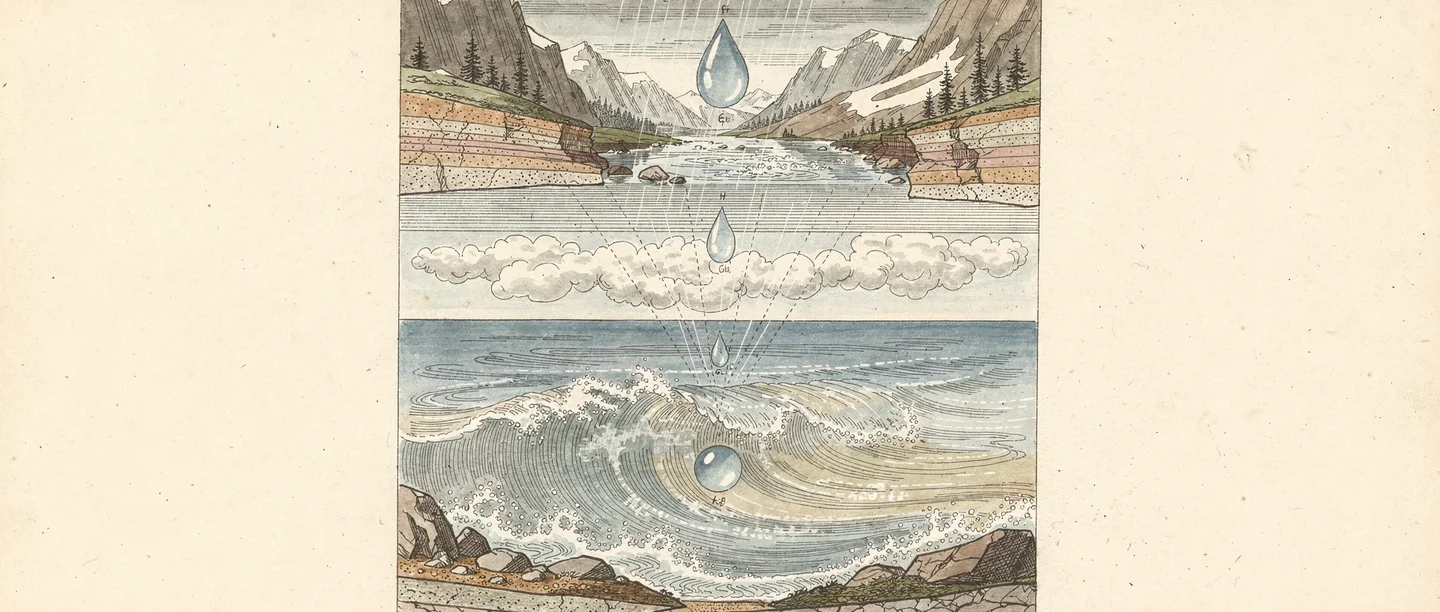
What is the water cycle — an overview
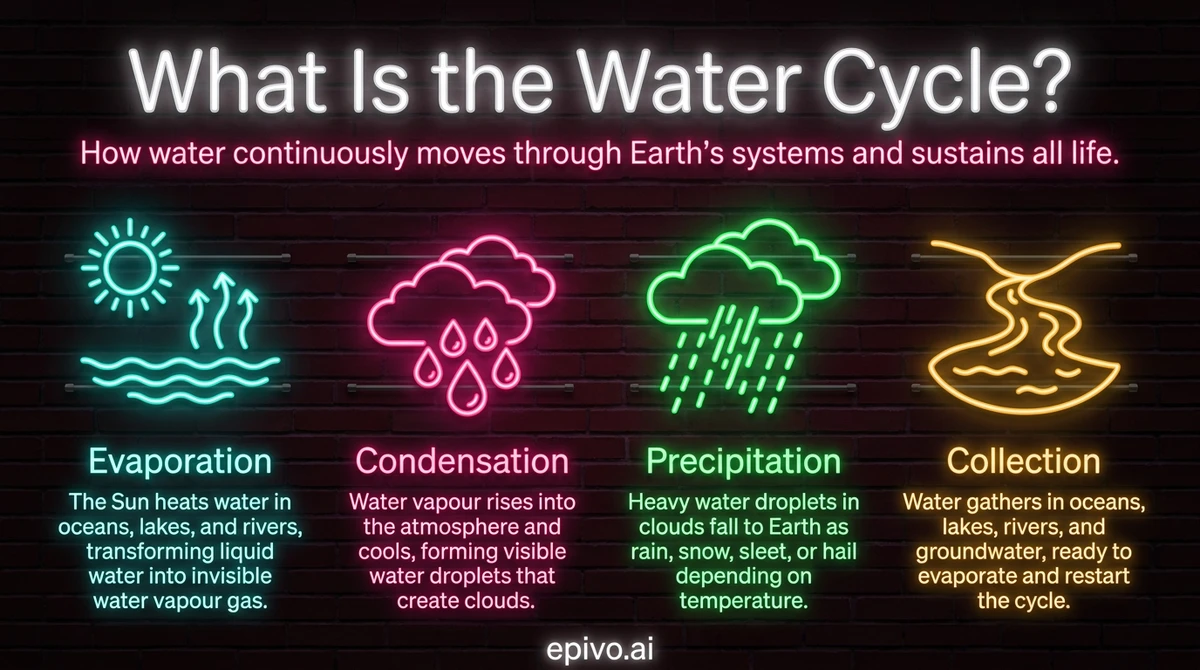
The water cycle is the ongoing movement of water between the Earth's surface and the atmosphere. No water is ever created or destroyed in this process — the same water has been recycling for billions of years.
The water cycle has four main stages:
- Evaporation — Water from oceans, rivers, and lakes is heated by the Sun and turns into water vapour, rising into the atmosphere.
- Condensation — As water vapour rises and cools at higher altitudes, it condenses into tiny water droplets that form clouds.
- Precipitation — When water droplets in clouds combine and grow heavy enough, they fall back to Earth as rain, snow, sleet, or hail.
- Collection — Water collects in rivers, lakes, and oceans, or soaks into the ground to form groundwater — and the water cycle begins again.
Two additional processes feed the water cycle: transpiration (water released by plant leaves) and runoff (surface water flowing into rivers). Together, evaporation and transpiration are called evapotranspiration.
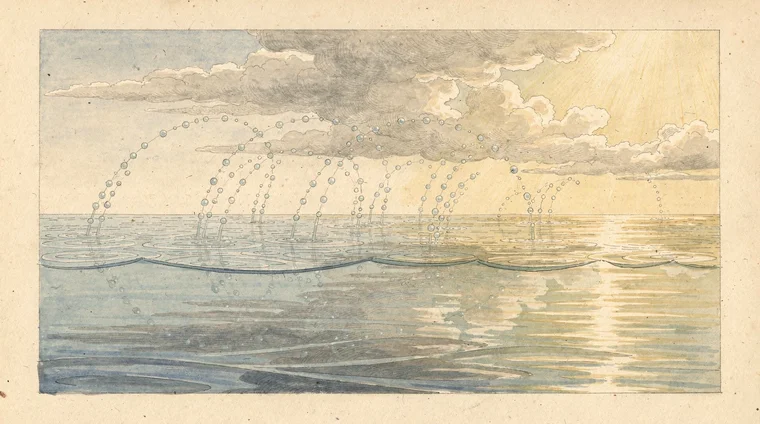
Evaporation and condensation — how the water cycle works upward
Evaporation — from surface to sky
Evaporation is the engine that drives the water cycle. The Sun heats oceans, lakes, and rivers, turning liquid water into water vapour — an invisible gas. Oceans supply the vast majority of the world's evaporated water, since they cover about 71% of Earth's surface.
Salt and other minerals in ocean water do not evaporate with it — only pure water molecules rise into the atmosphere. This is why rainwater is fresh, even when it originally came from the sea.
Condensation — from vapour to cloud
As water vapour rises, it enters cooler air at higher altitudes. Cool air holds less moisture than warm air. The vapour condenses around tiny dust or sea-salt particles, forming microscopic water droplets. Billions of these droplets cluster together to form clouds.
Clouds are not steam — they are tiny liquid water droplets, or ice crystals at higher altitudes, suspended in the air.
The stage at which water vapour turns back into liquid — the dew point — depends on temperature and humidity. Morning dew on grass is a visible example of condensation happening close to the ground.
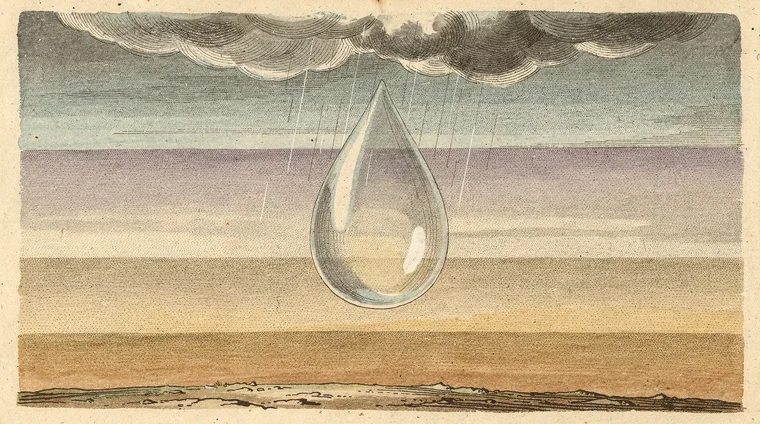
Precipitation and collection — how the water cycle completes
Precipitation — water falls to Earth
When water droplets inside clouds collide and join together, they grow heavy enough to fall. Precipitation takes different forms depending on the temperature:
- Rain — liquid water, when temperatures are above freezing
- Snow — ice crystals, when temperatures are at or below 0°C throughout the atmosphere
- Sleet — rain that partly refreezes before reaching the ground
- Hail — balls of ice formed inside powerful thunderstorm clouds
Collection — where water gathers
Once precipitation reaches the ground, water takes different paths. Some flows over the surface as runoff into streams and rivers, eventually reaching lakes, reservoirs, or the sea. Some soaks into the soil — a process called infiltration — and replenishes underground stores of water called aquifers. Some is absorbed by plant roots and re-released through transpiration, re-entering the water cycle directly.
The water cycle operates at different speeds in different places. In a tropical rainforest, water may cycle through in days. In a polar glacier, water may remain frozen for thousands of years before cycling back to the ocean.
For parents, the For parents guide suggests simple experiments — including the classic plastic-bag water cycle model.
Frequently asked questions
- How long does the water cycle take?
- There is no single answer — it varies enormously. Water in the atmosphere cycles in about 9 days. Water in a river may complete the cycle in weeks. Water stored in deep ocean layers or glaciers may take thousands of years to cycle back into the atmosphere.
- Does the water cycle affect weather and climate?
- Yes. The water cycle redistributes heat around the planet, drives weather patterns, and controls local and global climates. Evaporation cools the Earth's surface; precipitation returns water to land, supporting plant life and freshwater systems.
- Is the water cycle affected by climate change?
- Yes. A warmer atmosphere holds more water vapour, which intensifies the water cycle. Scientists observe more extreme rainfall, longer droughts, glacial melting, and rising sea levels. All are linked to how the water cycle intensifies under higher temperatures.
- Where does most of the water on Earth come from?
- Current scientific understanding suggests most of Earth's water arrived via comets and asteroids during the early solar system. Water has been present on Earth for over 4 billion years, cycling through the hydrological cycle ever since.