
How to build good habits — understanding how habits work
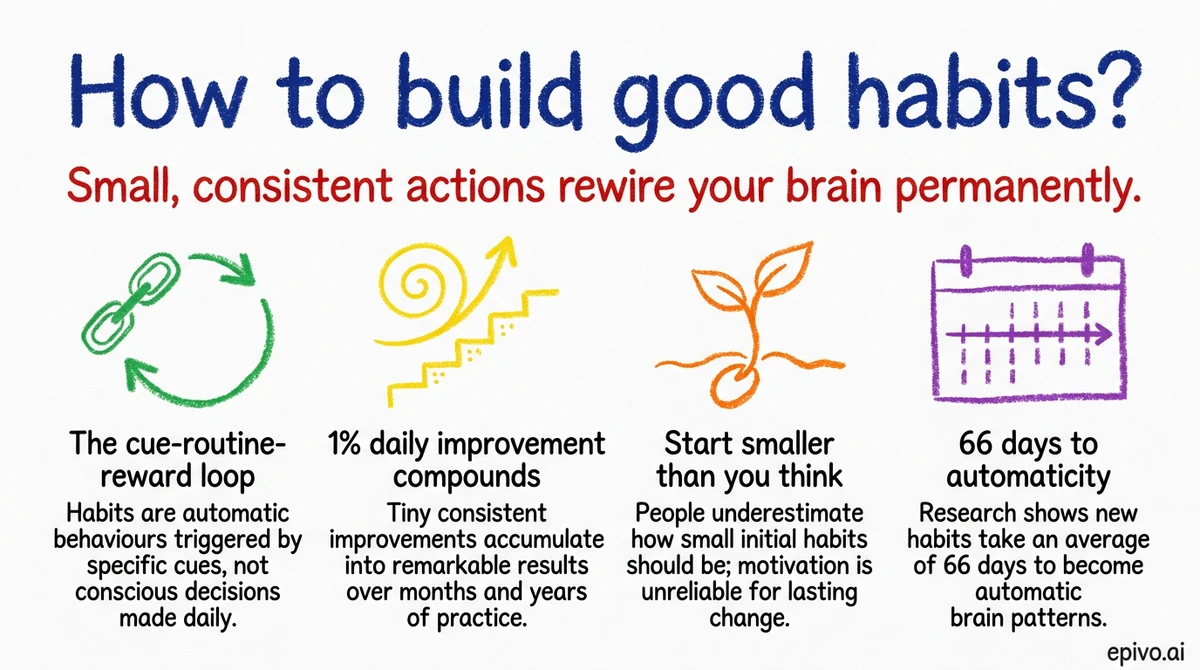
To build good habits successfully, it helps to understand how habits form in the brain. Habits are not decisions — they are automatic behaviours triggered by a specific cue. Researcher Charles Duhigg, in The Power of Habit, describes a three-part loop: cue, routine, and reward. The cue triggers the behaviour; the routine is the behaviour itself; the reward signals the brain to remember the pattern.
MIT neuroscientists discovered this loop operates in the basal ganglia — a region of the brain associated with procedural memory. Crucially, once a habit is encoded in the basal ganglia, it runs automatically without conscious decision-making. This is why habits are hard to break and, once established, equally hard to lose.
However, the same mechanism makes habits powerful tools for change. Because habits run automatically, a well-designed routine requires no ongoing willpower once it is established. The challenge is not motivation — it is the period between starting a new behaviour and the point at which it becomes automatic. Research suggests this process takes an average of 66 days, not the commonly cited 21.
James Clear's 1% rule — the power of small improvements
James Clear, author of Atomic Habits, argues that the key to building good habits is not dramatic change but tiny, consistent improvement. His central insight: a 1% improvement every day compounds to a 37-fold improvement over one year. Conversely, a 1% decline every day results in near-total decay.
The four laws of behaviour change
Clear translates this insight into four practical laws for building good habits:
- Make it obvious — design your environment so the cue is visible and clear
- Make it attractive — pair the habit with something you enjoy
- Make it easy — reduce friction until starting requires almost no effort
- Make it satisfying — add an immediate reward to reinforce the loop
Identity-based habits
Clear also introduces the concept of identity-based habits. Rather than focusing on outcomes ('I want to run a marathon'), focus on identity ('I am a runner'). Each time you act in line with that identity, you cast a vote for it. Consequently, the habit reinforces a sense of who you are, making it far more durable than willpower alone.

BJ Fogg's Tiny Habits — start smaller than you think
BJ Fogg, Director of the Behavior Design Lab at Stanford University, takes a complementary approach in his book Tiny Habits. His core finding: people consistently underestimate how small a habit can be when starting out, and this leads to failure.
The recipe: anchor, behaviour, celebration
Fogg's method involves three elements. First, an anchor — an existing behaviour that reliably happens each day. Second, a tiny new behaviour attached to that anchor. Third, an immediate celebration to generate positive emotion.
For example: after I pour my morning coffee (anchor), I will write one sentence in my journal (tiny behaviour), and I will feel proud for doing it (celebration). The behaviour is so small that motivation is almost irrelevant.
Environment design
Both Fogg and Clear emphasise the role of environment. Research shows that behaviour is strongly shaped by what is visible and accessible. Therefore, placing healthy foods at eye level, laying out exercise clothes the night before, or keeping a book on your pillow all meaningfully increase the likelihood of good habits forming. Removing friction matters at least as much as adding motivation.
For parents supporting their children's habits, visit For parents to see how Epivo's structured learning integrates these principles.

Did you know?
-
A University College London study by Phillippa Lally found that new habits take an average of 66 days to become automatic — with a range of 18 to 254 days depending on the complexity of the behaviour.
How habits are formed — Phillippa Lally, UCL -
James Clear's Atomic Habits identifies four laws of building good habits: make it obvious, make it attractive, make it easy, and make it satisfying. Breaking any one of these laws undermines the habit.
Atomic Habits — James Clear -
BJ Fogg's Tiny Habits research at Stanford shows that motivation is an unreliable driver of lasting behaviour change. Simplicity and environment design are more effective predictors of habit success.
Tiny Habits — BJ Fogg, Stanford
What the science says — how to build good habits for the long term
The scientific consensus on how to build good habits converges on several key principles. First, start smaller than feels meaningful — the goal in the early stages is to establish the cue-routine-reward loop, not to achieve maximum output. Second, design your environment before relying on willpower, because the environment determines behaviour more reliably than motivation.
Third, track your progress. Research on behavioural psychology consistently shows that visible progress reinforces habit loops. Jerry Seinfeld famously used a 'don't break the chain' method — marking a cross on a calendar for every day he wrote jokes. The growing chain became its own motivation.
Fourth, plan for failure. Missing one day does not break a habit — what breaks a habit is missing twice in a row. Research by Clear and others confirms that a single missed day has almost no measurable effect on long-term habit formation. Therefore, the focus should be on returning to the behaviour as quickly as possible after a lapse, not on maintaining a perfect record.
For structured learning that applies these principles to academic and personal development, explore Epivo's International curriculum.

Frequently asked questions
- How long does it take to build a good habit?
- Research by Phillippa Lally at University College London found that habits take an average of 66 days to become automatic, with a range of 18 to 254 days. The commonly cited '21 days' comes from a misreading of an older, informal observation and is not supported by current research.
- Why do good habits fail after a few weeks?
- Most habits fail because the initial motivation fades before the behaviour becomes automatic. James Clear's research shows that relying on motivation alone is ineffective. Sustainable habits depend on environment design — making the right behaviour easy and the wrong behaviour harder — not on willpower.
- What is the habit loop?
- The habit loop, described by Charles Duhigg, consists of three elements: cue (the trigger), routine (the behaviour), and reward (the positive signal that reinforces the pattern). Understanding this loop allows you to deliberately build new habits or redesign existing ones.
- What is the best way to start building a habit?
- BJ Fogg's research suggests starting with a behaviour so small it requires almost no motivation — for example, one press-up rather than a full workout. Attach it to an existing routine (anchor), then celebrate immediately after. Once the habit is established, the difficulty can increase gradually.
- What is an identity-based habit?
- An identity-based habit, from James Clear's Atomic Habits, means defining yourself by the behaviour you want to build. Instead of 'I want to read more', you say 'I am a reader.' Every time you act consistently with that identity, you reinforce it — making the habit more durable than goal-based approaches.