
What is flow state — Csikszentmihalyi's discovery
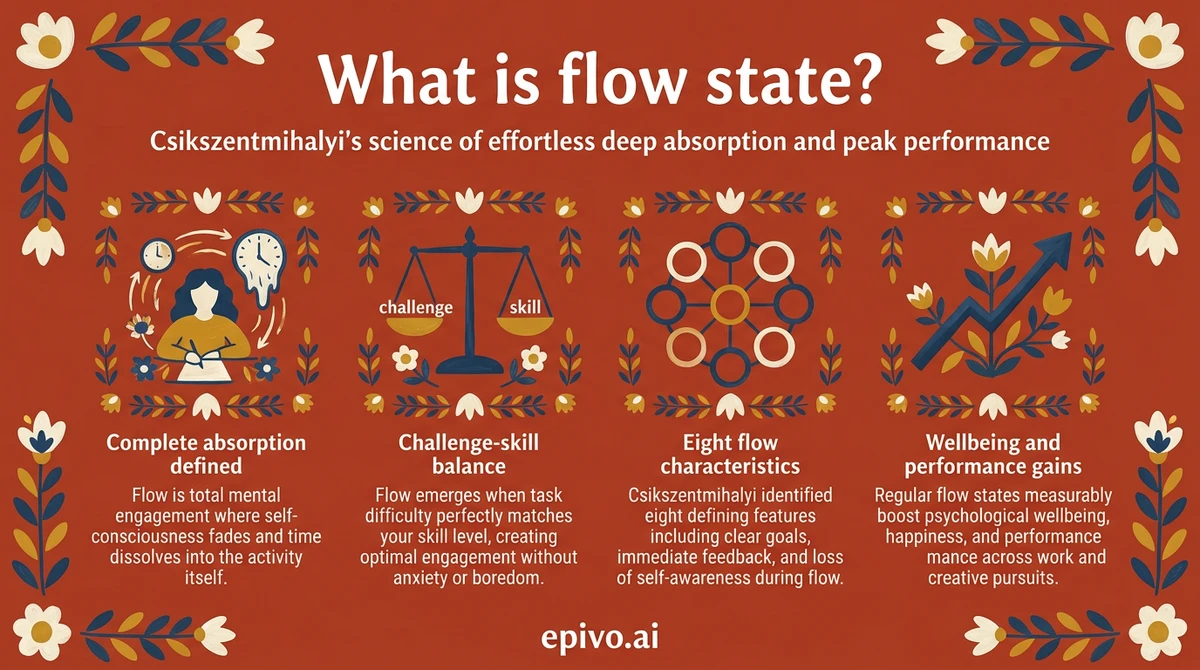
Flow state is a mental state of complete absorption in a meaningful, challenging activity — a condition in which a person is so fully engaged that self-consciousness fades and time seems to change. Psychologist Mihaly Csikszentmihalyi first described and named flow in the 1970s, based on interviews with artists, chess players, surgeons, climbers, and musicians who described the same distinctive experience: effortless concentration, a sense of clarity, and deep intrinsic reward.
Csikszentmihalyi defined flow as 'the state in which people are so involved in an activity that nothing else seems to matter; the experience itself is so enjoyable that people will do it even at great cost, for the sheer sake of doing it.' In his foundational book Flow: The Psychology of Optimal Experience, he argued that flow represents the highest form of human engagement — and that the capacity to enter it voluntarily is central to a good life.
Flow state is distinct from relaxation. Relaxation reduces arousal; flow state is a high-arousal condition that nonetheless feels effortless. It is also distinct from mere concentration: flow involves a qualitative shift in the experience of time and self, not just sustained attention. Understanding what is flow state means recognising it as a specific neurological and psychological condition with its own identifiable characteristics.
The eight characteristics of flow — what the experience involves
Csikszentmihalyi identified eight characteristics that define the flow state experience, based on thousands of interviews and later confirmed by experience sampling studies.
Complete concentration and loss of self-consciousness
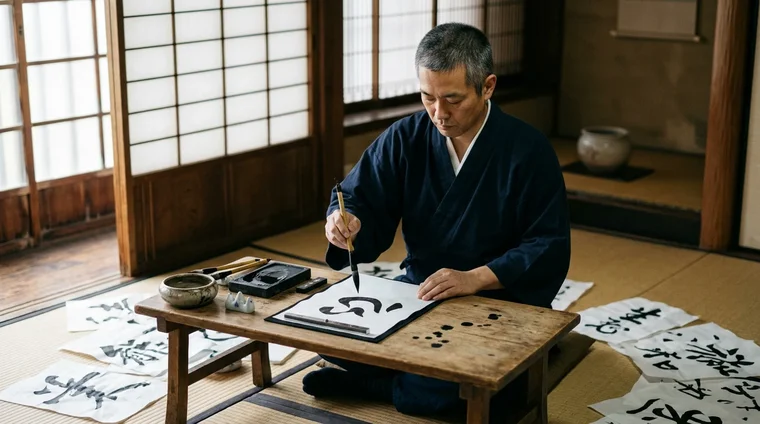
In flow, attention is fully absorbed by the task. Distracting thoughts, worries, and self-monitoring dissolve. People in flow describe feeling 'at one' with what they are doing — a composer described it as the music writing itself; a surgeon described the operation doing itself.
Clear goals and immediate feedback
Flow activities provide clear goals — you know what you are trying to do — and immediate feedback on how well you are doing it. In sport, the score is immediate. In music, you hear every note. This feedback loop sustains engagement and allows continuous adjustment.
The challenge-skill balance
The most critical condition for flow is a balance between the difficulty of the task and the skill of the person. If the task is too easy, the result is boredom. If it is too hard, the result is anxiety. Flow occurs in the zone between these two states — where the challenge stretches ability without overwhelming it.
Transformation of time
People in flow consistently report that time passes differently — usually much faster, though occasionally a sense of each moment stretching occurs. This alteration of time perception is considered a reliable marker of the flow experience.

How to reach flow state more consistently
Flow is not accidental. While some people enter it spontaneously during engaging work, it can be deliberately cultivated by designing the conditions that trigger it.
Match challenge to skill
The most reliable method for entering flow is to calibrate task difficulty to just above your current ability level. If you are learning a language, aim for texts slightly harder than comfortable. If you play an instrument, practise pieces at the edge of your competence. If tasks feel too easy, increase their complexity; if they feel overwhelming, break them into smaller steps.
Remove distractions before starting
Flow requires an undistracted environment at the outset. Research by Csikszentmihalyi and others shows that flow typically begins 15–20 minutes into uninterrupted work. Notifications, background conversations, and task-switching all prevent the sustained attention that precedes flow. Therefore, protecting a block of uninterrupted time is a prerequisite.
Set a clear intention
Before beginning, define what you are trying to achieve in the session. Clear goals align attention and make feedback legible. Without a clear target, the mind tends to wander rather than engage.
Visit For parents to see how Epivo helps students encounter flow through structured, challenging learning. Explore Epivo's International curriculum for courses designed to stretch and engage learners at their own level.
Did you know?
-
Mihaly Csikszentmihalyi studied flow for over 30 years and found that it occurs when task challenge matches personal skill at a high level — too easy produces boredom, too hard produces anxiety, the balance produces flow.
Flow: The Psychology of Optimal Experience — Csikszentmihalyi -
Experience sampling studies using beepers found that people report the highest levels of concentration, engagement, and positive emotion during flow states — significantly higher than during relaxation or passive entertainment.
Creativity: Flow and the Psychology of Discovery — Csikszentmihalyi -
Flow states are associated with increased activation of the prefrontal cortex and release of dopamine, norepinephrine, and serotonin — a neurological basis for the heightened performance and wellbeing reported during flow.
The Rise of Superman — Steven Kotler
Flow state and wellbeing — the long-term benefits
Beyond the immediate pleasure of the experience, flow state has measurable long-term benefits for both performance and psychological wellbeing. Csikszentmihalyi's research showed that people who reported frequent flow experiences also reported higher overall life satisfaction — not during the flow itself, which often precedes the positive emotion, but in retrospective evaluation.
Flow is also a core component of Martin Seligman's PERMA framework for flourishing. The E in PERMA stands for Engagement — the capacity to enter absorbed, intrinsically motivated states of activity. Seligman argues that without regular engagement, wellbeing is thin and unstable. Consequently, identifying the activities that reliably produce flow for you is one of the most direct investments you can make in long-term psychological health.
In educational and professional contexts, flow correlates strongly with both learning and performance. Students in flow states show deeper processing, better retention, and greater creative output. Athletes, musicians, and programmers in flow describe peak performance that exceeds what deliberate effort alone can produce.
The practical implication is direct: the most effective path to both excellence and happiness often runs through activities that produce flow. Finding those activities — and designing your life to make them more frequent — is one of the central practical contributions of the positive psychology movement.

Frequently asked questions
- What is flow state in simple terms?
- Flow state is a mental condition of complete absorption in a challenging, meaningful activity. Psychologist Csikszentmihalyi identified it as a specific experience in which self-consciousness fades, time changes, and performance feels effortless. It produces both high performance and strong positive emotion.
- What triggers flow state?
- Flow is most reliably triggered by three conditions: a clear goal, immediate feedback, and a match between the challenge level of the task and your current skill level. When the task is slightly harder than comfortable, attention engages fully and flow becomes possible.
- How long does flow state last?
- Flow episodes typically last between 20 minutes and several hours, depending on the activity and the person. They require an initial period of undistracted engagement — usually 15–20 minutes — before the characteristic absorption sets in. Interruptions generally end the state and require re-entry.
- Is flow state the same as being in the zone?
- Yes. 'Being in the zone', used by athletes and performers, describes the same experience as flow state. Both terms refer to a condition of peak performance and deep absorption in which the right action feels automatic, self-consciousness disappears, and time perception changes.
- Can anyone experience flow state?
- Yes. Csikszentmihalyi's research across cultures, ages, and professions found that flow is a universal human experience. It occurs in surgeons, chess players, farmers, coders, and students alike — provided the activity provides clear goals, immediate feedback, and an appropriate level of challenge.