
What is positive psychology — and how did it begin?
Positive psychology is the scientific study of what makes human life go well — not merely the treatment of illness and disorder. Psychologist Martin Seligman introduced the discipline formally in 1998 during his Presidential Address to the American Psychological Association. He argued that traditional psychology had, for decades, focused almost exclusively on mental illness. However, it had largely neglected the question of why some people flourish even under difficult conditions.
Seligman's approach built on earlier work by humanist psychologist Abraham Maslow, who proposed that human beings are motivated not only to survive but to grow. In particular, Maslow's concept of 'self-actualisation' — reaching one's full potential — anticipated many questions that positive psychology now studies systematically.
For anyone interested in human behaviour, positive psychology represents a scientific approach to questions people have always asked: Why are some people happy? What gives life meaning? How do strong relationships protect our wellbeing? These questions now have empirically grounded answers. Furthermore, the methods used to answer them are the same rigorous experimental methods that medicine uses to test treatments — making this a genuinely scientific field, not a self-help genre.
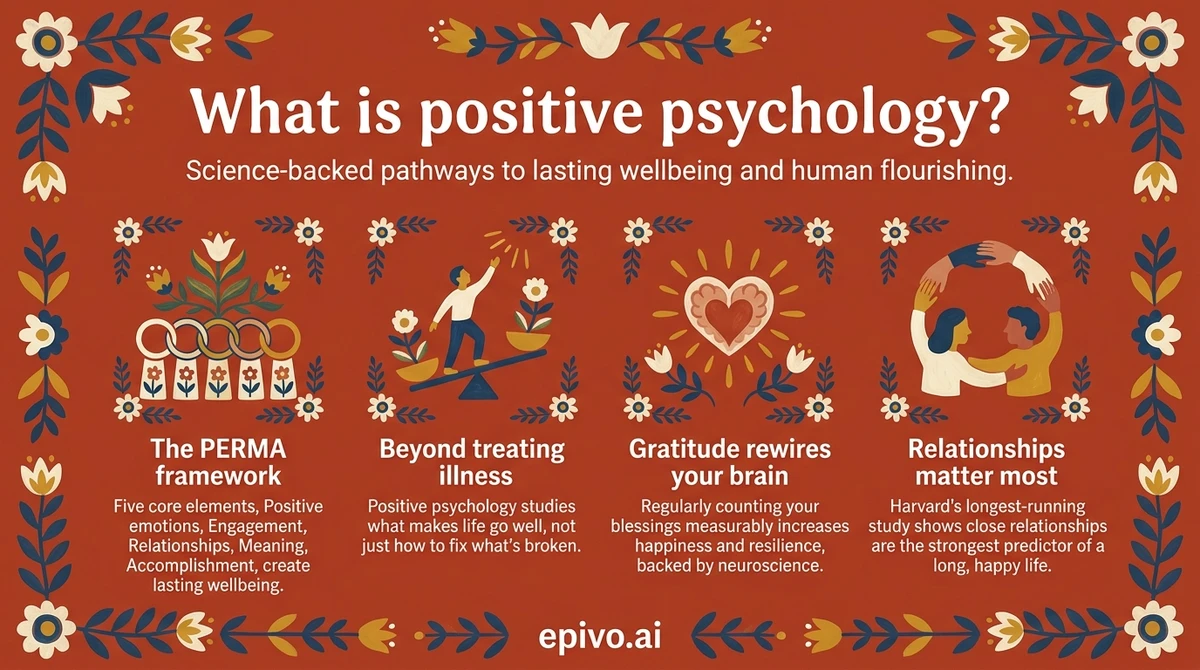
The PERMA framework — five pathways to flourishing
The most widely used model in positive psychology is the PERMA framework, developed by Seligman in his 2011 book Flourish. PERMA identifies five elements that together produce lasting wellbeing.
Positive emotions
Positive emotions means more than just happiness — it includes joy, gratitude, serenity, curiosity, and awe. Research shows that these emotions broaden our thinking and build long-term resilience.
Engagement and Relationships
Engagement refers to deep absorption in activities that stretch your abilities — a state Csikszentmihalyi called 'flow'. Relationships captures the fundamental importance of human connection: people consistently report that close, supportive bonds are the strongest single predictor of wellbeing.
Meaning and Achievement
Meaning refers to belonging to and serving something larger than yourself — through work, family, community, or belief. Achievement describes the satisfaction that comes from pursuing goals and developing mastery, independent of external reward.
Research by the VIA Institute on Character confirms that applying your personal strengths across each PERMA element accelerates flourishing. Consequently, positive psychology is now used in schools, workplaces, and healthcare settings across more than 50 countries.

How to apply positive psychology in everyday life
Positive psychology offers concrete practices that research shows reliably increase wellbeing. These are not self-help formulas — they are scientifically tested interventions with measurable effects.
The gratitude practice
One of the most replicated findings in positive psychology is that gratitude exercises increase life satisfaction. Robert Emmons, professor of psychology at UC Davis, found that participants who wrote three things they were grateful for each week showed significant gains in wellbeing and measurable reductions in stress. His research has been replicated in dozens of independent studies.
Identifying your strengths
The VIA Character Strengths survey identifies your top character strengths from 24 scientifically validated dimensions. Seligman's research shows that using your top strengths in new ways — at work, in relationships, or in daily tasks — produces a lasting boost in life satisfaction within a week of practice. Additionally, identifying the strengths you rarely use reveals areas for deliberate growth.
Parents can apply these tools with their children too. Visit For parents to see how Epivo integrates evidence-based wellbeing tools into structured learning.

Did you know?
-
Martin Seligman's PERMA framework identifies five pillars of lasting wellbeing: Positive emotions, Engagement, Relationships, Meaning, and Achievement. His 2011 book Flourish presents the full research basis.
Flourish — Martin Seligman -
The Harvard Study of Adult Development — the longest-running study of adult life ever conducted — found that the quality of personal relationships is the single strongest predictor of health and happiness in later life.
Harvard Study of Adult Development -
Gratitude research by Robert Emmons at UC Davis shows that regularly counting your blessings measurably increases subjective wellbeing, reduces physical symptoms of stress, and improves sleep quality.
Emmons Lab — Gratitude and Wellbeing
What the research says — evidence for positive psychology
The research base for positive psychology has grown substantially since Seligman's 1998 address. One landmark contribution is the Harvard Study of Adult Development, now the longest-running study of adult life ever conducted. Researcher Robert Waldinger summarised its central finding clearly: 'Good relationships keep us happier and healthier. Period.'
The study followed hundreds of participants over 80 years, tracking health, relationships, and wellbeing from adolescence into old age. Its conclusion — that relationship quality is the strongest single predictor of late-life health and happiness — directly validates the R element of PERMA.
A second body of evidence comes from positive psychology programmes in schools and organisations. The Action for Happiness organisation, operating across the UK and internationally, implements wellbeing courses based on positive psychology research. Their published data show that even brief, structured programmes reliably reduce anxiety, increase engagement, and improve self-reported wellbeing among participants of all ages.
For structured learning grounded in this research, explore Epivo's International curriculum, which integrates evidence-based psychology into personal development learning for students and adults alike.

Frequently asked questions
- What is positive psychology in simple terms?
- Positive psychology is the scientific study of what makes people thrive — not just the treatment of illness. Founded by Martin Seligman in 1998, it investigates happiness, meaning, strength, and resilience using the same rigorous methods as clinical psychology.
- Who founded positive psychology?
- Martin Seligman, former President of the American Psychological Association, founded positive psychology in 1998. He developed the PERMA framework to identify the five evidence-based elements of lasting wellbeing: Positive emotions, Engagement, Relationships, Meaning, and Achievement.
- What does PERMA stand for?
- PERMA stands for Positive emotions, Engagement, Relationships, Meaning, and Achievement. Seligman's research shows that people who invest in all five elements report higher and more stable levels of life satisfaction than those who focus on only one or two.
- Does positive psychology actually work?
- Yes. Positive psychology interventions — including gratitude journalling, strengths-based activities, and mindfulness practices — have been tested in hundreds of controlled studies. Meta-analyses confirm they reliably increase wellbeing and reduce depressive symptoms, with effects sustained over many months.
- How is positive psychology different from self-help?
- Self-help is a publishing genre; positive psychology is a scientific discipline. Positive psychology uses controlled experiments, peer-reviewed studies, and replicable findings. Its interventions are measured and tested, not based on personal testimony or anecdote.