All ages
Relativity
Why does time run slower for a moving clock, and faster at the top of a tower? Why can nothing outrun light, and what does E = mc² really say? Work out Einstein's ideas with your tutor, one thought experiment at a time, from trains and falling lifts to the clock correction that keeps GPS working and the question of whether the past can ever be visited. Then go further: draw space and time on paper, meet horizons, ask whether black holes destroy information, and join the search for what comes after Einstein. No maths or physics background needed.
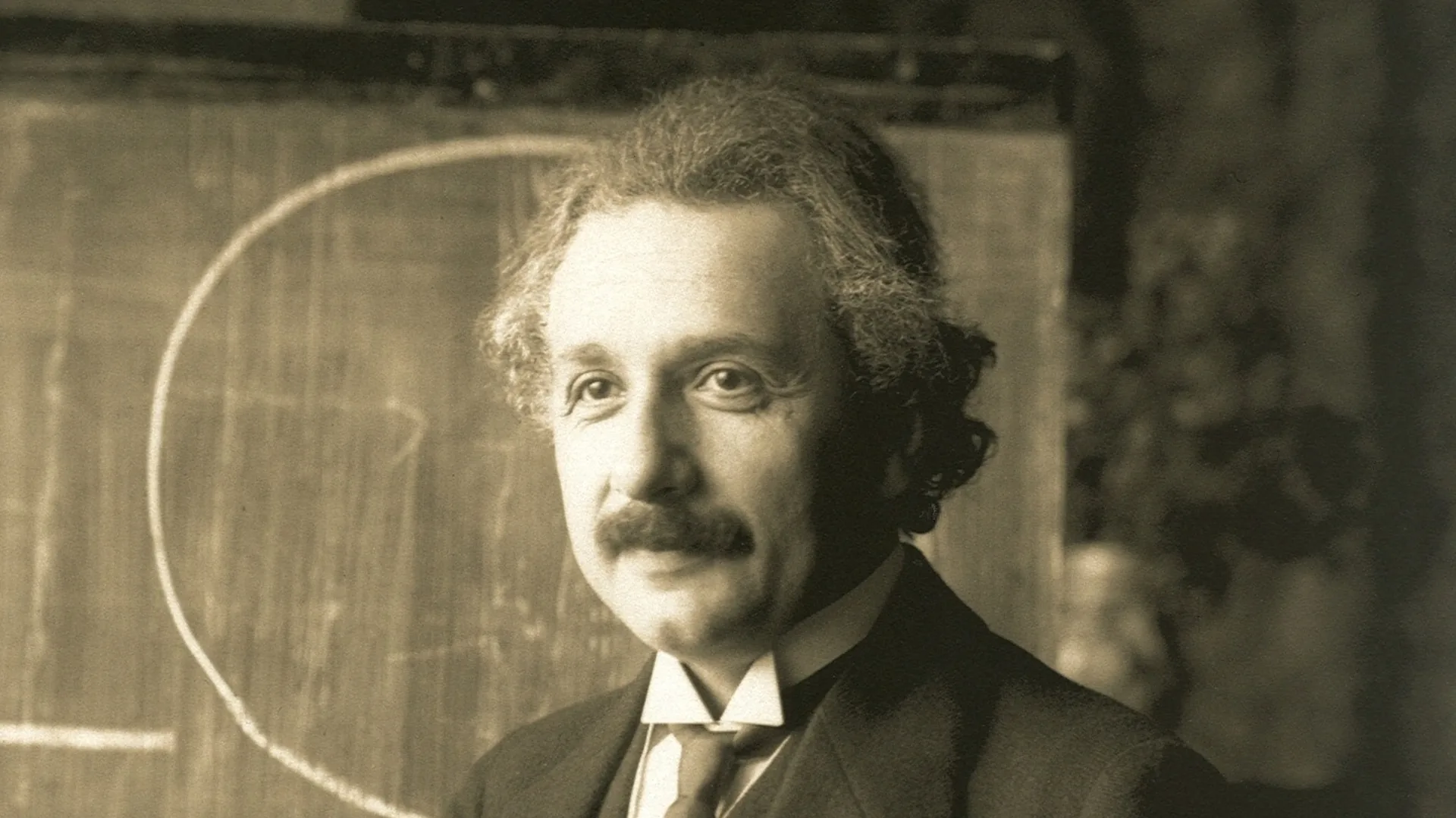
Albert Einstein lecturing in Vienna in 1921, photographed by Ferdinand Schmutzer.
Ferdinand Schmutzer · Public domain
Science
- After Einstein: The Search for Gravity's Next Theory Why can't Einstein's gravity and quantum physics both be right all the way down? Explore where the two clash and the rival ideas that might join them, from strings and loops to space stitched from entanglement. Ask whether a black hole destroys information, and look at a challenge to Einstein at the scale of galaxies. Most of this is still open, so instead of being handed an answer nobody has yet, you weigh the candidates against the evidence, including the experiments that have already ruled some ideas out.
- Gravity Bends Space and Time: General Relativity Why do astronauts float when gravity up there is almost as strong as on the ground? Follow Einstein from a falling lift to gravity as curved spacetime, where an apple falls mostly because time runs slower nearer the ground. Then see how the idea has been tested: starlight bent during the 1919 eclipse, the clock correction that keeps GPS working, ripples in spacetime, and a star racing past the black hole at our galaxy's centre.
- Spacetime Up Close: The Geometry Behind Relativity A twin flies to a star and back and comes home younger than her sister. Why, if it isn't the jolt of turning round? Draw space and time on squared paper and the answer falls out of the picture, along with why observers disagree about what is happening 'now' and the one clock reading they all agree on. Then ask whether spinning is relative, from Newton's bucket to light racing round a ring. See why tides, not falling, are the true mark of curved spacetime, and put Einstein's equation into plain words. Finally, meet horizons with no black hole in sight, from the one behind an accelerating rocket to a horizon for waves in a tank of flowing water.
- Time Stretches: Special Relativity and E = mc² Why does an astronaut come home from the space station a few thousandths of a second younger than everyone on the ground? Start from one surprising fact, that light passes everyone at the same speed, and work out why moving clocks run slow, why moving things shrink, why nothing can be pushed up to light speed, and what E = mc² says about sunlight, nuclear power and the mass of the protons inside every atom. Then find relativity where you least expect it: in the pull of a magnet, the colour of gold and the chemistry of mercury and car batteries.
- Time Travel, Time's Arrow and Einstein's Limits Could anyone ever visit the past? Einstein's equations allow time loops on paper, so weigh the grandfather paradox, wormholes and the proposed ways out. Then ask why time runs only forwards when almost every law of physics works just as well backwards, and find where the theory itself gives out, much of it still argued over today. Along the way, meet the patent clerk who rebuilt space and time, and two predictions of his own theory that he argued against.
Ready to start learning?
Start for free