All ages
Restless Earth
Why does the ground shake, why do some volcanoes explode while others ooze, and how can anyone know the Earth is 4.5 billion years old? Work it out with your tutor, one clue at a time — from earthquakes, eruptions and tsunamis to the solid metal ball at the planet's centre, crystals that still keep time, and the canyons, coasts, caves and ores of the surface. No maths or science background needed.
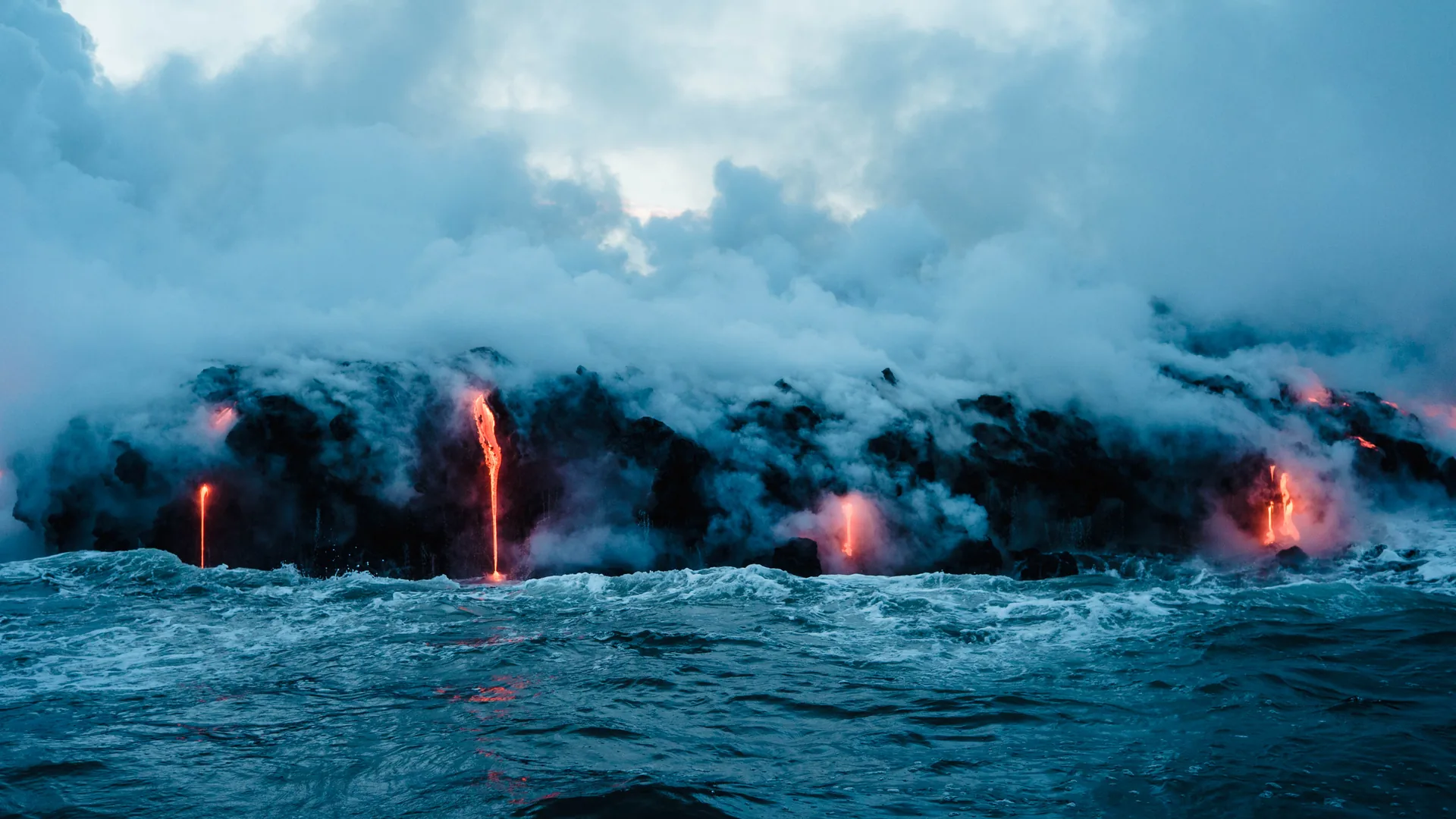
Lava from Kilauea flowing into the Pacific Ocean near Kalapana, Hawaii, photographed in 2016.
Buzz Andersen ldandersen · CC0
Science
5 courses
- Deep Time: How Old Is the Earth, and How Do We Know? How could two layers of rock on a Scottish shore show that the Earth is far older than six thousand years? Follow the clues from James Hutton's cliff and Lord Kelvin's brilliant, wrong answer to the atoms that keep time, and find out how a grain of sand can carry the birth date of a vanished rock and how geologists catch a date that is wrong. See how the Earth's calendar was written, from William Smith's 1815 map of Britain's rock layers to the vote on a human epoch. Then weigh the evidence on questions still debated: when the plates began to move, and which supercontinent comes next.
- Hazards in Depth: Forecasting, Monitoring and the Quakes We Cause Can pumping water deep underground set off an earthquake? Start with the Colorado oil field where scientists turned earthquakes on and off, then look at the reservoirs and a geothermal project in South Korea linked to quakes. Work out how one earthquake can push the next fault closer to breaking, what decides whether a building falls or stands, why a slope gives way, and how scientists follow magma gathering beneath Iceland's Reykjanes Peninsula. Then weigh the hard questions: does an earthquake know how big it will be, and how should scientists talk about risk after the L'Aquila trial?
- Inside the Planet: The Engine Under Our Feet How can anyone tell what lies at the centre of the Earth when no one can ever go there? Follow the earthquake waves that revealed a liquid core wrapped around a ball of solid metal, find out how solid rock in the mantle can still flow, and see how magnetic stripes on the sea floor proved that new ocean floor is made at the ridges. Discover where Earth's magnetic field comes from and how rocks remember its flips, why mountains have roots, and how a rock's crystals tell how it cooled. Then weigh one of geology's chief open questions: what actually moves the plates?
- Shaping the Surface: Landscapes, Coasts and the Riches Beneath How did a river carve the Grand Canyon, and why have geologists disagreed so sharply about its age? Work out why valleys carved by ice are shaped like a U, how boulders in the wrong place map ice that has vanished, why waves strike headlands hardest while bays collect sand, and how a weak acid carves limestone caves. Then follow the riches beneath: why a ruby is red and a sapphire blue, how copper ore gathers above buried magma, and how carbon dioxide can be turned to stone. Along the way, weigh a question geologists still argue over: whether glaciers limit how tall mountains can grow.
- Why the Ground Moves: Earthquakes, Volcanoes and Tsunamis Why do earthquakes line up in narrow bands across the globe instead of striking anywhere? Work out how Earth's stiff outer shell rides on rock that slowly flows, and why plates pull apart in Iceland, sink beneath one another and grind past each other on the San Andreas. Find out why one city shakes harder than another, why some volcanoes ooze while others explode, and why a tsunami moves the whole ocean from surface to floor. Then weigh the evidence on a question scientists still argue over: could a fault quietly give itself away before the big one?
Ready to start learning?
Start for free