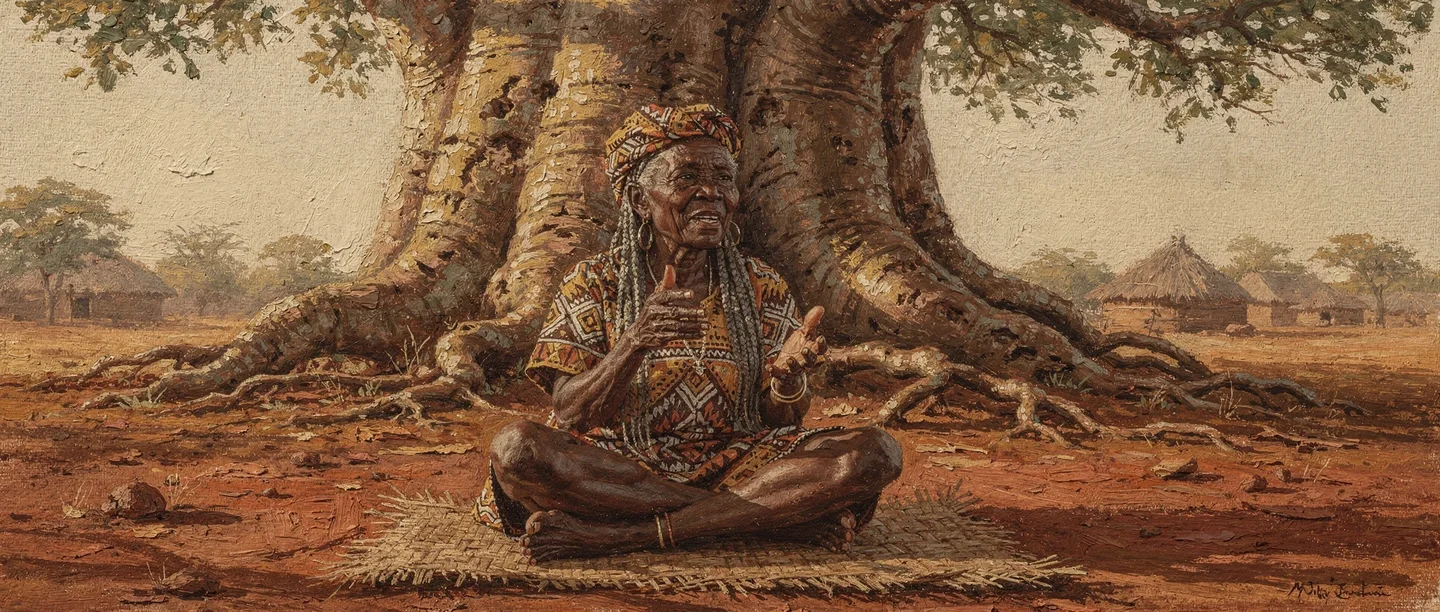
Ancient roots of African philosophy
African philosophy did not begin with European contact. Its roots stretch back thousands of years to some of the earliest written philosophical reflections in human history.
Egyptian philosophical texts
The Maxims of Ptahhotep, composed around 2400 BCE in ancient Egypt, are among the oldest surviving works of moral philosophy anywhere in the world. They offer guidance on justice, humility, and right conduct — themes that would later occupy Greek thinkers. The Instruction of Amenemope (c. 1200 BCE) influenced the Hebrew Book of Proverbs. These texts demonstrate that systematic ethical reflection was taking place in Africa long before Socrates questioned the citizens of Athens.
Zera Yacob and Ethiopian rationalism
In 17th-century Ethiopia, the philosopher Zera Yacob (1599–1692) wrote the Hatata, a treatise arguing that human reason — not religious authority — is the proper guide to truth. Writing independently of the European Enlightenment, Zera Yacob questioned religious dogma, defended the equality of men and women, and insisted on the primacy of rational inquiry. His work has been compared to Descartes, though the two thinkers were unaware of each other.
These ancient and early modern examples challenge the assumption that philosophy is a uniquely European invention. Africa's philosophical traditions developed alongside — and sometimes before — those of Europe and Asia.
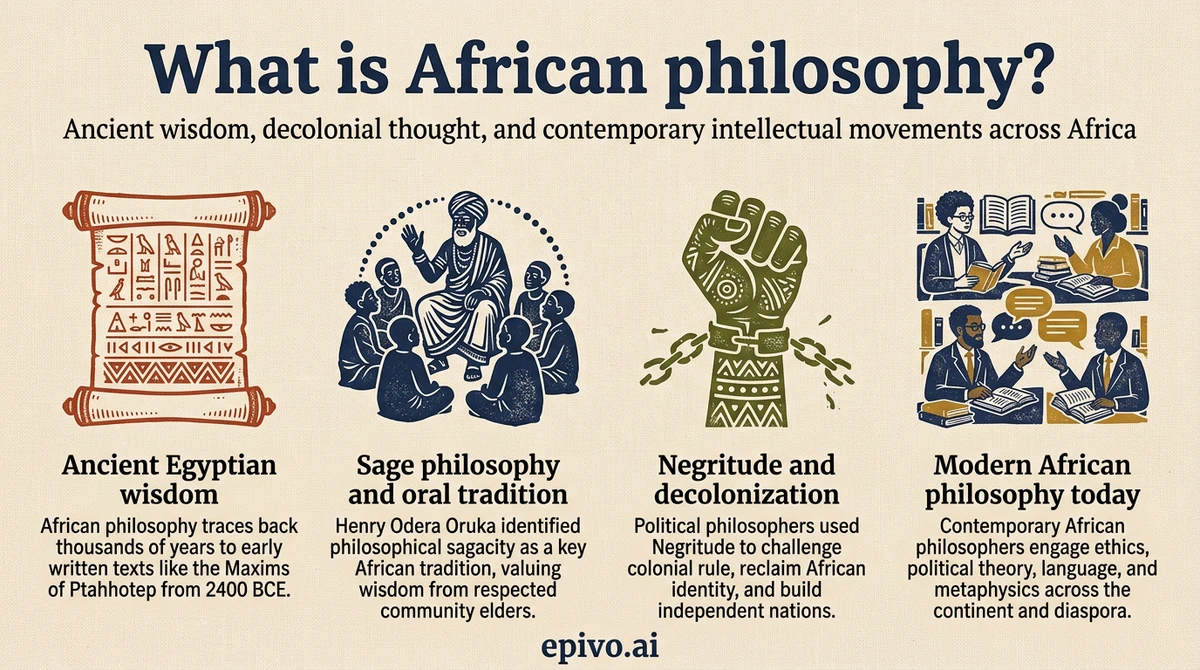
What is African philosophy as an academic discipline?
In the 20th century, African philosophy became a formal academic field. Several distinct movements emerged, each offering a different answer to the question of what counts as African philosophy.
Ethnophilosophy
The Belgian missionary Placide Tempels published Bantu Philosophy in 1945, arguing that African peoples possessed a coherent philosophical system centred on the concept of vital force. While Tempels drew serious attention to African thought, critics accused him of treating entire ethnic groups as though they shared a single worldview — a view that denied individual Africans the capacity for independent reasoning.
Sage philosophy
The Kenyan philosopher Henry Odera Oruka responded by developing the concept of 'philosophical sagacity.' Oruka interviewed individual African thinkers — rural sages who had never attended university but engaged in rigorous philosophical reflection. His work demonstrated that critical, independent thinking existed within oral traditions, not only in written academic texts.
Professional philosophy
Paulin Hountondji of Benin argued that authentic African philosophy must meet the same standards of rigorous argumentation applied anywhere else. He rejected ethnophilosophy as a romantic projection that denied Africans genuine philosophical agency. For Hountondji, African philosophy is what African philosophers do — critical, individual, and written.

Image: Generated with AI (Epivo)
Political philosophy and conceptual decolonization in Africa
Some of the most influential African philosophers worked at the intersection of philosophy and politics, using ideas to challenge colonial rule and build new nations.
Negritude
The Negritude movement, founded in the 1930s by the Martinican poet Aime Cesaire and the Senegalese philosopher Leopold Sedar Senghor, asserted the value and distinctiveness of Black African culture against European claims of superiority. Senghor argued that African thought emphasised intuition, rhythm, and communal feeling — qualities he saw as complementary to European rationalism. Critics, including the Nigerian philosopher Wole Soyinka, questioned whether Negritude merely inverted colonial stereotypes rather than transcending them.
Consciencism
Ghana's first president, Kwame Nkrumah, developed 'Consciencism' as a philosophical framework for African political independence. Nkrumah sought to synthesise traditional African communalism, Islamic thought, and Western philosophy into a coherent ideology that could guide post-colonial governance. His work connected philosophical reflection directly to the practical demands of nation-building.
Conceptual decolonization
The Ghanaian philosopher Kwasi Wiredu argued that African thinkers must decolonize the very concepts they use. Many philosophical terms — truth, mind, person, reality — carry assumptions rooted in European languages and traditions. Wiredu proposed translating philosophical problems into African languages to reveal alternative ways of thinking. For example, some West African languages have no single word for the mind-body distinction that has dominated Western philosophy since Descartes.
These movements show that understanding what is African philosophy requires engaging with questions of power, identity, and intellectual independence — not only abstract argument. The legacy of colonialism shaped the conditions under which African philosophy developed.

Image: Generated with AI (Epivo)
Did you know?
-
The Maxims of Ptahhotep, written in ancient Egypt around 2400 BCE, are among the oldest surviving works of philosophical ethics in the world — predating Socrates by nearly two thousand years.
Stanford Encyclopedia of Philosophy — African Sage Philosophy -
Henry Odera Oruka identified four trends in African philosophy: ethnophilosophy, philosophical sagacity, nationalistic-ideological philosophy, and professional philosophy. This framework remains widely used in academic discussions of the field.
Internet Encyclopedia of Philosophy — Africana Philosophy -
Zera Yacob of Ethiopia wrote his rationalist philosophical treatise, the Hatata, in 1667 — the same decade as key works by Spinoza and Locke — yet entirely independently of European intellectual developments.
Wikipedia — African Philosophy
What is African philosophy today?
Contemporary African philosophy is a vibrant and contested field. Today's African philosophers work across ethics, political theory, philosophy of language, and metaphysics — engaging with both African intellectual traditions and global philosophical debates.
One central question persists: what makes a philosophy 'African'? Is it the ethnicity of the philosopher, the geographical origin of the ideas, or the use of distinctively African concepts? Kwasi Wiredu argued that the most productive approach is to focus on the philosophical problems that arise from African experience and languages, rather than trying to define a single 'African' way of thinking.
Communitarian ethics — the idea that moral obligations arise from relationships within a community — remains a major strand of African philosophical thought. Ubuntu philosophy, with its principle that 'I am because we are,' is one well-known expression of this tradition, but it is far from the only one. Akan ethics from Ghana, Yoruba moral philosophy from Nigeria, and Maasai concepts of communal responsibility all contribute to a rich and diverse ethical landscape.
African philosophy also engages directly with contemporary global challenges. Philosophers such as Achille Mbembe examine post-colonial power, migration, and the politics of identity. Others apply African communitarian frameworks to debates about climate justice, digital rights, and the ethics of artificial intelligence.
For students exploring what is African philosophy, the field offers something distinctive: a tradition that insists philosophy must be connected to lived experience, community, and the concrete conditions of human life — rather than treated as a purely abstract exercise. It challenges the assumption that philosophical wisdom flows in one direction, from Europe to the rest of the world, and reveals a far richer global history of ideas.

Image: Generated with AI (Epivo)
Frequently asked questions
- What is African philosophy in simple terms?
- African philosophy is the body of philosophical thought that has developed across the African continent. It includes ancient Egyptian ethics, oral traditions of wisdom, modern academic movements like sage philosophy and ethnophilosophy, and the political philosophies that shaped African independence. It is not a single system but a diverse intellectual tradition.
- How is African philosophy different from Western philosophy?
- Western philosophy has historically emphasised individual reason, written texts, and formal argumentation. African philosophy often emphasises communal relationships, oral traditions, and the connection between thinking and lived experience. However, African professional philosophers such as Paulin Hountondji insist that African philosophy should meet the same standards of rigorous argument as any other tradition.
- Is Ubuntu the same as African philosophy?
- No. Ubuntu is one important strand within African philosophy — a communitarian ethic from southern and eastern Africa. But African philosophy also includes Egyptian philosophical texts, Ethiopian rationalism, West African ethical traditions, the Negritude movement, Consciencism, and contemporary academic philosophy. Ubuntu is part of the story, not the whole of it.
- Who are the most important African philosophers?
- Key figures include Ptahhotep (ancient Egypt), Zera Yacob (17th-century Ethiopia), Henry Odera Oruka (Kenya), Kwame Nkrumah (Ghana), Paulin Hountondji (Benin), Kwasi Wiredu (Ghana), Leopold Sedar Senghor (Senegal), and Achille Mbembe (Cameroon). The tradition spans millennia and covers every major branch of philosophy.
- Did philosophy exist in Africa before colonialism?
- Yes. The Maxims of Ptahhotep date to around 2400 BCE — nearly two thousand years before Socrates. Zera Yacob wrote a rationalist philosophical treatise in Ethiopia in 1667. Oral philosophical traditions, including debates among sages and elders, existed across the continent long before European contact.
- Why is African philosophy not taught more widely?
- The legacy of colonialism meant that European intellectual traditions dominated university curricula worldwide. Many philosophy departments still treat Western philosophy as the default and African thought as a regional curiosity. This is changing as scholars and institutions work to decolonize the curriculum and recognise the global history of philosophical thought.