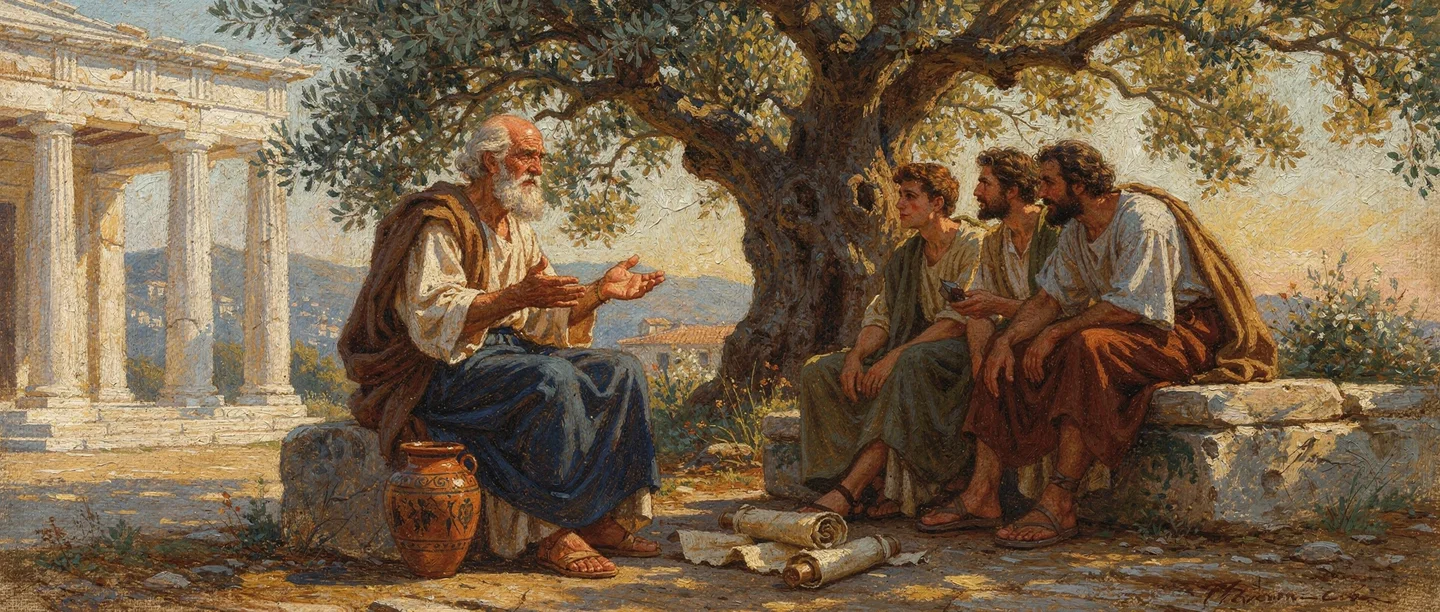
Where Philosophy Began
Philosophy began in ancient Greece around the 6th century BCE, when thinkers started seeking natural explanations for the world instead of relying on myths. This shift from mythology to reason marks one of the most important turning points in human thought.
Thales of Miletus is often called the first philosopher. He proposed that water was the fundamental substance of all things. His answer may seem naive today, but the question — what is reality ultimately made of? — launched a tradition of inquiry that continues to this day.
The three most influential Greek philosophers were Socrates, Plato, and Aristotle. Socrates (469–399 BCE) taught by asking relentless questions, forcing his students to examine their own assumptions. His method — now called the Socratic method — remains central to legal education and critical thinking. Plato, his student, founded the Academy in Athens and wrote dialogues exploring justice, beauty, and the nature of reality. Aristotle, Plato's student, investigated logic, biology, ethics, and politics with systematic rigour.
These thinkers built on the culture of debate and inquiry that flourished in ancient Greece. Their ideas shaped Western civilisation for over two thousand years.
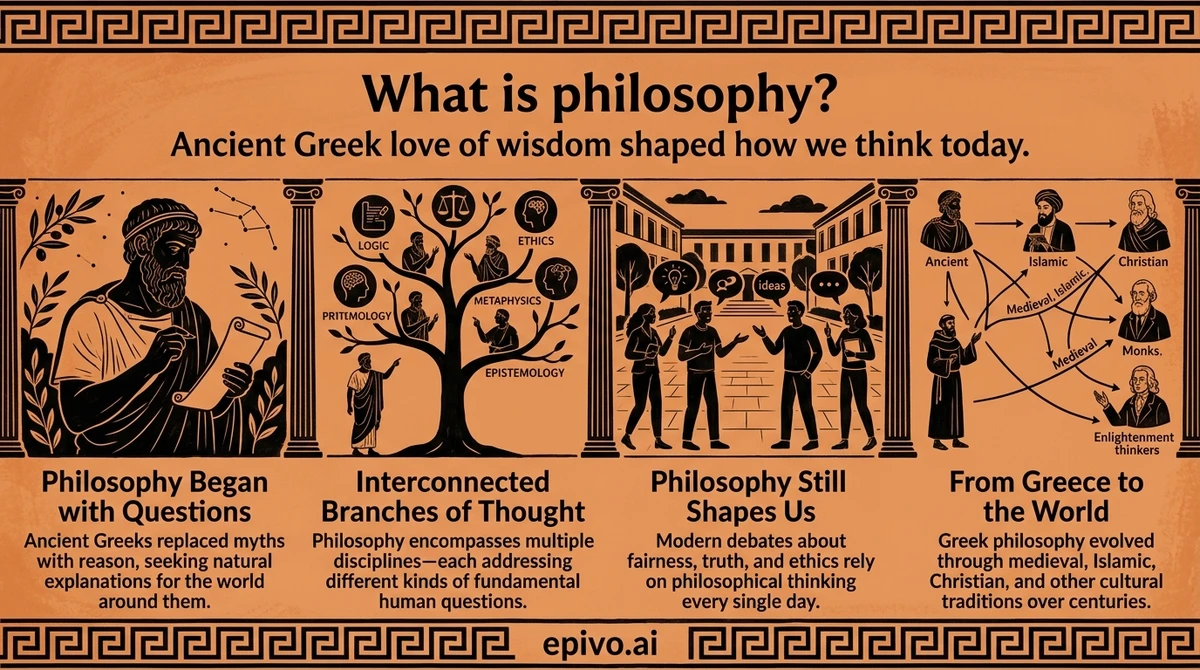
The Main Branches of Philosophy
To understand what is philosophy at a deeper level, it helps to explore its main branches. Philosophy is not a single subject but a family of interconnected disciplines, each addressing a different kind of fundamental question.
Metaphysics
Metaphysics asks what exists and what the nature of reality is. Does God exist? Do we have free will? What is the relationship between mind and body? These questions cannot be settled by scientific experiment alone — they require philosophical reasoning.
Epistemology
Epistemology is the study of knowledge. How do we know what we know? What counts as evidence? Can we ever be certain about anything? In an age of misinformation, epistemological thinking is more relevant than ever.
Ethics
Ethics examines right and wrong, good and bad. Should we judge actions by their consequences or by the principles behind them? What do we owe to strangers? Ethical philosophy underpins debates about human rights, medical decisions, and artificial intelligence.
Logic
Logic studies the rules of valid reasoning. It provides the foundation for mathematics, computer science, and clear argument. Aristotle was the first to formalise logical rules, and his system dominated Western thought for nearly two millennia.

Image: Generated with AI (Epivo)
Philosophy Beyond the Ancient World
Greek philosophy did not stand still after Aristotle. It continued to evolve and interact with new cultures, religions, and scientific discoveries.
During the medieval period, Christian, Islamic, and Jewish scholars worked to reconcile Greek philosophy with religious belief. Thinkers such as Thomas Aquinas, Averroes, and Maimonides shaped theology and law through philosophical argument.
The Enlightenment of the 17th and 18th centuries brought a renewed emphasis on reason, individual rights, and scepticism of authority. Philosophers like John Locke, Immanuel Kant, and David Hume laid the intellectual foundations for modern science, democracy, and constitutional government.
In the 19th and 20th centuries, philosophy branched further. Existentialists asked how individuals create meaning in an apparently indifferent universe. Feminist philosophers challenged assumptions about gender embedded in the tradition. Analytic philosophers in Britain and America focused on language and logic, while continental philosophers in France and Germany explored culture, power, and interpretation.
Today, philosophers work on questions raised by technology, climate change, and global justice. The Stanford Encyclopedia of Philosophy documents thousands of active areas of philosophical research.

Image: Generated with AI (Epivo)
Did you know?
-
The word 'philosophy' comes from the ancient Greek philosophia, meaning 'love of wisdom'. It was reportedly first used by Pythagoras in the 6th century BCE.
Stanford Encyclopedia of Philosophy — Ancient Philosophy -
Plato's Academy, founded around 387 BCE in Athens, is considered the first institution of higher learning in the Western world. It operated for nearly 300 years.
Wikipedia — Platonic Academy -
Aristotle wrote on subjects ranging from biology and physics to poetry and politics. His surviving works cover an estimated 31 distinct fields of inquiry.
Stanford Encyclopedia of Philosophy — Aristotle
Why Philosophy Matters Today
So what is philosophy good for in the modern world? Philosophy is sometimes dismissed as impractical, but its influence is everywhere. Every time we debate whether something is fair, question a claim, or ask what makes a good life, we are doing philosophy.
Philosophical thinking builds skills that employers and universities value highly. According to research published by the American Philosophical Association, philosophy graduates consistently score among the highest on graduate admissions tests in both verbal reasoning and analytical writing.
Moreover, philosophy helps students navigate a world of competing claims. In an era of rapid technological change, questions about privacy, artificial intelligence, and the ethics of data collection are fundamentally philosophical. Understanding how to construct and evaluate arguments is not a luxury — it is a necessity.
For parents, encouraging philosophical discussion at home strengthens a child's ability to think independently. Asking open-ended questions — Why do you think that? What would be fair here? How do you know? — mirrors the Socratic method and builds habits of careful reasoning that serve students across every subject.

Image: Generated with AI (Epivo)
Frequently asked questions
- What is philosophy in simple terms?
- Philosophy is the study of fundamental questions about reality, knowledge, morality, and reasoning. Unlike science, which tests hypotheses through experiments, philosophy uses logic and argument to examine questions that cannot be resolved by observation alone.
- Who is considered the father of philosophy?
- Socrates is often called the father of Western philosophy. He did not write anything down, but his method of questioning — recorded by his student Plato — transformed how people think about ethics, knowledge, and the examined life.
- What is the difference between philosophy and science?
- Science investigates the natural world through observation and experiment. Philosophy examines questions that lie beyond empirical testing — such as what makes an action moral, what consciousness is, or what counts as knowledge. The two disciplines complement each other.
- Is philosophy still relevant today?
- Absolutely. Philosophy shapes debates about artificial intelligence, human rights, climate ethics, and democratic governance. It also builds critical thinking and argumentation skills that are valuable in law, business, technology, and public policy.
- What are the main branches of philosophy?
- The four main branches are metaphysics (the nature of reality), epistemology (the study of knowledge), ethics (right and wrong), and logic (the rules of valid reasoning). Other important areas include aesthetics, political philosophy, and philosophy of mind.