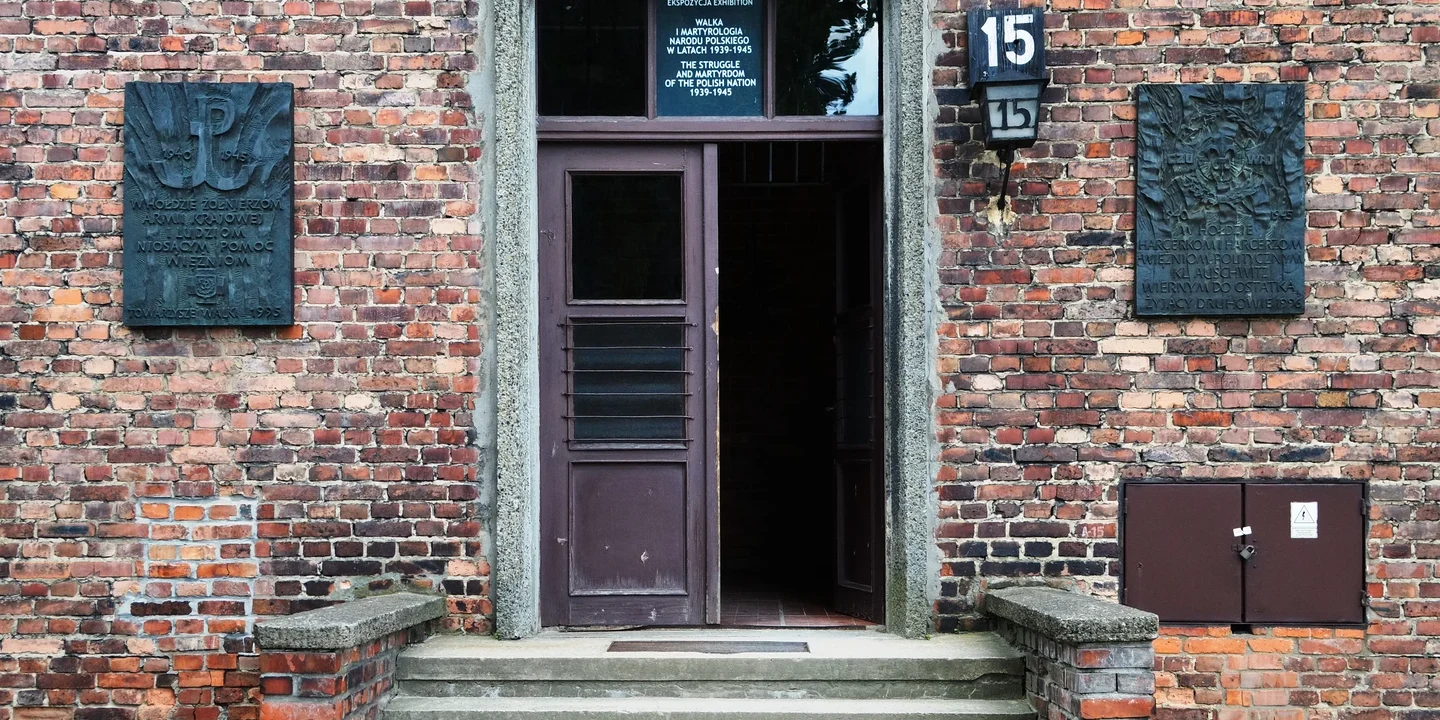
What the Holocaust was and why it happened
The Holocaust was the deliberate, organised genocide of Europe's Jewish population carried out by Nazi Germany during World War 2. The word "Holocaust" comes from the Greek word meaning "sacrifice by fire."
The roots of antisemitism
Antisemitism — hatred of Jewish people — had existed in Europe for centuries. However, the Nazi Party under Adolf Hitler turned this prejudice into state policy. When Hitler came to power in 1933, he blamed Jewish people for Germany's economic troubles and military defeat in World War 1. Nazi propaganda portrayed Jews as an existential threat to Germany.
From discrimination to persecution
The persecution escalated in stages. In 1935, the Nuremberg Laws stripped Jewish citizens of their German citizenship and prohibited marriages between Jews and non-Jews. On 9 November 1938, the state-orchestrated violence of Kristallnacht ("Night of Broken Glass") destroyed thousands of Jewish businesses, synagogues, and homes across Germany and Austria. Around 30,000 Jewish men were arrested and sent to concentration camps.
These steps normalised violence against Jewish communities and laid the groundwork for what was to come. Each measure removed more legal protections, making further persecution possible.
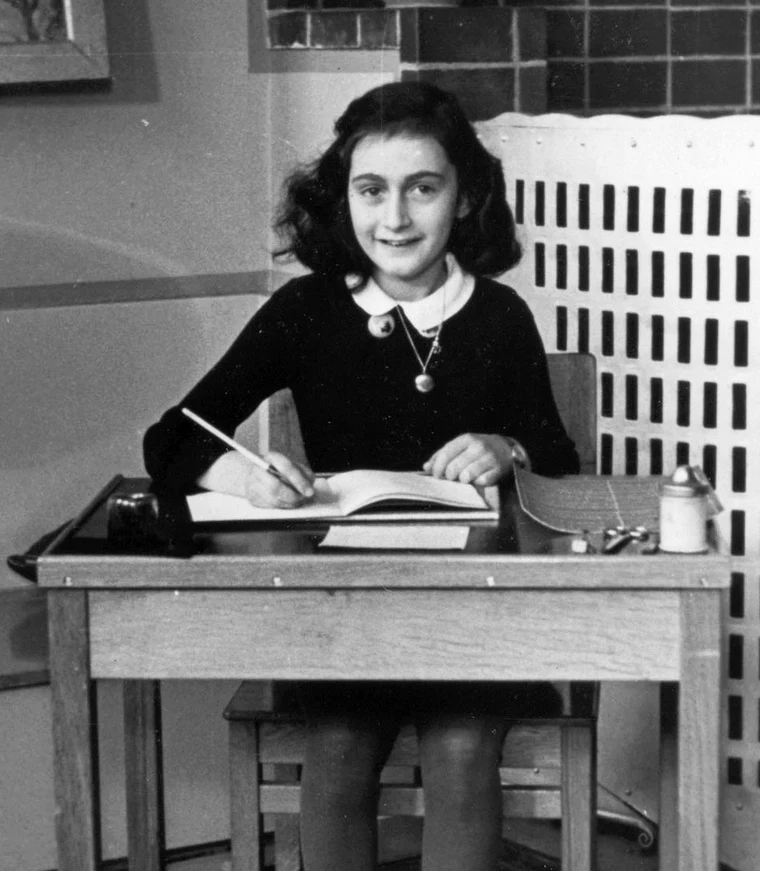
Anne Frank writing at her desk at the 6th Montessori school in Amsterdam, 1940. Her diary, written while in hiding, became one of the most widely read accounts of the Holocaust.. Image: Unknown photographer, Collectie Anne Frank Stichting Amsterdam, via Wikimedia Commons (Public domain)
Key events of the Holocaust
The genocide unfolded through a series of escalating measures that moved from isolation to mass murder.
Ghettos and forced labour
After invading Poland in 1939, the Nazis forced Jewish populations into overcrowded walled-off areas called ghettos. The Warsaw Ghetto held over 400,000 people in an area of just 3.4 square kilometres. Residents faced starvation, disease, and forced labour. Similar ghettos were established across occupied Eastern Europe.
The "Final Solution"
In January 1942, senior Nazi officials met at the Wannsee Conference to coordinate the systematic extermination of all European Jews — what they called the "Final Solution." Extermination camps were built at Auschwitz-Birkenau, Treblinka, Sobibor, and other sites, primarily in occupied Poland. These camps were designed for mass killing.
Other victims
The Nazis also targeted approximately five million non-Jewish victims. These included Roma and Sinti people, people with disabilities, political opponents, gay men, Jehovah's Witnesses, and Soviet prisoners of war. The regime viewed all of these groups as threats to its vision of racial purity.
Liberation
As Allied forces advanced in 1944 and 1945, they liberated the camps. Soviet troops reached Auschwitz on 27 January 1945. British and American forces liberated Bergen-Belsen, Dachau, and Buchenwald in April 1945. The evidence they found shocked the world and became central to holding the perpetrators accountable.
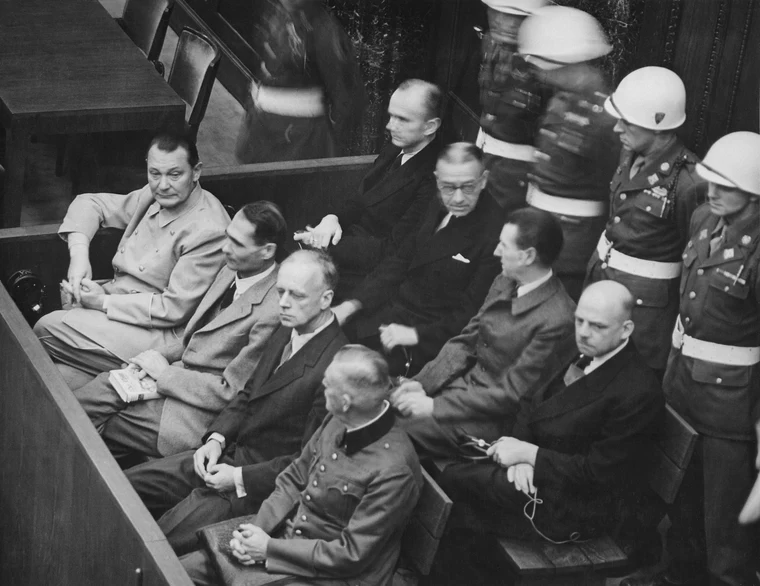
The International Military Tribunal at Nuremberg, November 1945. Senior Nazi leaders were prosecuted for war crimes and crimes against humanity.. Image: United States Army Signal Corps, via Harvard Law School Library / Wikimedia Commons (Public domain)
The aftermath and legacy of the Holocaust
The consequences of the Holocaust reshaped international law, politics, and moral thinking in ways that persist today.
The Nuremberg Trials
Beginning in November 1945, the Nuremberg Trials held senior Nazi leaders accountable for war crimes, crimes against humanity, and genocide. These trials established the principle that individuals — including heads of state — can be held responsible under international law for atrocities. This was a legal precedent that did not exist before.
Human rights and international law
The horror of the Holocaust was a driving force behind the creation of the United Nations and the adoption of the Universal Declaration of Human Rights in 1948. The concept of human rights as universal and inalienable protections grew directly from the determination that such atrocities must never be repeated.
The founding of Israel
The Holocaust accelerated the movement for a Jewish homeland. In 1948, the State of Israel was established, providing a sovereign nation for Jewish people. This decision had far-reaching consequences for the Middle East that continue to shape geopolitics today.
"Never Again"
Holocaust remembrance is observed worldwide on 27 January — the date Auschwitz was liberated. The phrase "Never Again" has become a commitment to prevent genocide in all its forms. Institutions such as the United States Holocaust Memorial Museum and Yad Vashem preserve testimony and educate new generations about the dangers of hatred and indifference.
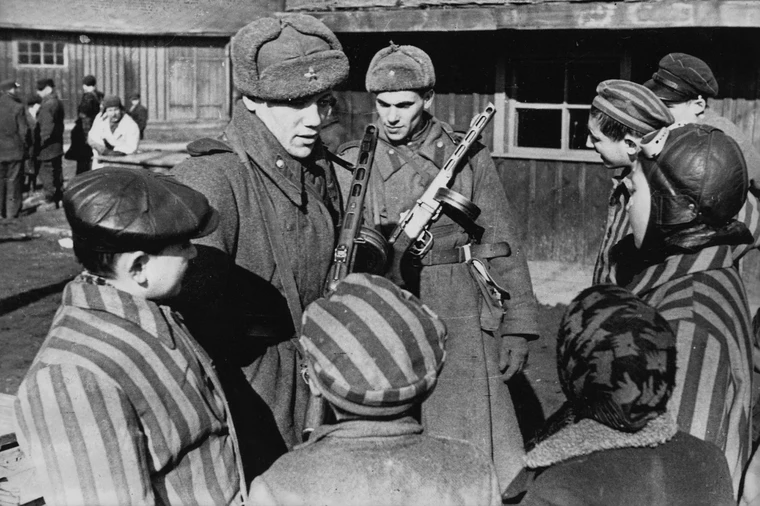
Soviet soldiers with children liberated from Auschwitz concentration camp, January 1945.. Image: Unknown photographer, via Wikimedia Commons (Public domain)
Why learning about the Holocaust matters today
Studying the Holocaust is essential because it demonstrates how prejudice, propaganda, and indifference can escalate into genocide. The Holocaust did not begin with extermination camps. It began with words — with stereotypes, scapegoating, and the gradual removal of legal protections from a minority group.
For students, learning about the Holocaust develops critical thinking about the role of individuals and institutions in enabling or resisting injustice. It connects directly to the study of human rights, democracy, and citizenship.
For parents, discussing the Holocaust with children is an opportunity to build empathy and moral reasoning. Age-appropriate conversations can focus on the choices people made — those who participated, those who were bystanders, and those who chose to resist or rescue others at great personal risk.
Today, as antisemitism and other forms of hatred persist around the world, Holocaust education remains one of the most important tools for building societies that value human dignity. Understanding history is the first step toward ensuring it does not repeat.
Epivo's International Curriculum covers the Holocaust alongside World War 2, human rights, and global citizenship, helping students engage with these topics in a supported, age-appropriate way.
Learning about the Holocaust helps build empathy, critical thinking, and a commitment to human dignity.. Image: Generated with AI (Epivo)
Did you know?
-
Six million Jews — approximately two-thirds of Europe's Jewish population — were murdered during the Holocaust between 1941 and 1945.
United States Holocaust Memorial Museum -
The Nazis and their collaborators also killed approximately five million non-Jewish victims, including Roma, people with disabilities, political prisoners, and Soviet POWs.
Yad Vashem — The World Holocaust Remembrance Center -
International Holocaust Remembrance Day is observed on 27 January each year — the anniversary of the liberation of Auschwitz-Birkenau by Soviet forces in 1945.
United Nations — Holocaust Remembrance
Frequently asked questions
- What was the Holocaust in simple terms?
- The Holocaust was the systematic murder of six million Jews by Nazi Germany during World War 2 (1941-1945). The Nazis also killed approximately five million others, including Roma people, people with disabilities, and political prisoners.
- Why did the Holocaust happen?
- The Holocaust resulted from deep-rooted antisemitism exploited by the Nazi regime. Hitler blamed Jewish people for Germany's problems and used propaganda to dehumanise them. The Nazis escalated from discrimination to persecution and ultimately to genocide.
- What were concentration camps and extermination camps?
- Concentration camps were used for forced labour, punishment, and detention. Extermination camps — such as Auschwitz-Birkenau and Treblinka — were specifically built for mass killing. The distinction is important: extermination camps had no purpose other than murder.
- Who were the Righteous Among the Nations?
- This is a title given by Yad Vashem to non-Jewish people who risked their lives to save Jews during the Holocaust. Over 28,000 individuals from more than 50 countries have been recognised, including Oskar Schindler and Raoul Wallenberg.
- How is the Holocaust remembered today?
- The Holocaust is remembered through memorials, museums, education programmes, and International Holocaust Remembrance Day on 27 January. Institutions like the US Holocaust Memorial Museum and Yad Vashem preserve survivor testimony for future generations.