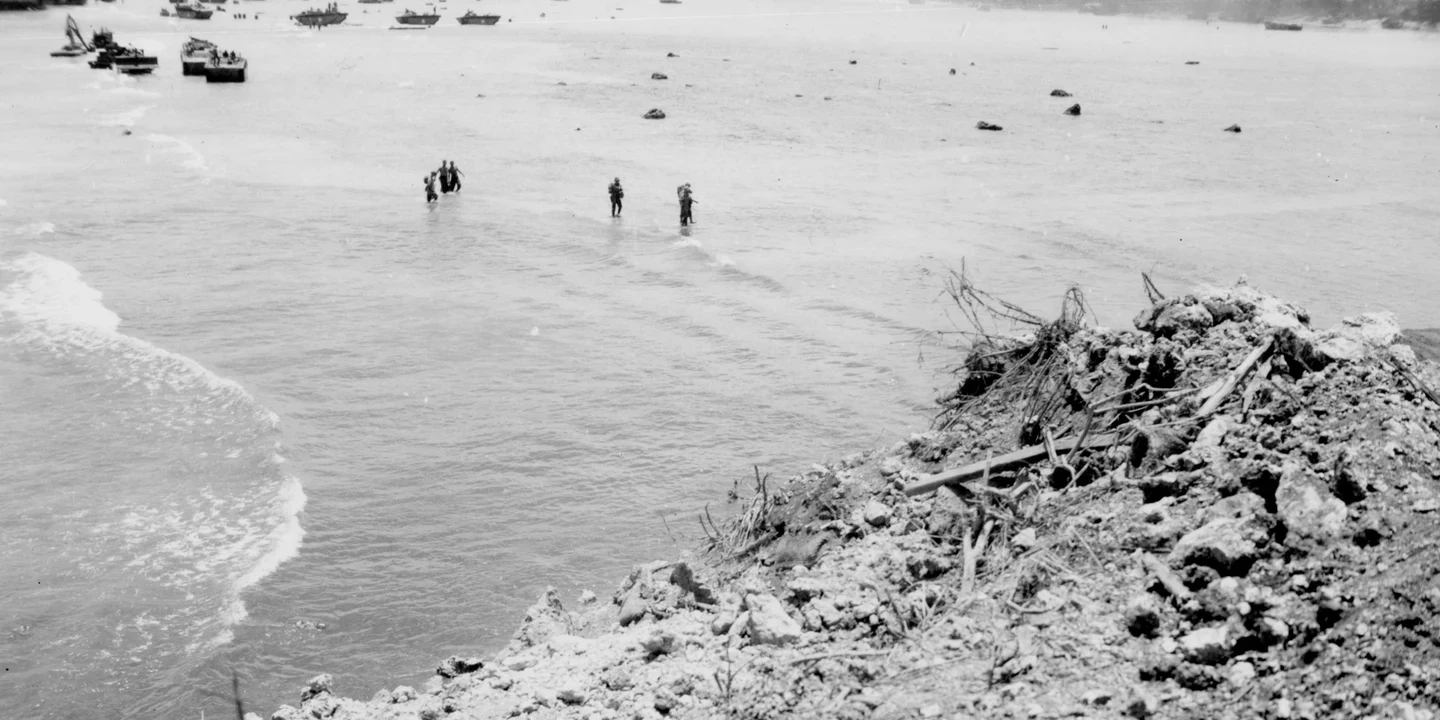
What Caused World War 2
The conflict grew from the unresolved consequences of World War 1 and the crises of the 1930s.
The failure of the peace
The Treaty of Versailles (1919) imposed harsh terms on Germany — massive reparations, territorial losses, and sole blame for the war. Economic humiliation combined with hyperinflation and then the Great Depression created fertile conditions for extremism. Adolf Hitler rose to power in Germany in 1933, promising to restore national greatness and overturn the Versailles settlement. The full story of the causes of World War 2 shows how multiple factors compounded.
Appeasement and expansion
Britain and France attempted to avoid conflict by accommodating Hitler's demands. Germany remilitarised the Rhineland (1936), annexed Austria (1938), and took the Sudetenland — all without military resistance. The Munich Agreement (1938) gave Hitler the Sudetenland in exchange for a promise of no further territorial demands. When Germany invaded Poland on 1 September 1939, Britain and France finally declared war.
The wider world
In the Pacific, Japan had been expanding aggressively since the 1930s — invading China in 1937. The United States entered after Japan's attack on Pearl Harbor on 7 December 1941. This transformed a European war into a truly global conflict.
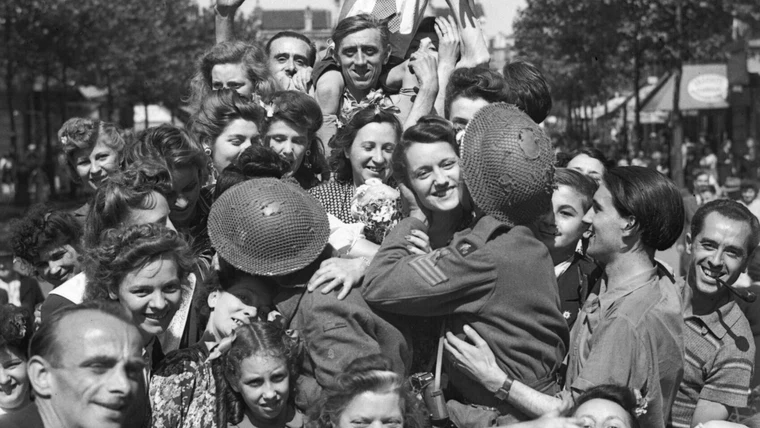
Parisians line the streets to welcome Allied troops during the liberation of Paris on 26 August 1944, after four years of German occupation.. Image: Capt. Malindine E G, No. 5 Army Film & Photographic Unit, Imperial War Museums (IWM BU 21), via Wikimedia Commons (Public domain)
Key Events of World War 2
The conflict spanned six years across multiple theatres — Europe, North Africa, and the Pacific.
Blitzkrieg and the fall of France
Germany's 'lightning war' strategy combined armoured divisions with air power to overwhelm opponents before they could respond. France fell in six weeks in 1940. Britain stood alone for a year, surviving the Battle of Britain — a sustained aerial campaign — without being invaded.
The Holocaust
The Nazi regime systematically murdered six million Jews and millions of others — Roma, disabled people, political prisoners, gay men, and Soviet POWs. The Holocaust was carried out through mass shootings, death camps, and forced labour. It remains history's most documented genocide and the central moral reckoning of the 20th century.
The Eastern Front
Germany invaded the Soviet Union in June 1941. The resulting conflict was the largest in history — the Soviet Union suffered an estimated 26 million deaths. The Battle of Stalingrad (1942–43) was the turning point: Soviet victory halted the German advance and began the long retreat.
D-Day and victory in Europe
On 6 June 1944, Allied forces landed in Normandy in the largest amphibious operation in history. By May 1945, Germany had surrendered. In the Pacific, the United States dropped atomic bombs on Hiroshima (6 August) and Nagasaki (9 August) 1945. Japan surrendered on 15 August 1945.
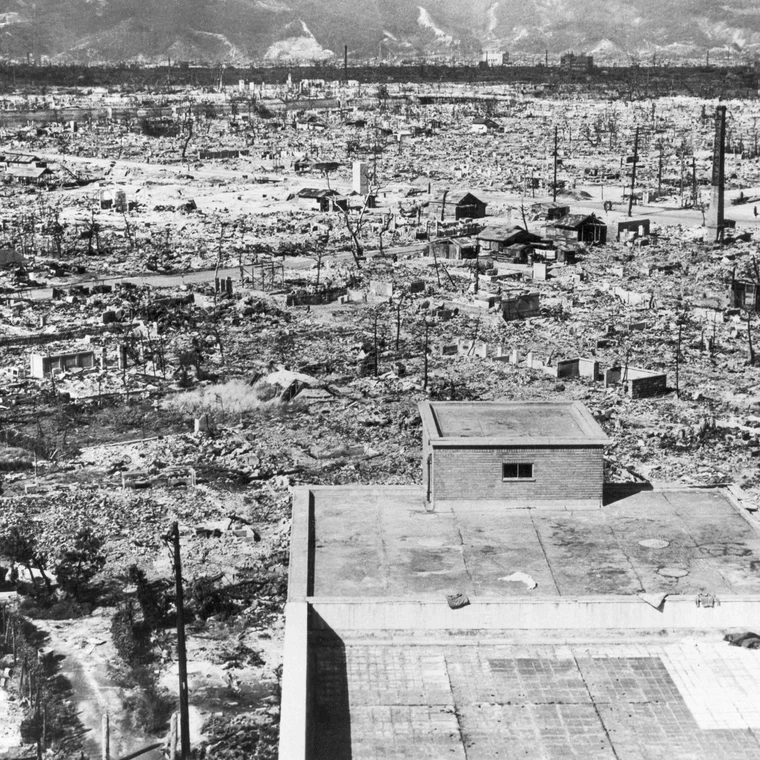
An aerial view of Hiroshima after the atomic bomb was dropped on 6 August 1945. The bombing killed an estimated 80,000 people instantly and hastened Japan's surrender.. Image: Unknown photographer, via Wikimedia Commons (Public domain)
The Legacy of World War 2
No conflict has shaped the modern world more profoundly. Its consequences continue to influence international politics today.
The post-war order
The United Nations was founded in 1945 to prevent future wars through international cooperation. The Universal Declaration of Human Rights (1948) established for the first time that all people have inalienable rights regardless of nationality. Europe's integration project — now the European Union — was explicitly designed to make war between France and Germany impossible.
The Cold War
The defeat of Nazi Germany left two superpowers — the United States and the Soviet Union — in an ideological struggle that dominated the second half of the 20th century. The Cold War defined global politics for 45 years, bringing the world to the brink of nuclear war during the Cuban Missile Crisis (1962).
Decolonisation
The war fatally weakened the European colonial empires. Britain, France, Belgium, and the Netherlands — exhausted and indebted — could no longer sustain overseas empires. Dozens of nations in Asia and Africa achieved independence in the two decades after 1945. The post-war world order was fundamentally different from the one that preceded the conflict.
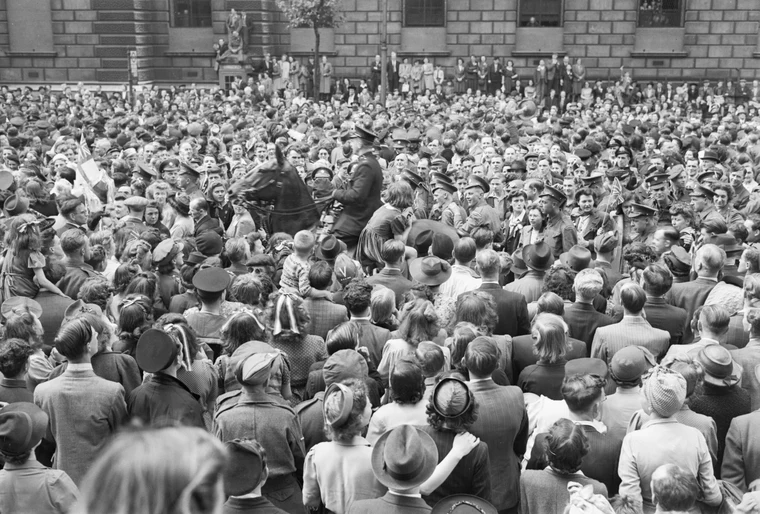
Crowds celebrate Victory in Europe Day in London on 8 May 1945, marking Germany's unconditional surrender and the end of nearly six years of war in Europe.. Image: Ministry of Information Photo Division, Imperial War Museums (IWM D 24584), via Wikimedia Commons (Public domain)
Frequently asked questions
- How many people died in World War 2?
- Estimates range from 70 to 85 million deaths — the deadliest conflict in history. Roughly 50–55 million were civilians, including six million Jews killed in the Holocaust. The Soviet Union suffered approximately 26 million deaths; China lost an estimated 15–20 million. The unprecedented civilian toll transformed how the world thought about war and human rights.
- Why did Germany lose World War 2?
- Germany fought on multiple fronts — the Eastern Front against the Soviet Union, the Western Front against Britain and America, and the Mediterranean. No economy could sustain this indefinitely. Soviet manpower and industrial capacity proved decisive. Hitler's errors — invading the USSR and declaring war on the US after Pearl Harbor — sealed Germany's fate.
- Was the dropping of atomic bombs on Japan justified?
- This remains one of the most debated questions in 20th-century history. Supporters argue the bombs ended the war quickly, avoiding an invasion that could have killed millions. Critics argue they killed 200,000 civilians indiscriminately, Japan was near surrender anyway, and using nuclear weapons against cities constituted a war crime. Historians debate both positions.
- How did World War 2 lead to the Cold War?
- The war left two superpowers — the United States and the Soviet Union — with opposing systems. Wartime cooperation broke down as the USSR imposed communist governments on Eastern Europe and the West resisted. By 1947, the world had divided into two blocs, beginning four decades of competition that defined global politics until 1991.