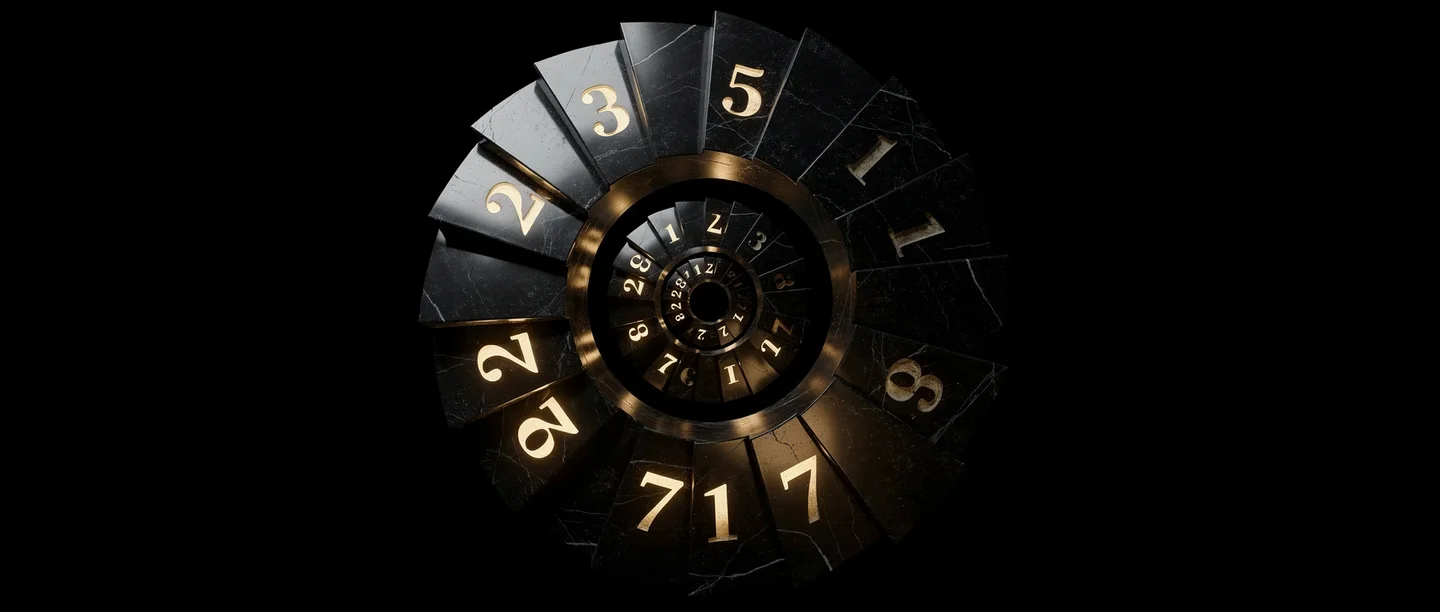
What are prime numbers — the definition
Prime numbers are whole numbers greater than 1 that have exactly two factors: 1 and the number itself. A factor is a whole number that divides another number exactly, leaving no remainder.
The first ten prime numbers are: 2, 3, 5, 7, 11, 13, 17, 19, 23, 29.
To check whether a number is prime, try dividing it by all whole numbers up to its square root. If none divide it exactly, it is prime.
Numbers that are NOT prime
- 1 is not prime. By definition, prime numbers must have exactly two factors. The number 1 has only one factor — itself. (Excluding 1 from the primes keeps the Fundamental Theorem of Arithmetic clean: every number has a unique prime factorisation.)
- Composite numbers have more than two factors. For example, 12 has factors 1, 2, 3, 4, 6, and 12 — so 12 is composite, not prime.
One special prime
2 is the only even prime number. Every other even number is divisible by 2 and therefore has at least three factors, making it composite. This makes 2 uniquely interesting among prime numbers.
Mathematically, they are the atomic building blocks of all whole numbers — every whole number greater than 1 is either prime or can be broken down into prime factors.

The Sieve of Eratosthenes — how to find prime numbers
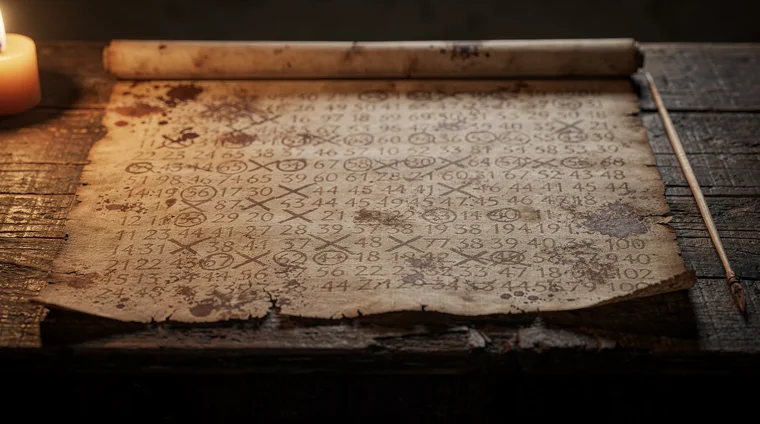
The ancient Greek mathematician Eratosthenes (c. 276–194 BC) devised a systematic method for finding all prime numbers up to a given limit. It is still used today and is a standard topic in school maths.
How the Sieve works:
- Write all numbers from 2 to your chosen limit.
- Start at 2. Circle it (it is prime). Cross out all multiples of 2 (4, 6, 8...).
- Move to the next uncrossed number (3). Circle it. Cross out all multiples of 3 (6, 9, 12...).
- Repeat: circle the next uncrossed number, cross out all its multiples.
- Continue until no multiples remain to cross out.
- All circled numbers are prime.
The numbers that "fall through" the sieve, uncrossed, are the prime numbers.
Prime factorisation
Every whole number greater than 1 can be written as a unique product of prime numbers. This is called the Fundamental Theorem of Arithmetic. For example:
- 12 = 2 × 2 × 3
- 60 = 2 × 2 × 3 × 5
- 100 = 2 × 2 × 5 × 5
Prime factorisation is used to find the Highest Common Factor (HCF) and Lowest Common Multiple (LCM) of numbers — skills students need for simplifying fractions.
Why prime numbers matter — from school to cybersecurity
Prime numbers are not merely a curiosity for school mathematics — they are central to how the modern internet stays secure.
Cryptography and internet security
Every time you see a padlock symbol in your browser, your connection is protected by encryption based on prime numbers. The RSA encryption algorithm — widely used to secure online banking, email, and e-commerce — relies on the fact that multiplying two very large prime numbers together is easy, but factorising the result back into its two prime factors is extremely hard, even for powerful computers.
A typical RSA key uses prime numbers that are hundreds of digits long. The difficulty of finding those primes is what keeps encrypted data safe.
Unsolved mysteries
Despite their apparent simplicity, they remain mysterious:
- How many prime numbers are there? Infinitely many — this was proved by Euclid around 300 BC.
- The twin prime conjecture — are there infinitely many pairs of prime numbers that differ by 2 (like 11 and 13, or 17 and 19)? Mathematicians believe so, but it has never been proved.
- The Riemann Hypothesis — a 165-year-old question about the distribution of prime numbers, considered one of the most important unsolved problems in all of mathematics.
For parents, the Sieve of Eratosthenes on graph paper is an engaging activity — an engaging and concrete activity. The For parents guide has more maths activity ideas for home.
Frequently asked questions
- Is 1 a prime number?
- No. By definition, primes must have exactly two distinct factors: 1 and the number itself. The number 1 has only one factor — itself — so it does not meet the definition of a prime number. It is also not composite. The number 1 sits in its own category.
- What are prime numbers used for in everyday life?
- The most direct everyday impact of prime numbers is digital security. RSA encryption — which protects online banking, shopping, and messaging — relies on the difficulty of factorising large numbers back into their factors. Every time you shop online, prime numbers are silently protecting your payment details.
- Are there infinitely many prime numbers?
- Yes. The ancient Greek mathematician Euclid proved around 300 BC that there is no largest prime number. His proof by contradiction is elegant: assume a largest prime exists, multiply all known primes together and add 1 — the result is either prime itself or has a prime factor not in the original list, contradicting the assumption.
- What is the largest known prime number?
- As of 2024, the largest known prime number has over 41 million digits. It was discovered using a distributed computing project called GIMPS (Great Internet Mersenne Prime Search), which uses volunteers' computers worldwide to search for large primes of a specific form called Mersenne primes.