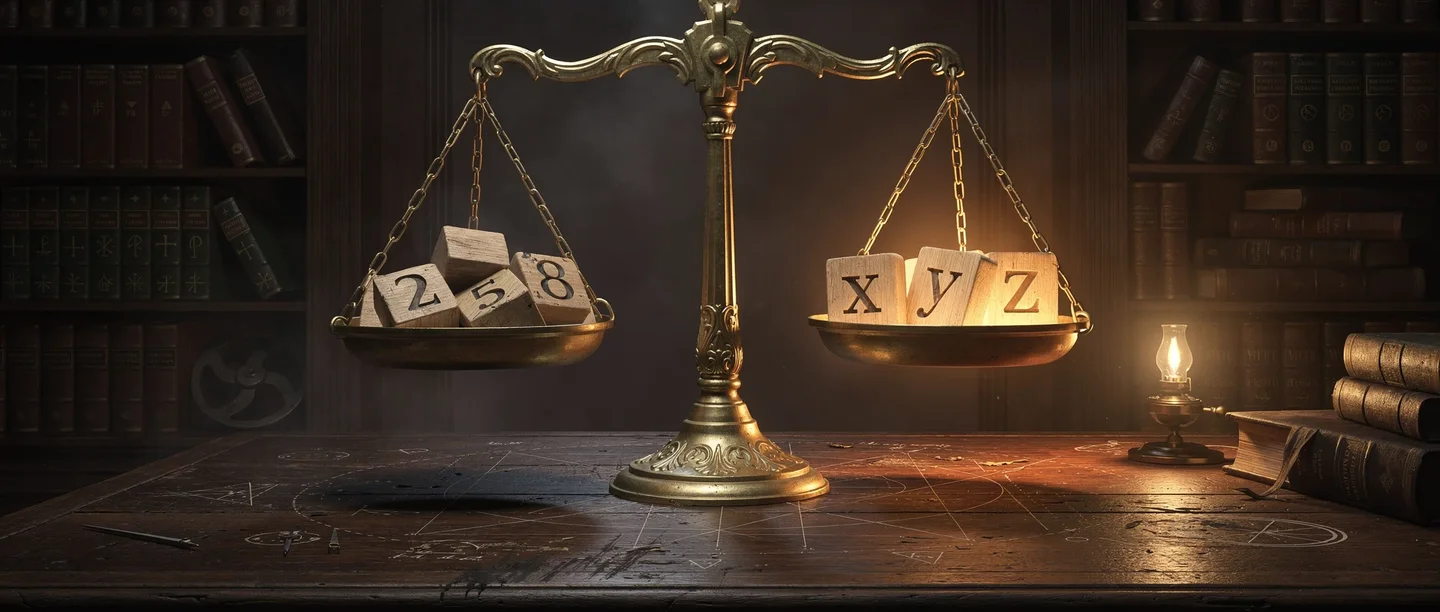
What is algebra — the foundations
Algebra is a branch of mathematics in which letters and symbols are used to represent numbers and quantities in formulae and equations. The name comes from a 9th-century Arabic text by al-Khwarizmi. The Latin form of al-jabr became "algebra".
The key building blocks of algebra are:
- Variable — a letter (commonly x, y, or n) that represents an unknown number or a quantity that can change. Variables allow us to write general rules that work for any number.
- Expression — a combination of numbers, variables, and operations, such as
3x + 5or2y − 7. An expression does not have an equals sign. - Equation — a statement that two expressions are equal, such as
3x + 5 = 11. Solving an equation means finding the value of the variable that makes the statement true. - Formula — an equation that describes a relationship between quantities, such as the area formula
A = l × w.
At its core, it is the language for expressing relationships and solving problems involving unknown quantities — and the foundation for almost all advanced mathematics.

How to solve algebraic equations — step by step
The central skill in algebra is solving equations — finding the value of the unknown variable. The golden rule is:
Whatever you do to one side of an equation, you must do the same to the other side.
This keeps the equation balanced, like keeping two sides of a set of scales equal.
Example: solving a linear equation
Solve 3x + 5 = 11:
- Subtract 5 from both sides:
3x = 6 - Divide both sides by 3:
x = 2
Check: 3(2) + 5 = 11 ✓
Types of equations students encounter
- Linear equations — the variable appears to the first power (no exponents):
2x + 3 = 7. These produce one solution. - Simultaneous equations — two equations with two unknowns:
x + y = 5andx − y = 1. Solved together to find both x and y. - Quadratic equations — the variable is squared:
x² + 3x − 4 = 0. These can have two solutions.
Algebra also involves simplifying expressions: expanding brackets (e.g., 3(x + 4) = 3x + 12), collecting like terms (e.g., 2x + 3x = 5x), and factorising (e.g., 6x + 9 = 3(2x + 3)).

Why algebra matters — real-life applications
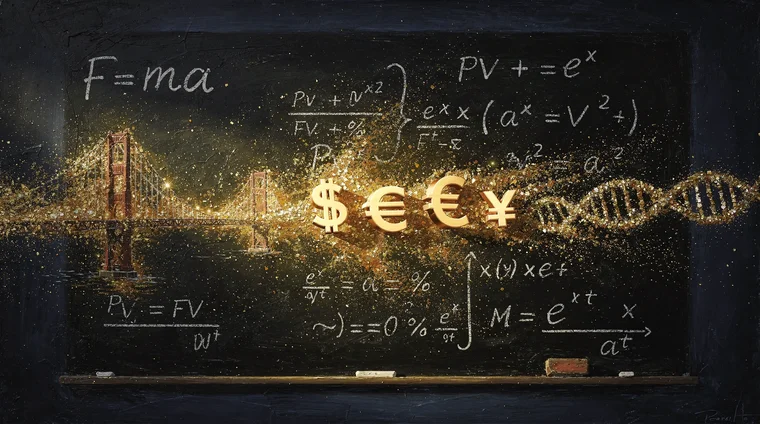
It is not just a school subject — algebra is the language used in every scientific, technical, and financial field.
Science and engineering
Every physics formula is algebra: F = ma (force equals mass times acceleration), v = d/t (velocity equals distance divided by time), E = mc². Engineers use it to design bridges, aeroplanes, and circuits. Scientists use it to model everything from planetary motion to the growth of bacteria.
Technology
Every algorithm in software, every query in a database, and every function in a spreadsheet is rooted in algebra. Programming is in many ways applied algebra: computers evaluate expressions and solve equations millions of times per second.
Everyday life
It helps with everyday problems: working out whether a discount is genuine, splitting bills fairly, converting currencies, and understanding loan interest.
For parents wondering how to support algebra at home: the most useful thing is to normalise the idea of using a letter to stand for an unknown. Phrases like "if x is the number of sweets, and we share them equally..." build the mental habit. The For parents guide has practical suggestions for making algebra less daunting.
Frequently asked questions
- Why do we use letters in algebra?
- Letters represent quantities we do not know yet, or quantities that can change. Using a letter (like x) lets us write a general rule that works for any value. Once we know the context, we can solve for x to find the specific number. This is far more powerful than working only with specific numbers.
- What is the difference between an expression and an equation in algebra?
- An expression is a mathematical phrase with no equals sign — it cannot be 'solved', only simplified or evaluated: e.g., 3x + 5. An equation contains an equals sign and makes a claim that two expressions are equal — it can be solved to find the value of the unknown: e.g., 3x + 5 = 11.
- At what age do students start algebra?
- Students are often introduced to algebraic thinking — a box representing an unknown — from around age 7–9. Formal algebra with variables and equations typically begins around age 11–13 (grades 6–8). Simultaneous equations and quadratics are usually introduced in grades 8–10.
- Is algebra harder than arithmetic?
- It feels harder because it introduces an extra level of abstraction — operating on unknown quantities rather than known numbers. But the rules of arithmetic still apply completely. Students who are comfortable with arithmetic operations find that algebra extends those same rules to more general situations. Lots of practice with worked examples is the most effective approach.