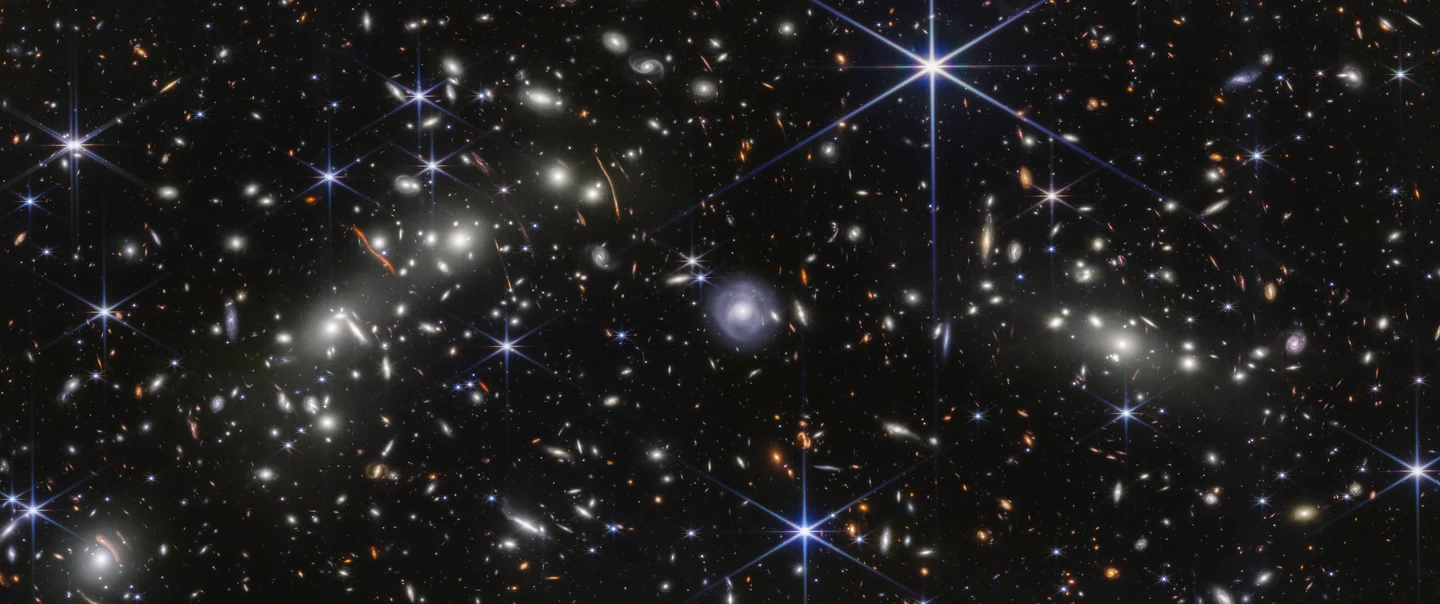
How astronomers discovered dark matter
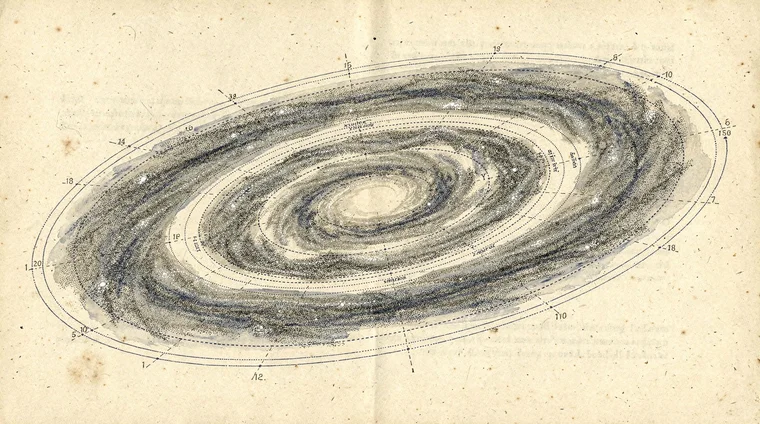
The clearest early evidence for dark matter came from astronomer Vera Rubin and physicist Kent Ford in the 1970s. They measured how fast stars orbit the centre of galaxies. According to Newtonian gravity, stars at the outer edges of a galaxy should orbit more slowly than stars near the centre — just as the outer planets in our solar system orbit more slowly than the inner ones.
What Rubin and Ford found was startling. Outer stars moved just as fast as inner stars. The only explanation was that invisible mass was present throughout the galaxy — not just at its bright centre. This pattern — called a flat galaxy rotation curve — appeared in galaxy after galaxy.
Rubin and Ford were not measuring errors. They were measuring something real. In 1980, Rubin and colleagues published their landmark findings in the Astrophysical Journal, showing flat rotation curves across 21 galaxies. The term that had circulated in theoretical astronomy for decades suddenly became unavoidable: dark matter.
Dark matter does not emit, absorb, or reflect light of any kind. It is invisible to every telescope ever built. But its gravitational pull is measurable, and it matches observations precisely where ordinary matter alone cannot.
The Bullet Cluster: dark matter caught in the act
The most compelling single piece of evidence for dark matter came in 2006 when astronomers studied the Bullet Cluster — two galaxy clusters that had collided and passed through each other.
In the collision, the hot gas slowed dramatically due to electromagnetic interactions and piled up in the middle. Hot gas makes up most of the ordinary matter in a cluster. Astronomers could see this gas glowing in X-rays. But when they mapped the total mass using gravitational lensing, the mass was not where the gas was. Gravitational lensing detects mass by how it bends light from objects behind it. Two invisible blobs of mass had kept moving, as if nothing had happened.
This is exactly what dark matter predicts. Dark matter does not interact with ordinary matter through electromagnetism, so it simply passed through the collision undisturbed. The visible gas and the dark matter separated cleanly, and astronomers observed the separation directly.
Physicist Douglas Clowe and colleagues published this result in the Astrophysical Journal Letters in 2006, describing it as "direct empirical proof of the existence of dark matter." It remains one of the most cited results in cosmology.
Gravitational lensing itself — the bending of light by mass — is a direct prediction of Einstein's general relativity and requires no assumptions about dark matter to use. When lensing maps consistently show more mass than visible matter can account for, the evidence is independent of any model. You can explore how relativity and gravity connect in our article on what is the Big Bang theory.
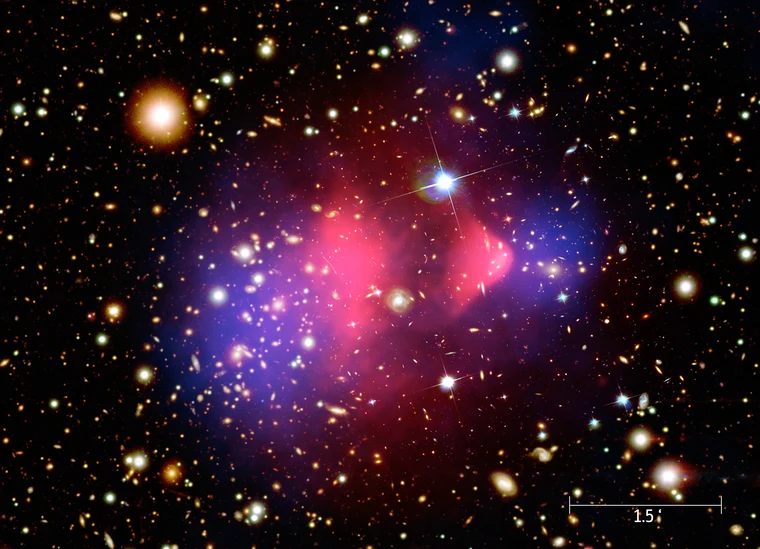
A composite image of the Bullet Cluster from NASA's Chandra X-Ray Observatory. Pink shows hot gas detected in X-rays, while blue shows the distribution of total mass mapped by gravitational lensing. The separation between gas and mass proved that dark matter exists independently of visible matter.. Image: NASA/CXC/M. Weiss — Chandra X-Ray Observatory, via Wikimedia Commons (Public domain)
Did you know?
-
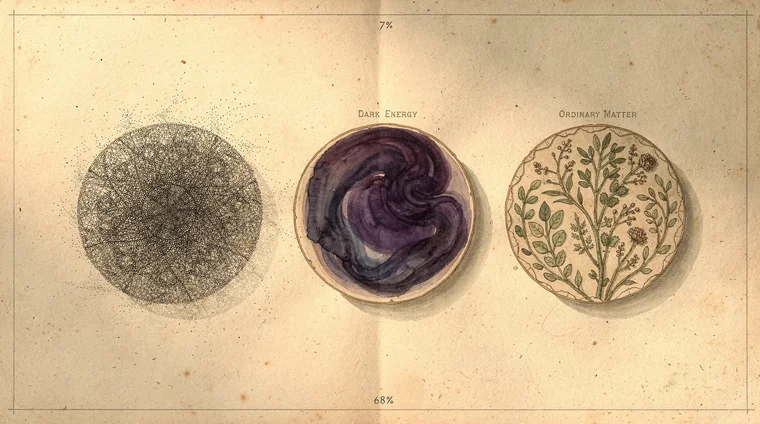
The universe is made of 4.9% ordinary matter, 26.8% dark matter, and 68.3% dark energy. These proportions are encoded in the tiny temperature differences of the cosmic microwave background and have been measured to high precision by the Planck satellite.
Planck Collaboration 2020. Planck 2018 results. Astronomy and Astrophysics 641:A6 -
Vera Rubin and Kent Ford's galaxy rotation measurements across 21 galaxies showed flat velocity curves that could only be explained by large amounts of unseen mass surrounding every galaxy studied.
Rubin et al. 1980. Rotational properties of 21 Sc galaxies. Astrophysical Journal 238:471 -
The Bullet Cluster collision provided direct empirical proof of dark matter by showing that the invisible mass of two colliding galaxy clusters passed straight through each other while the visible gas slowed and clumped in the middle.
Clowe et al. 2006. A direct empirical proof of the existence of dark matter. Astrophysical Journal Letters 648:L109
What dark matter might be made of
What is dark matter made of? That is the central unsolved question in physics. Scientists have ruled out many candidates — dead stars, black holes, and ordinary particles that simply do not emit light — but the true nature of dark matter remains unknown.
The leading candidates are:
WIMPs
Weakly Interacting Massive Particles (WIMPs) are hypothetical particles that interact with ordinary matter only through gravity and the weak nuclear force. They would pass through walls, planets, and people without leaving any trace — except a rare, tiny recoil in an extremely sensitive detector.
The XENON experiment sits deep underground in Italy's Gran Sasso National Laboratory. It uses several tonnes of liquid xenon to hunt for WIMPs. The underground location shields it from cosmic rays that would otherwise swamp any signal. Despite running for years at high sensitivity, the XENON collaboration has not yet detected a WIMP. Each null result narrows down what a WIMP can possibly be, published in Physical Review Letters in 2023.
Axions
Axions are another leading candidate — far lighter than WIMPs and originally proposed to solve a different problem in particle physics. Several experiments around the world are searching for axions using strong magnetic fields that could convert them into detectable photons.
No candidate has been confirmed yet. This is normal science: constraints accumulate, and each experiment either finds something or rules out part of the parameter space. The search for the identity of dark matter is one of the most active frontiers in modern physics.
The leading scientific review of dark matter candidates is published by the Particle Data Group, updated annually with the latest experimental results.
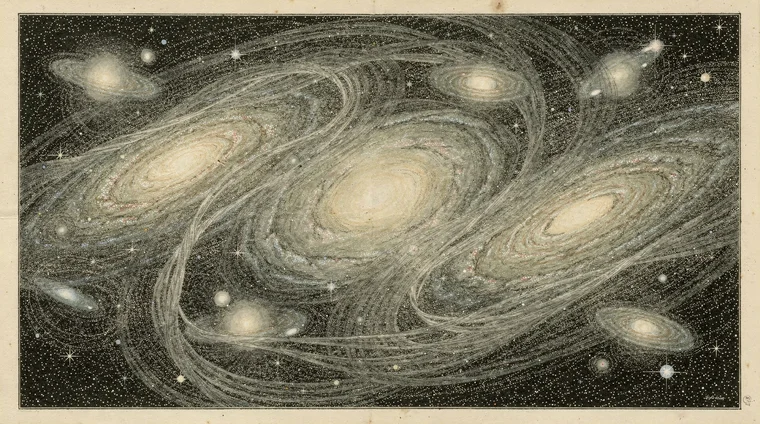
Dark energy, dark matter, and the universe recipe
Dark matter is just one mystery in the universe's composition. In 1998, two independent teams studying Type Ia supernovae made a shocking discovery. The expansion of the universe is not slowing down — it is accelerating. Something is pushing space apart faster and faster over time. That something is called dark energy.
Saul Perlmutter, Brian Schmidt, and Adam Riess led the two teams. They won the 2011 Nobel Prize in Physics for this discovery. Dark energy accounts for about 68.3 percent of the total energy content of the universe. Its nature is entirely unknown. It does not behave like matter — dark or otherwise. The leading description is a constant energy built into empty space itself.
The universe recipe looks like this. Everything we have ever seen, touched, or built is made of ordinary matter — protons, neutrons, and electrons. That accounts for only 4.9 percent of the universe. Dark matter makes up another 26.8 percent. The remaining 68.3 percent is dark energy.
The Planck satellite measured the cosmic microwave background temperature across the full sky. It published these proportions to high precision in 2020. For parents explaining this to children, a useful analogy is an iceberg. What we can see is only a tiny fraction of what is there.
Understanding dark matter and dark energy is not just an abstract puzzle. It bears on the universe's ultimate fate. Will it expand forever, slow to a halt, or be torn apart? Students can explore these questions through Epivo's how-the-universe-works curriculum, designed for curious learners of any age. For parents looking to support science learning at home, see our guide for parents.
Frequently asked questions
- What is dark matter in simple terms?
- Dark matter is an invisible form of matter that cannot be seen, touched, or detected by any telescope. We know it exists because its gravity pulls on visible stars and galaxies in ways that ordinary matter alone cannot explain. It makes up about 27 percent of the total content of the universe.
- Has dark matter ever been directly detected?
- Not yet. Experiments like XENON in Italy use tonnes of liquid xenon deep underground to hunt for dark matter particles, but no confirmed detection has been made. Each experiment narrows down what dark matter can be, even without finding it. The search is ongoing at laboratories worldwide.
- What is the difference between dark matter and dark energy?
- Dark matter is invisible mass that clumps around galaxies and galaxy clusters, holding them together with gravity. Dark energy is a different phenomenon — a force driving the accelerating expansion of the universe. They are unrelated. Dark matter makes up about 27 percent of the universe; dark energy makes up about 68 percent.
- Could dark matter be black holes?
- This was an early hypothesis, but observations have largely ruled it out as the main explanation. Gravitational lensing surveys have placed strict limits on how many black holes of various masses could exist. While some dark matter might be in the form of very small primordial black holes, this cannot account for all of it.
- Why can't we just modify gravity instead of inventing dark matter?
- Some physicists have proposed modified gravity theories that adjust Newton's laws at low accelerations. These theories can explain galaxy rotation curves but struggle with the Bullet Cluster, where dark matter and ordinary matter separated physically during a collision. No modified gravity theory has matched all the observational evidence as well as dark matter does.