How a black hole forms
A black hole forms when a star much larger than our Sun exhausts its fuel and gravity wins the battle it has been fighting for millions of years. For most of a star's life, nuclear fusion pushes outward with enough pressure to balance gravity's inward pull. However, once the core fills with iron — the endpoint of fusion — that outward pressure stops. Gravity wins instantly.
The core collapses in milliseconds, falling inward at a quarter the speed of light. It compresses until protons and electrons merge into neutrons. The collapse then bounces off this dense neutron core and blasts the outer layers away in a supernova explosion that briefly outshines billions of ordinary stars. If the remaining core exceeds about three times the Sun's mass, nothing can halt the collapse. The result is a black hole.
Smaller stars avoid this fate. Sun-like stars expand into red giants, shed their outer layers as a planetary nebula, and leave behind a cooling white dwarf. Only stars more than eight times the Sun's mass end their lives so violently. You can explore how stars live and die in more depth with Epivo's How the Universe Works curriculum.
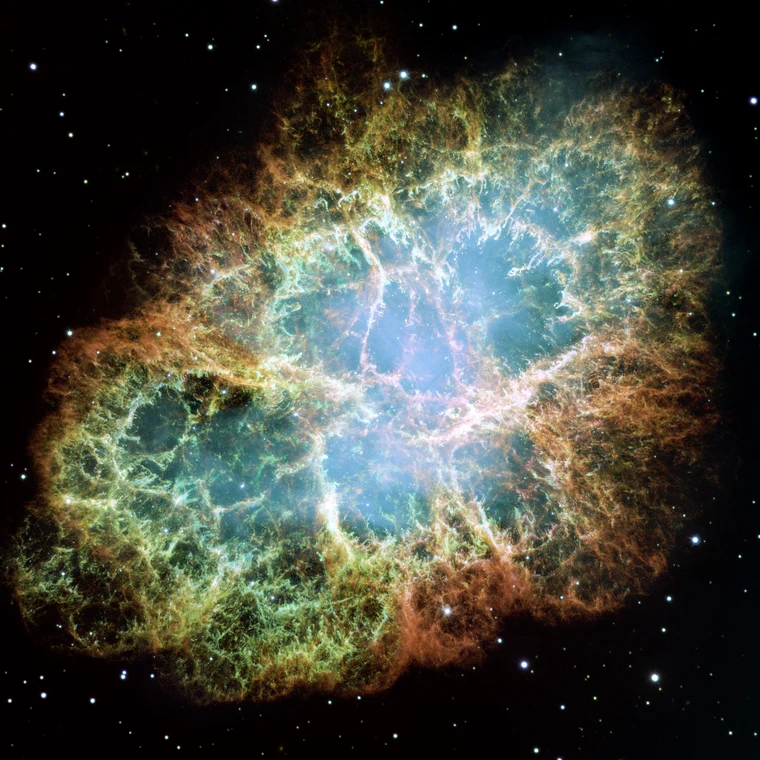
The Crab Nebula, the expanding remnant of a supernova explosion observed in 1054 AD. At its center lies a rapidly spinning neutron star that was left behind when the original star's core collapsed.. Image: NASA, ESA, J. Hester and A. Loll (Arizona State University), via Wikimedia Commons (Public domain)
The event horizon: a point of no return
The event horizon is not a physical wall or a visible surface. It is an invisible boundary in spacetime — the point at which escape velocity exceeds the speed of light. Cross it, and every possible path through space curves inward. Even light bends toward the center and never returns.
Think of it like the edge of a waterfall on a wide river. The water looks calm near the edge, but once you drift past it the current sweeps you over. An astronaut crossing the event horizon of a large black hole might notice nothing dramatic in the immediate moment. Space around them would look normal. However, every direction they could travel would now point inward, toward the singularity at the center.
The event horizon of a stellar-mass black hole is only about 30 kilometers across. For the supermassive black hole at the center of galaxy M87, it is larger than our entire solar system. According to NASA's astrophysics research, size varies enormously, but the rule is absolute: once inside, nothing comes back out.
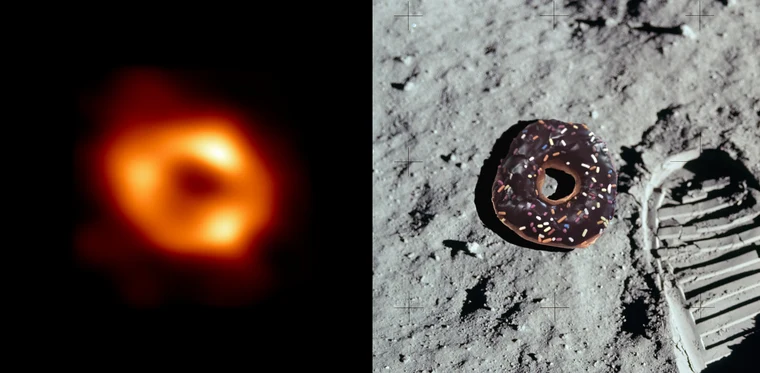
The first image of Sagittarius A*, the supermassive black hole at the center of the Milky Way galaxy. Captured by the Event Horizon Telescope in 2022, it confirmed the black hole's mass at about four million times that of the Sun.. Image: EHT Collaboration, via Wikimedia Commons (CC BY 4.0)
Supermassive black holes at the centers of galaxies
Not all black holes form from dying stars. The largest category — supermassive black holes — sit at the centers of nearly every large galaxy in the universe. Our own Milky Way hosts one called Sagittarius A*, which weighs about four million times the mass of our Sun. That figure sounds enormous, but it is modest by cosmic standards. The galaxy M87 harbors a black hole of 6.5 billion solar masses.
These giants are not passive tenants. As matter spirals toward them, it forms a superheated accretion disk that can outshine the entire surrounding galaxy. Some supermassive black holes launch jets of plasma at nearly the speed of light, stretching thousands of light-years into space. These jets heat surrounding gas and prevent new stars from forming nearby. Astronomers have found a consistent relationship between a black hole's mass and the properties of its host galaxy, suggesting that the two grew together over billions of years.
Furthermore, the Event Horizon Telescope Collaboration's 2022 research produced the first image of Sagittarius A*, confirming its mass and structure.
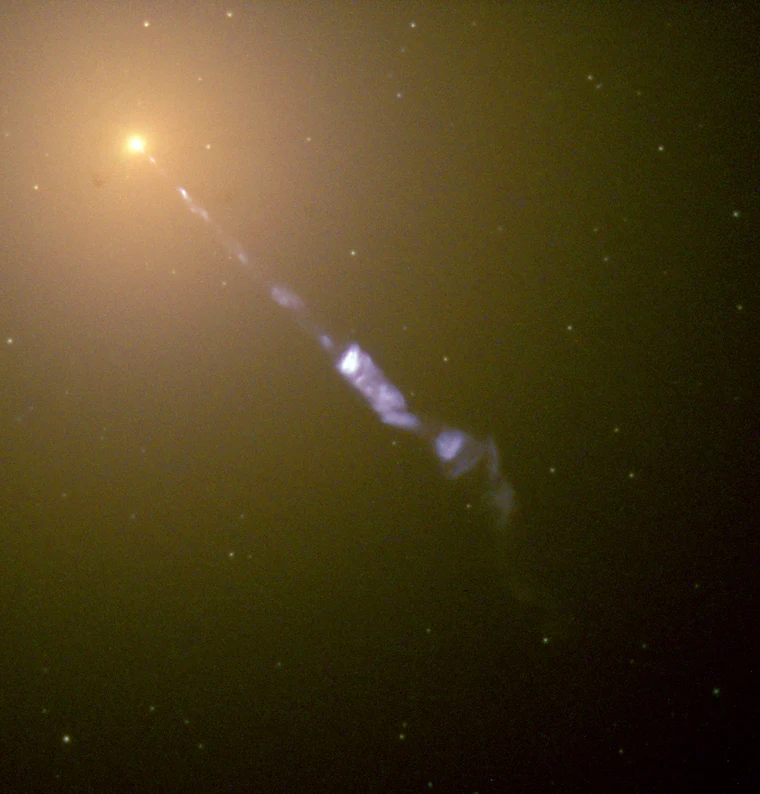
Galaxy M87 imaged across multiple wavelengths, showing the relativistic jet of plasma launched by its supermassive black hole. The jet extends roughly 5,000 light-years from the galaxy's center.. Image: NASA, ESA, Z. Levay (STScI); Radio: NRAO/AUI/NSF; X-ray: NASA/CXC/CfA; Optical: NASA, ESA, Hubble Heritage Team, via Wikimedia Commons (Public domain)
Did you know?
-
On 14 September 2015, LIGO detected gravitational waves from two black holes merging 1.3 billion light-years away — the first direct confirmation that black holes collide and that gravitational waves exist.
LIGO Scientific Collaboration & Virgo Collaboration, Physical Review Letters, 2016 -
The 2019 Event Horizon Telescope image of M87's black hole required eight radio telescopes linked across the globe into a virtual dish the size of Earth, collecting five petabytes of data over four nights.
Event Horizon Telescope Collaboration, The Astrophysical Journal Letters, 2019 -
LIGO can detect a length change of one ten-thousandth the width of a proton — equivalent to measuring the distance to the nearest star with an accuracy equal to the width of a human hair.
LIGO Laboratory, California Institute of Technology, 2024
How scientists photograph a black hole
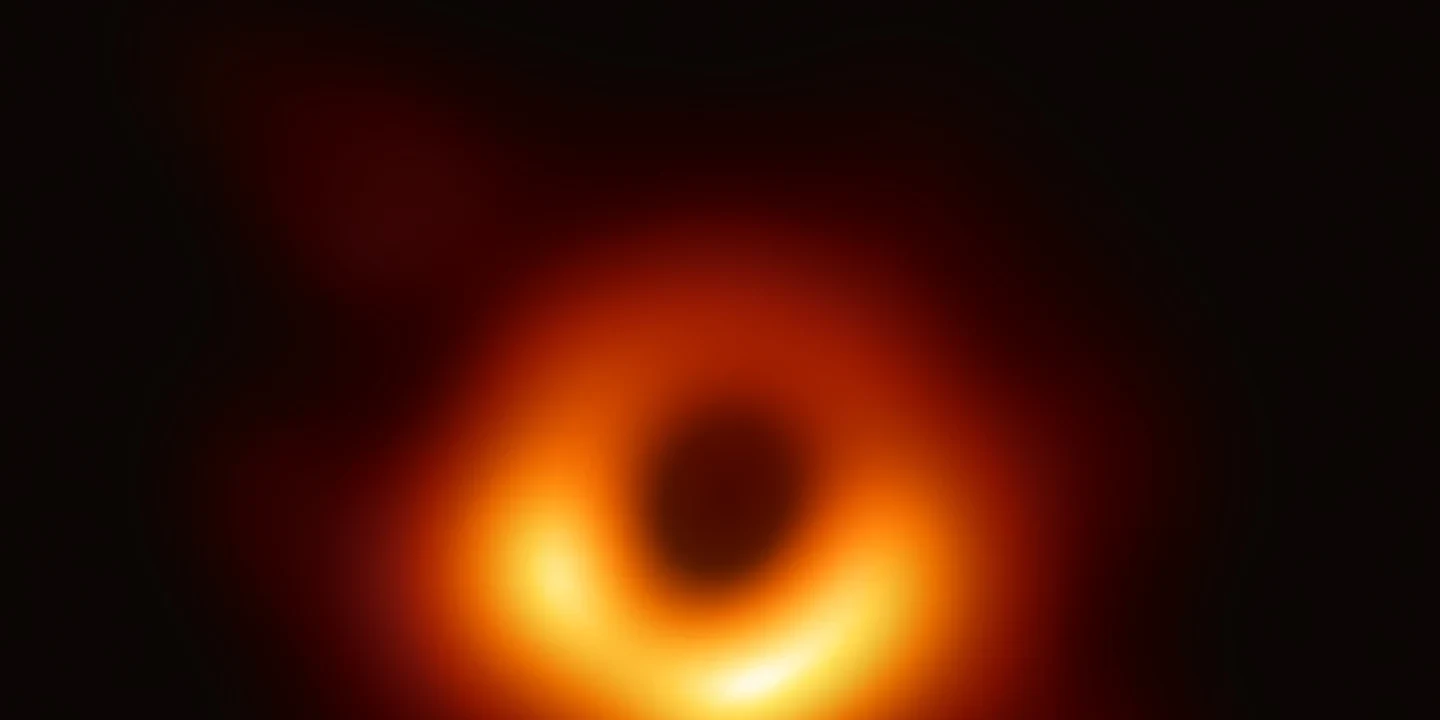
You cannot photograph a black hole directly, because it emits no light. However, you can photograph its shadow. In April 2019, the Event Horizon Telescope team released an image that the world had never seen before: a glowing orange ring of superheated gas surrounding a dark void at the center of galaxy M87, 55 million light-years away.
To capture it, astronomers linked eight radio telescopes on four continents into a coordinated network. The result was a virtual dish the size of Earth. They collected five petabytes of data over four nights in 2017, then spent two years processing it. The bright ring is gas orbiting at nearly the speed of light. The dark center is the black hole's shadow — the region where light falls in and never returns.
In 2022, the same collaboration released a second image, this time of Sagittarius A*, the black hole at the center of our own galaxy. Together, these two images transformed black holes from theoretical objects into observed reality. You can also learn more about the solar system as a starting point for understanding our place in the cosmos.
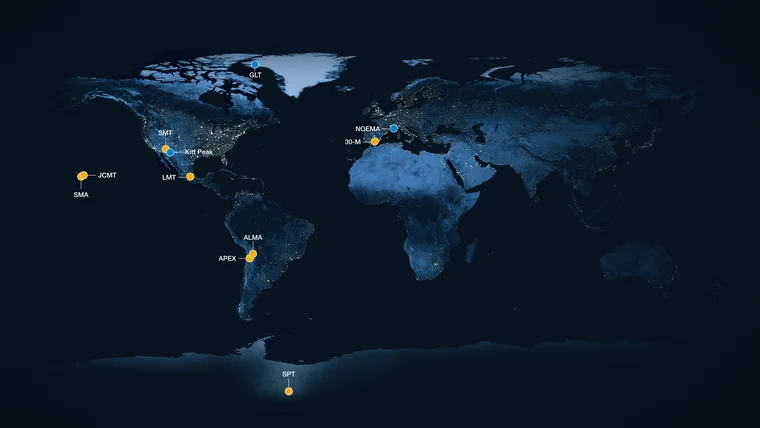
A diagram of the eight radio observatories that make up the Event Horizon Telescope network. Spanning four continents, these facilities combine to form a virtual telescope the size of Earth.. Image: ESO/M. Kornmesser et al., via Wikimedia Commons (CC BY 4.0)
Frequently asked questions
- What is a black hole in simple terms?
- A black hole is a region of space where gravity is so strong that nothing — not even light — can escape. It forms when a very massive star collapses at the end of its life. The boundary around it is called the event horizon. Cross that boundary and you can never return.
- Could a black hole swallow the Earth?
- Not unless a black hole came extremely close, which is not expected to happen. The nearest known stellar-mass black hole is thousands of light-years away. Black holes do not move through space vacuuming up matter. They only pull in objects that travel within their gravitational reach, just as the Sun does.
- What happens if you fall into a black hole?
- For a stellar-mass black hole, intense tidal forces would stretch you apart long before you reached the event horizon. For a supermassive black hole, you could cross the event horizon without noticing — but from that point, every path leads toward the singularity and nothing, including information, can escape.
- How do we know black holes exist if we cannot see them?
- Scientists detect black holes by their effects on nearby matter and light. Stars orbiting the Milky Way's center move as if circling an invisible massive object. Gravitational waves from merging black holes have been detected by LIGO since 2015. The Event Horizon Telescope photographed a black hole's shadow in 2019.
- What is the difference between a stellar black hole and a supermassive black hole?
- A stellar black hole forms from a collapsing massive star and typically has a mass between 5 and 100 times that of the Sun. A supermassive black hole sits at the center of a galaxy and can be millions or billions of times the Sun's mass. How supermassive black holes first formed is still an active area of research.