How Gravity Works
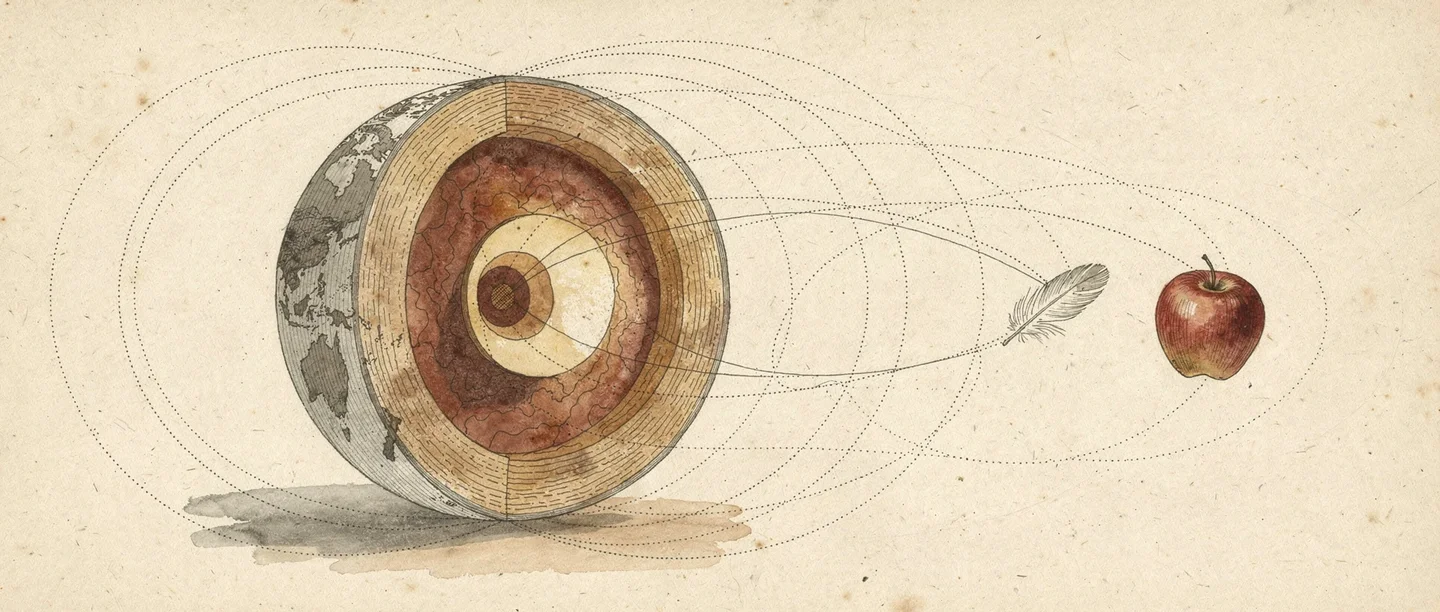
Isaac Newton described gravity mathematically in 1687. He showed that every object with mass attracts every other object. The strength depends on two things: the mass of each object and the distance between them.
Double the mass and the force doubles. Double the distance and it drops to one quarter. This is why the Sun — 330,000 times Earth's mass — holds all eight planets in their orbits. Earth's gravity keeps the Moon circling at an average distance of 384,000 kilometres.
What Einstein added
Albert Einstein showed that gravity is a curvature in spacetime. His 1915 theory of general relativity described massive objects as bending the space around them. Other objects follow those curves. This is why light bends near the Sun — an effect confirmed during the 1919 solar eclipse.
Gravity on Earth and in Space
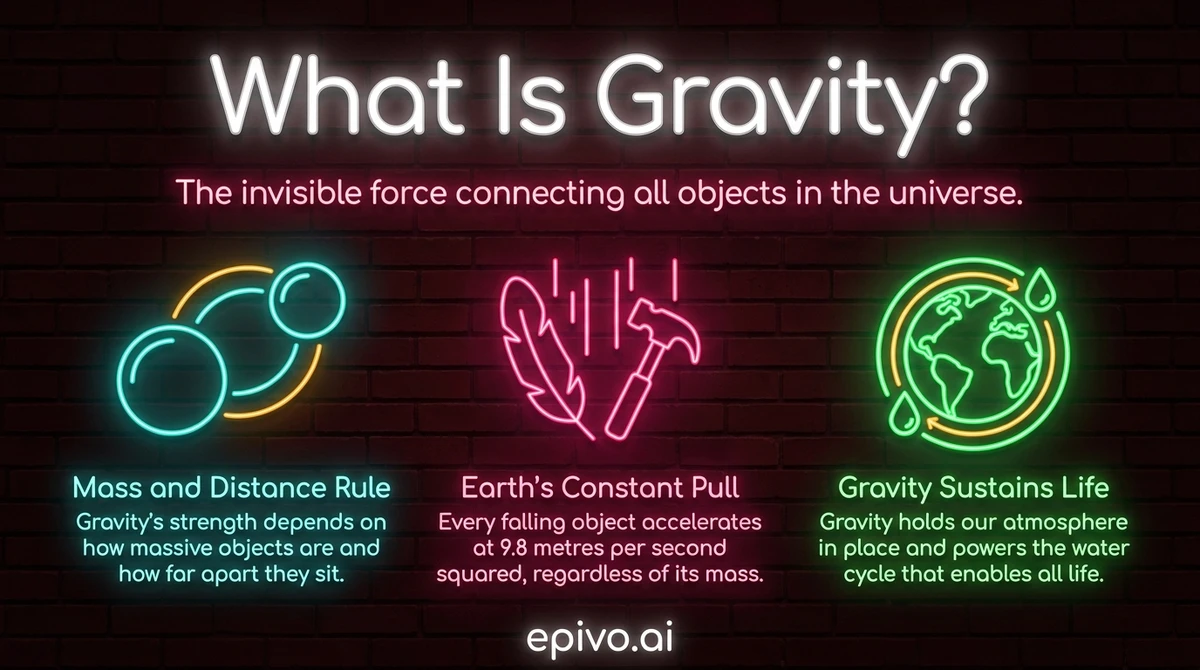
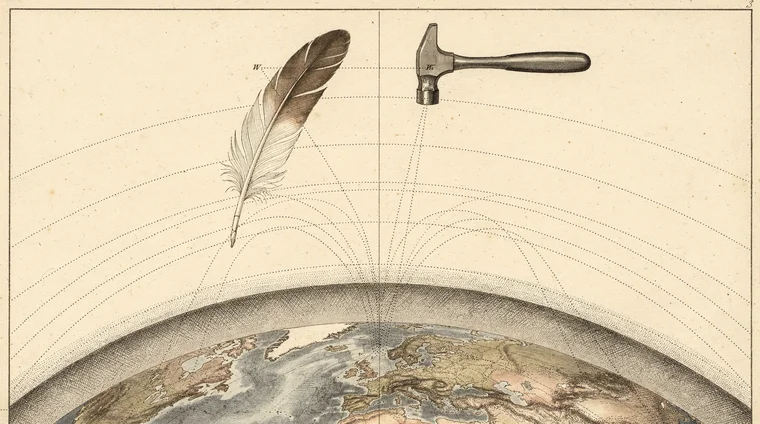
Earth's surface gravity accelerates falling objects at 9.8 metres per second squared. A falling object gains 9.8 m/s of speed every second. This acceleration is equal for all masses. A feather and a hammer dropped in a vacuum hit the ground at the same time.
Orbits and weightlessness
Astronauts on the International Space Station feel weightless — but they are not free of gravity. The station is in continuous freefall around Earth. It moves sideways fast enough to keep missing the surface. That is what an orbit is: a constant fall that curves around the planet.
Escape velocity
To leave Earth's gravity entirely, an object must reach 11.2 kilometres per second. This is called escape velocity. Below that speed, whatever goes up must eventually come down.
Gravity in Everyday Life
Gravity shapes the world constantly. It keeps the atmosphere pressed against Earth, allowing you to breathe. It pulls rain downward, powering rivers and the water cycle. It determines how tall buildings can stand.
Tides
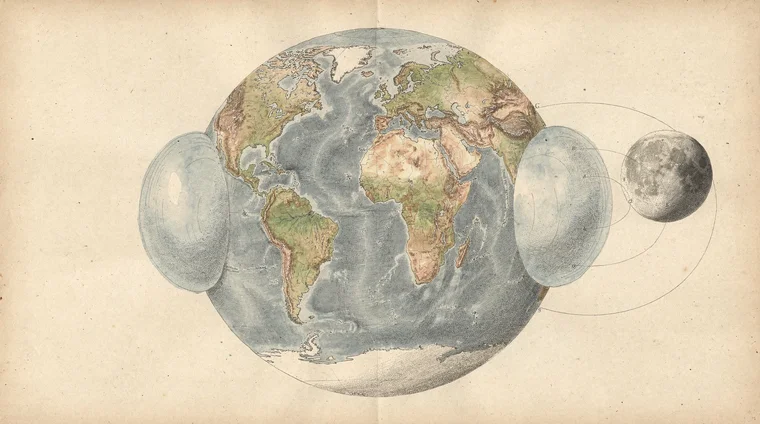
The Moon's gravity pulls on Earth's oceans. As the Moon orbits, it raises a bulge of water on the side facing it. This produces tides — the regular rise and fall of sea levels that sailors have relied on for centuries. The Sun also affects tides, though less strongly.
Gravitational slingshots
Space agencies use gravity as a free energy source. A spacecraft flying close to a planet steals some of its orbital energy. The probe gains speed without burning extra fuel. NASA's Voyager missions used this technique to reach the outer solar system.
Frequently asked questions
- Does gravity work in outer space?
- Yes. Space is full of gravity — it weakens with distance but never reaches zero. Astronauts on the International Space Station feel weightless because they are in constant freefall around Earth, not because gravity is absent. The Moon, the Sun, and distant stars all exert gravitational pulls across space.
- Why does the Moon not fall to Earth?
- It does fall — sideways fast enough to keep missing Earth's surface. That is what an orbit is: a continuous fall where forward speed and downward pull balance out. Isaac Newton described this with a thought experiment about a cannonball fired fast enough to curve around Earth.
- Is gravity the same everywhere on Earth?
- Nearly, but not exactly. Earth bulges at the equator, so gravity is marginally weaker there than at the poles. Altitude also matters — the higher you are, the farther from Earth's centre, and the slightly weaker the pull. The differences are tiny in daily life but matter for satellites and precision instruments.
- What is the difference between mass and weight?
- Mass is the amount of matter in an object — it never changes. Weight is the force gravity exerts on that mass. On the Moon, your mass stays the same, but your weight drops to about one-sixth, because the Moon's gravitational pull is much weaker than Earth's pull at its surface.