The Structure of DNA
DNA is a long, twisted molecule shaped like a double helix — two strands wound around each other, like a twisted ladder. The sides of the ladder are made of alternating sugar and phosphate molecules. The rungs are made of pairs of nitrogen bases.
There are four bases: adenine (A), thymine (T), cytosine (C), and guanine (G). They always pair in a fixed way: A pairs with T, and C pairs with G. This base-pairing rule is the key to how DNA copies itself.
Genes and the genome
A gene is a specific sequence of DNA bases that contains instructions for making a protein. Proteins do almost everything in the body — they form structures, carry oxygen, fight infection, and control chemical reactions. The human genome contains about 20,000–25,000 genes, spread across 3 billion base pairs in 23 pairs of chromosomes. The full human genome sequence was completed in 2003.
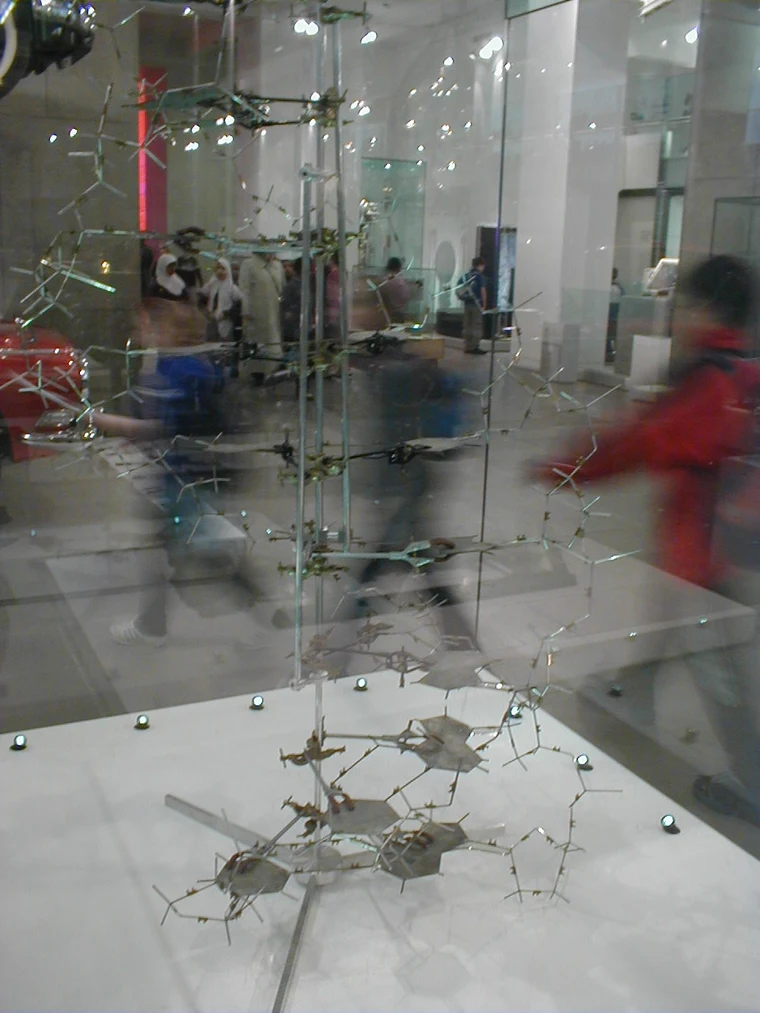
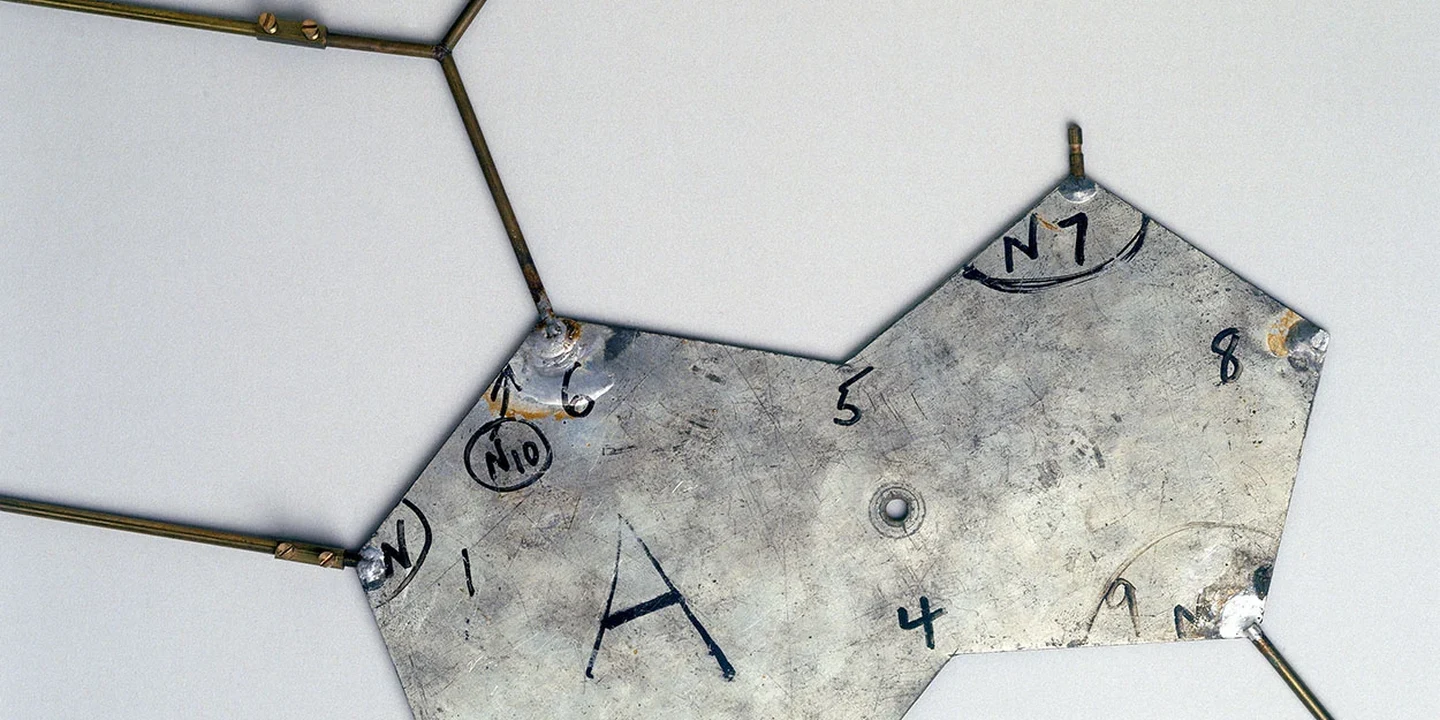
Template pieces from Watson and Crick's original 1953 DNA model, preserved at the Science Museum in London. These metal plates represent the four nucleotide bases that form the rungs of the double helix.. Image: Science Museum London / Science & Society Picture Library, via Wikimedia Commons (CC BY-SA 2.0)
How DNA Is Copied and Used
Every time a cell divides, it must copy its entire DNA first. The double helix unzips down the middle. Each strand serves as a template. New matching bases attach to each strand. Two identical double helixes are produced from one. This process is called DNA replication.
From DNA to protein
To make a protein, a section of DNA is first copied into a related molecule called messenger RNA (mRNA). The mRNA travels out of the nucleus to ribosomes in the cell. Ribosomes read the mRNA sequence and assemble a chain of amino acids — which folds into a protein. This two-step process is called transcription and translation.
Mutations
Occasionally errors occur during replication. These changes in the DNA sequence are called mutations. Most are harmless or repaired. Some mutations cause disease. Others drive evolution — giving organisms new traits that may help or hinder their survival.
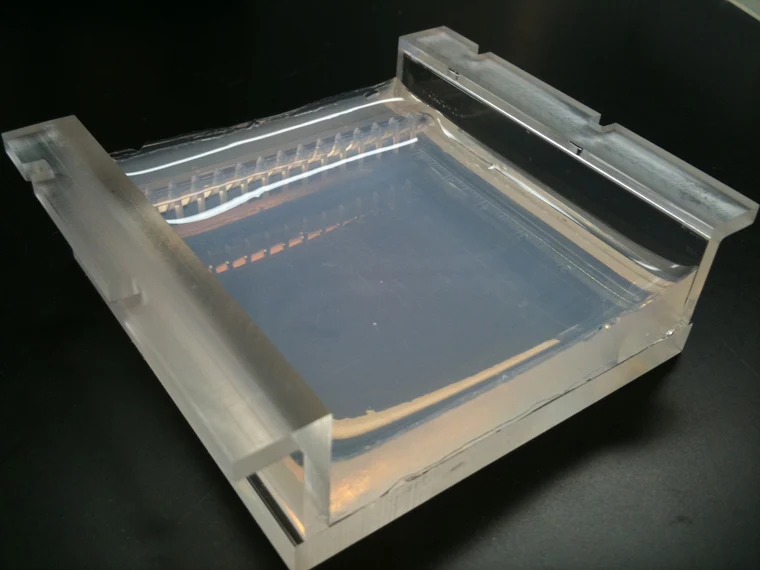
A DNA gel electrophoresis result showing banding patterns. This laboratory technique separates DNA fragments by size, allowing scientists to analyze genetic sequences and compare DNA samples.. Image: Mnolf, via Wikimedia Commons (CC BY-SA 3.0)
DNA in Science and Society
DNA research has transformed medicine and science. Scientists James Watson and Francis Crick described the double helix structure in 1953, building on X-ray images produced by Rosalind Franklin. The Nobel Prize was awarded to Watson, Crick, and Maurice Wilkins in 1962.
Forensic science
DNA fingerprinting — comparing DNA profiles from biological samples — has revolutionised criminal investigation. A tiny sample of blood, hair, or skin can identify a person with near certainty. The technique has exonerated wrongly convicted people and solved decades-old cold cases.
Genetic medicine
Genetic testing can reveal mutations linked to hereditary conditions like BRCA gene variants associated with breast cancer. Gene therapy — directly editing or replacing faulty DNA — is now used to treat some rare diseases. CRISPR technology allows precise editing of the DNA sequence with unprecedented accuracy.
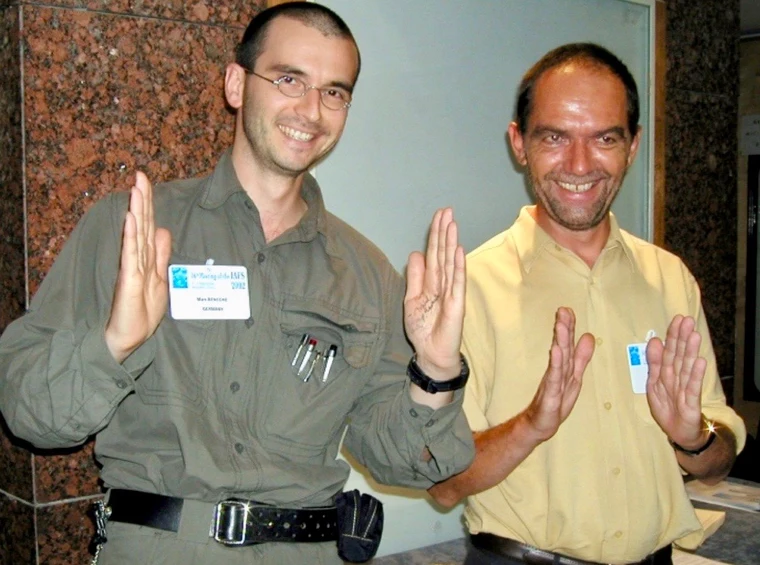
Sir Alec Jeffreys, who invented DNA fingerprinting in 1984, photographed with forensic biologist Mark Benecke. DNA fingerprinting revolutionized criminal investigation and paternity testing worldwide.. Image: Mark Benecke, via Wikimedia Commons (CC BY-SA 4.0)
Frequently asked questions
- How much DNA do humans share with other species?
- Humans share about 98.7% of their DNA with chimpanzees, our closest living relatives. We share roughly 85% with mice, 60% with fruit flies, and even about 50% with bananas. This reflects the common ancestry of all life on Earth — DNA has been copied and modified over billions of years of evolution.
- Is DNA the same in every cell of your body?
- Yes — almost every cell contains an identical copy of your full genome. Different cell types use different genes, which is why a liver cell behaves differently from a skin cell, even though both carry the same DNA. Red blood cells are an exception: they lose their nucleus, and with it their DNA, as they mature.
- What is a chromosome?
- A chromosome is a tightly coiled package of DNA. Humans have 46 chromosomes in 23 pairs — one set from each parent. Chromosomes are visible under a microscope during cell division. The sex chromosomes (XX or XY) determine biological sex. Each chromosome contains hundreds or thousands of genes.
- Can DNA change during a person's lifetime?
- The sequence you inherit stays mostly the same, but mutations accumulate slowly. Some are caused by copying errors, others by external factors like UV radiation or chemical exposure. These mutations can occasionally lead to cancer if they affect genes that control cell growth. Most are repaired or cause no problem.