How nuclear fusion works
What is nuclear fusion? Nuclear fusion is the joining of two atomic nuclei to form a heavier nucleus. It is the opposite of fission, which splits a heavy nucleus apart. Fusion releases far more energy per unit of fuel than any chemical reaction, and far more than nuclear fission as well.
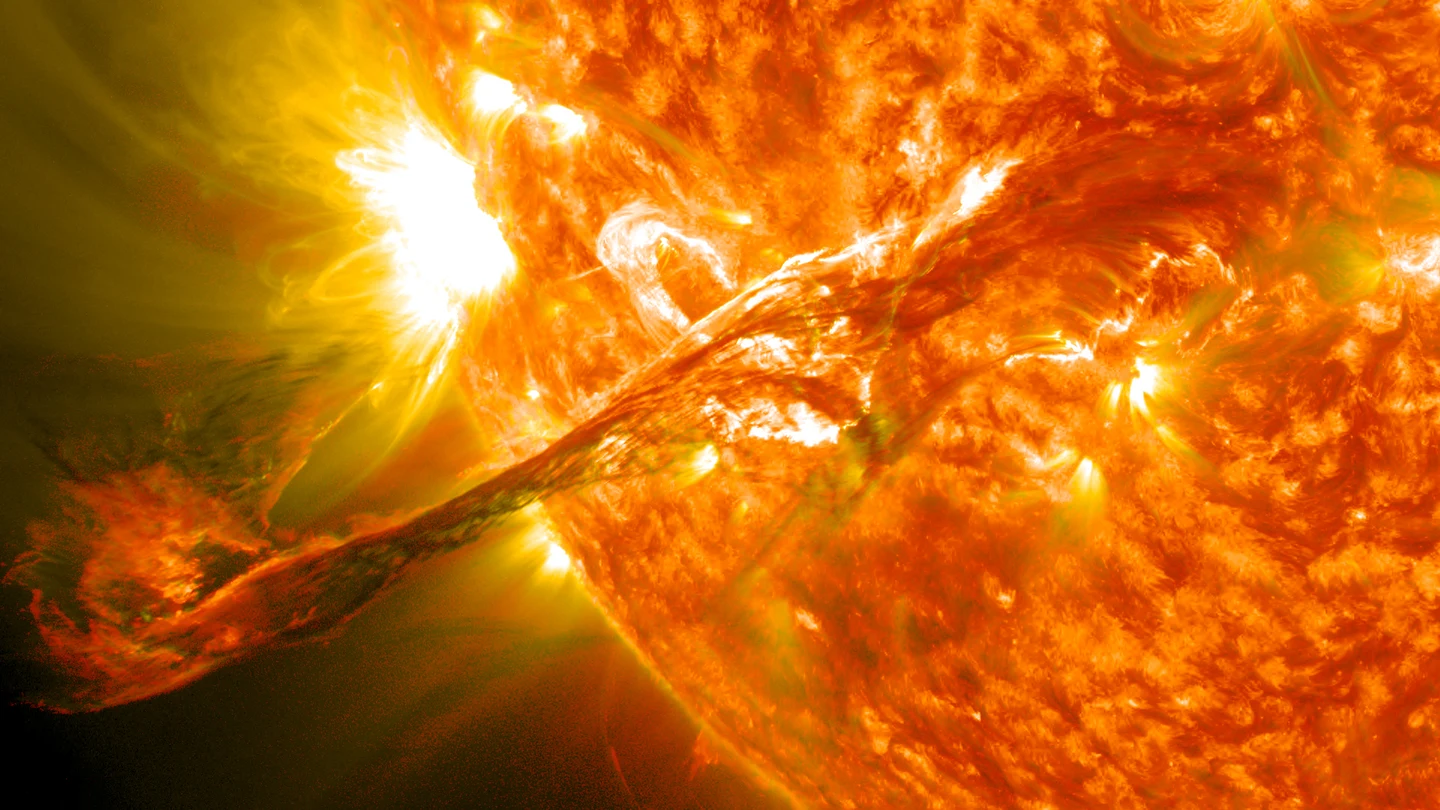
In the Sun's core, temperatures exceed 15 million degrees Celsius. At this extreme heat, hydrogen nuclei — which are single protons — move fast enough to overcome their mutual electrical repulsion and collide. Four hydrogen nuclei fuse together through a chain of steps to produce one helium nucleus. Here is the crucial detail: the helium nucleus weighs slightly less than the four hydrogen nuclei that formed it. That missing mass does not disappear. It converts directly into energy, according to Albert Einstein's famous equation E=mc². Because the speed of light (c) is enormous, even a tiny amount of mass produces a vast amount of energy.
The Sun converts approximately four million tonnes of matter into pure energy every single second. Despite this staggering rate, the Sun has enough hydrogen fuel to continue for another five billion years. That endurance comes from sheer scale: the Sun contains about 2 × 10³⁰ kilograms of matter.
Epivo's How the Universe Works curriculum covers nuclear fusion and stellar physics from first principles.
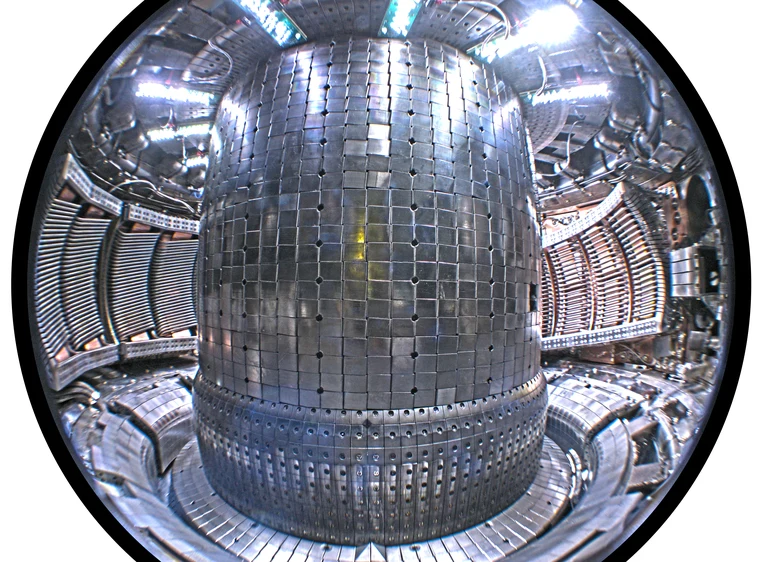
The interior of MIT's Alcator C-Mod tokamak, a magnetic confinement fusion device. The doughnut-shaped chamber uses powerful magnets to contain hydrogen plasma at tens of millions of degrees -- conditions needed to achieve nuclear fusion on Earth.. Image: Mike Garrett, via Wikimedia Commons (CC BY 3.0)
How stars stay alive — and how they die
A star is essentially a giant balancing act. Gravity pulls billions of tonnes of gas inward, trying to crush the star to a point. Nuclear fusion pushes outward with radiation pressure, resisting that collapse. This balance is called hydrostatic equilibrium. It gives a star its stable round shape and its long, steady life.
When the balance holds, the star shines steadily. Our Sun has maintained this balance for 4.6 billion years and will continue for roughly five billion more. Smaller stars, called red dwarfs, burn their fuel so slowly that they can remain stable for trillions of years. Massive stars, by contrast, burn far hotter and exhaust their fuel in millions of years rather than billions.
What happens when fusion stops
When a Sun-like star exhausts its hydrogen, the core contracts and heats up enough to fuse helium instead. The outer layers expand enormously, turning the star into a red giant. Eventually the outer layers drift away as a glowing cloud called a planetary nebula, leaving a dense, slowly cooling core called a white dwarf.
For stars more than eight times the Sun's mass, the end is far more violent. These stars fuse progressively heavier elements — helium, carbon, oxygen, neon, silicon — each round of fusion producing a denser, hotter core. The chain ends at iron. Iron does not release energy when fused; it absorbs energy instead. The moment the core fills with iron, fusion stops providing support. Gravity wins in milliseconds. The core collapses at one-quarter the speed of light and compresses to roughly 12 kilometres across. It then rebounds in a catastrophic supernova that briefly outshines an entire galaxy.
According to OpenStax Astronomy 2e, this collapse and explosion is how the universe seeds space with heavy elements forged by nuclear fusion deep inside dying stars.
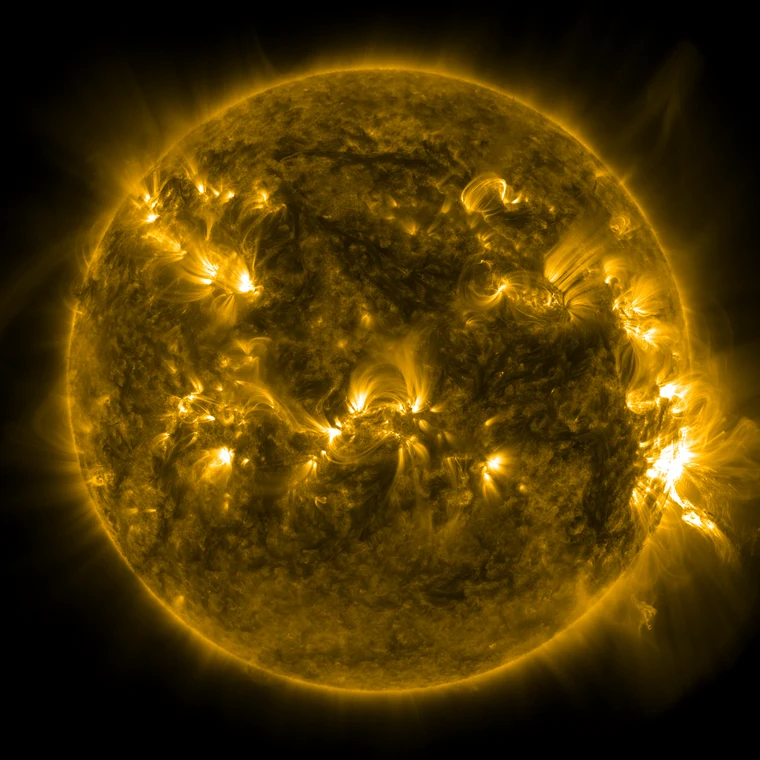
The Sun imaged in extreme ultraviolet light by NASA's Solar Dynamics Observatory, revealing the structure of the solar atmosphere. The Sun converts approximately four million tonnes of matter into energy every second through nuclear fusion.. Image: NASA/SDO (Atmospheric Imaging Assembly), via Wikimedia Commons (Public domain)
Where every element comes from — stellar nucleosynthesis
The Big Bang produced only three elements: hydrogen, helium, and traces of lithium. Every other element on the periodic table was forged later by nuclear fusion inside stars — a process called stellar nucleosynthesis.
Elements up to iron are built by fusion inside stars and scattered into space by stellar winds and supernova explosions. But some elements are too heavy to form this way. Gold, platinum, and uranium require conditions even more extreme than a supernova core. They form when two neutron stars collide — an event called a kilonova.
In August 2017, the LIGO and Virgo gravitational-wave detectors picked up a signal from two neutron stars spiralling together and merging 130 million light-years away. Telescopes worldwide then observed the kilonova that followed. As LIGO reported, the event produced quantities of gold and platinum equivalent to several times the mass of the Earth. That observation confirmed a decades-old prediction. The gold in a wedding ring was made in a neutron star collision billions of years before the Sun was born.
This is what nuclear fusion ultimately means for everyday life. The carbon in your body was fused in a red giant. The oxygen you breathe was scattered by a supernova. The iron in your blood was formed in the core of a massive star. We are, quite literally, made of stardust — the products of nuclear fusion across cosmic time.
Parents connecting science to curiosity can find support at our guide for parents.
Did you know?
-
The Sun converts approximately four million tonnes of matter into energy every second via nuclear fusion, and has done so for 4.6 billion years. It still has enough hydrogen fuel to burn for another five billion years.
NASA Science. The Sun -
Fusion requires temperatures above 10 million degrees Celsius. At this heat, hydrogen nuclei move fast enough to overcome their electrical repulsion and fuse into helium. The slight mass difference converts to energy via E=mc².
OpenStax Astronomy 2e. Chapter 16.1: The Sun, a Garden-Variety Star -
In 2017, LIGO detected gravitational waves from two neutron stars merging — an event called a kilonova. Follow-up observations confirmed the collision produced Earth-masses of gold and platinum, confirming where heavy elements form.
LIGO Scientific Collaboration. GW170817 Press Release. California Institute of Technology
Fusion energy on Earth — building an artificial star
If nuclear fusion powers the Sun so efficiently, can humanity replicate it here on Earth? That question has driven research since the 1950s. The challenge is enormous. Igniting fusion requires confining hydrogen plasma at 100 million degrees — hotter than the Sun's core — long enough for nuclei to collide and fuse.
Two main approaches are being pursued. Magnetic confinement uses powerful magnets to contain the hot plasma in a doughnut-shaped chamber called a tokamak. The international ITER project in France is a collaboration of 35 nations. It is the world's largest tokamak, designed to produce ten times more energy than it consumes. Inertial confinement fires powerful lasers at a tiny hydrogen fuel pellet from all directions. The rapid compression and heating ignites fusion for a fraction of a second.
In December 2022, the National Ignition Facility in California announced a historic milestone. Its laser experiment produced more fusion energy than the laser energy delivered to the target — called ignition. It was the first time in history that a fusion experiment generated net energy from the fuel itself.
Fusion fuel is abundant and clean. The primary fuels — deuterium and tritium — can be derived from seawater and lithium. Fusion produces no carbon dioxide and no long-lived radioactive waste. The quest for practical fusion energy has been called humanity's attempt to build a star on Earth. Continue the story with Epivo's How the Universe Works curriculum, alongside what is the solar system and what is a black hole.
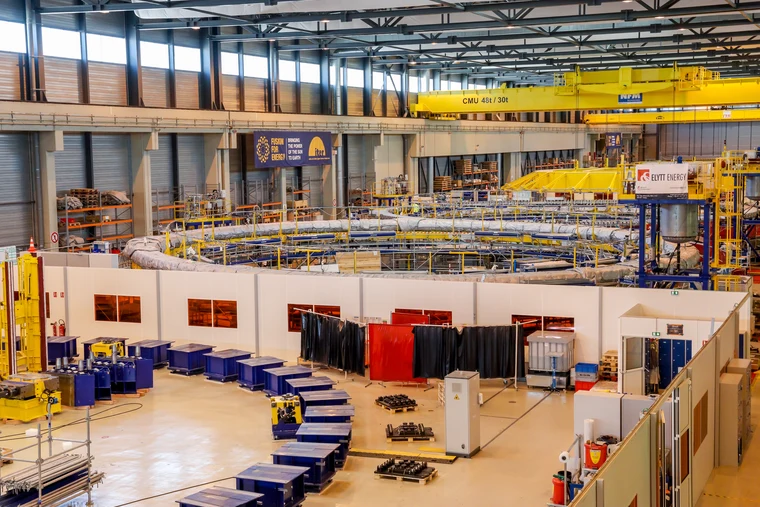
The ITER experimental fusion reactor under construction in Cadarache, France. A collaboration of 35 nations, ITER is designed to be the first fusion device to produce ten times more energy than it consumes.. Image: ITER Organization, via Wikimedia Commons (CC BY 2.0)
Frequently asked questions
- What is nuclear fusion in simple terms?
- Nuclear fusion is the process of joining two light atomic nuclei — typically hydrogen — to form a heavier nucleus. The new nucleus weighs slightly less than the original parts. That missing mass converts directly to energy, according to Einstein's equation E=mc². This is the process that powers the Sun and every other star.
- What is the difference between nuclear fusion and nuclear fission?
- Fission splits a heavy nucleus — such as uranium — into two smaller pieces, releasing energy. Fusion joins two light nuclei together to form a heavier one, also releasing energy. Stars run on fusion. Current nuclear power plants run on fission. Fusion releases more energy per unit of fuel and produces far less radioactive waste.
- Why is nuclear fusion so difficult to achieve on Earth?
- Fusion requires temperatures of 100 million degrees or more to force hydrogen nuclei close enough to fuse. At those temperatures, the fuel becomes a plasma that cannot touch any physical container. Containing it requires either powerful magnetic fields or extremely fast laser compression. Sustaining that containment long enough to extract useful energy is the central engineering challenge.
- Has nuclear fusion been achieved?
- Yes — briefly and in controlled settings. Hydrogen bombs use uncontrolled fusion. In December 2022, the US National Ignition Facility produced more fusion energy from its fuel target than the laser energy delivered to it — the first demonstration of fusion ignition in a laboratory. Large-scale commercial fusion power has not yet been achieved but is being actively pursued.
- Where did gold come from if stars can only fuse elements up to iron?
- Gold, platinum, and other heavy elements form in neutron star collisions called kilonovae. When two neutron stars merge, the extreme conditions allow rapid neutron capture — nuclei absorb neutrons faster than they can decay, building up very heavy elements. In 2017, LIGO detected exactly such a collision and confirmed it produced massive quantities of gold and platinum.