Early Earth: the ingredients for life
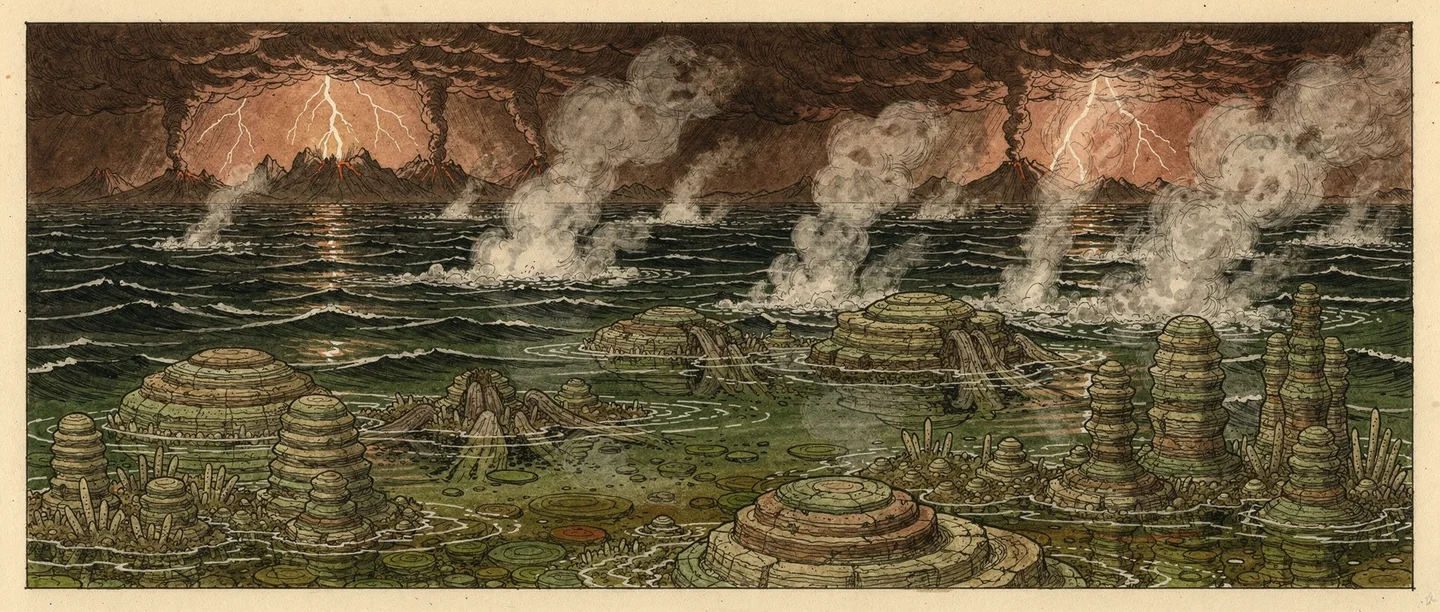
When Earth formed 4.5 billion years ago, its surface was molten rock. As it cooled, oceans formed — but they looked nothing like today's. They were acidic, rich in dissolved iron, and tinged green. The atmosphere contained no oxygen — just carbon dioxide, nitrogen, water vapour, and methane. The young Sun was fainter than today, but a thick blanket of greenhouse gases kept the planet warm.
In 1953, chemist Stanley Miller at the University of Chicago set up a now-famous experiment. He sealed those gases in a flask and sparked them with electricity to simulate lightning. After just one week, amino acids had formed spontaneously — the same building blocks found in every protein in every living cell.
The absence of oxygen was crucial. Oxygen is highly reactive — it would have destroyed the fragile organic molecules forming in those early oceans. Life's chemistry needed to start before the Great Oxidation Event. That shift only occurred around 2 billion years ago, when photosynthesising microbes began flooding the atmosphere with oxygen.
The Miller experiment showed that chemistry alone — no special force — can produce life's raw materials under natural conditions.
The RNA world: a molecule that does two jobs
Once you have amino acids and simple organic molecules, the next puzzle is how they became self-replicating. Life as we know it faces a paradox. You need proteins to copy DNA, but you need DNA to make proteins. Which came first?
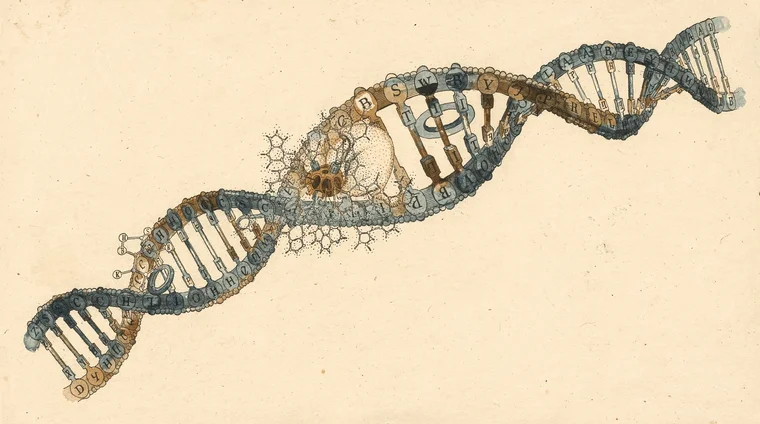
The answer may be neither. In the 1980s, biochemist Thomas Cech discovered that RNA can both store genetic information AND catalyse chemical reactions. RNA is a molecule closely related to DNA. These RNA enzymes are called ribozymes. His discovery won the Nobel Prize and opened the door to the RNA world hypothesis. Early life may have run entirely on RNA, before DNA and proteins took over.
Walter Gilbert coined the phrase in 1986, and evidence has built steadily since. The ribosome is itself a ribozyme at its core — a molecular fossil from the RNA world. It is the molecular machine inside every cell that makes proteins.
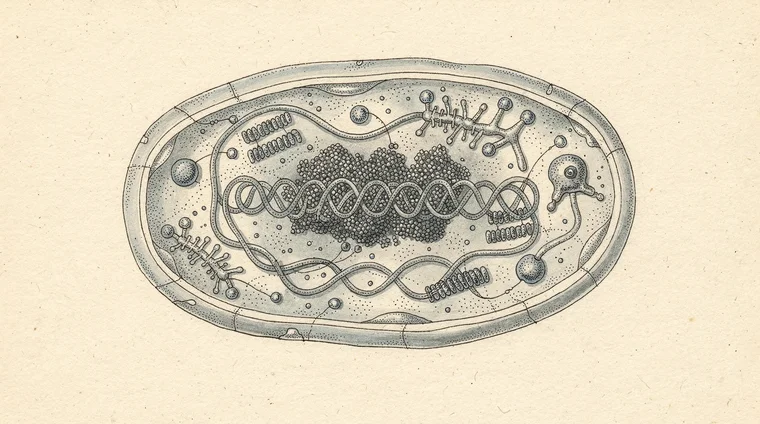
The next step was getting RNA molecules inside a boundary — something like a cell membrane. Chemist Jack Szostak showed that fatty acids, which form naturally in water, spontaneously assemble into hollow vesicles. These protocells can grow, divide, and concentrate RNA inside them. The basic machinery of a cell can arise from chemistry alone, with no living organism required to build it.
Did you know?
-
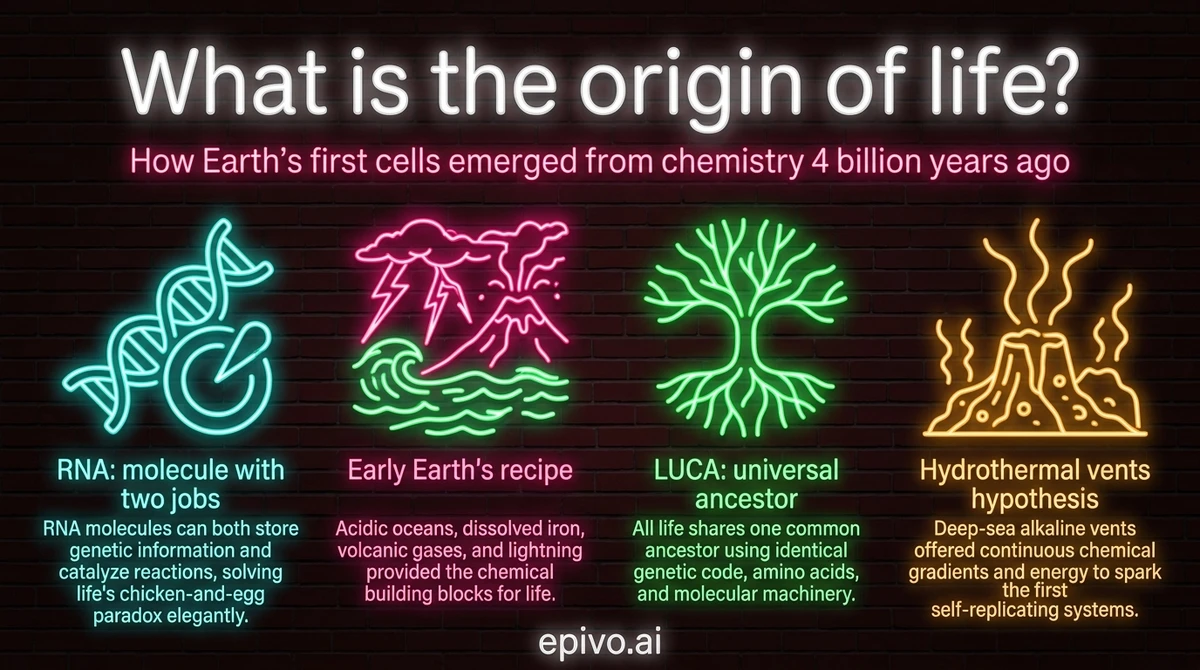
In 1953, Stanley Miller sparked a mixture of gases mimicking early Earth's atmosphere. Within one week, amino acids — the building blocks of all proteins — had formed spontaneously, without any living organism involved.
Miller SL. A Production of Amino Acids Under Possible Primitive Earth Conditions. Science, 117(3046):528, 1953 -
A 2016 analysis of 355 gene families shared by all bacteria and archaea suggests our Last Universal Common Ancestor (LUCA) lived about 4 billion years ago, used hydrogen for energy, and likely lived near hydrothermal vents.
Weiss MC et al. The physiology and habitat of the last universal common ancestor. Nature Microbiology, 1:16116, 2016 -
RNA molecules called ribozymes can catalyse chemical reactions — solving the chicken-and-egg paradox of DNA and proteins. This discovery by Thomas Cech led to the RNA world hypothesis and won the Nobel Prize in Chemistry in 1989.
Gilbert W. Origin of life: The RNA world. Nature, 319:618, 1986
LUCA: the ancestor we all share
Every form of life on Earth — bacteria, fungi, plants, animals — uses the same genetic code. The same 20 amino acids. The same DNA reading direction. The same basic molecular machinery for making proteins. This is not a coincidence. It is powerful evidence that all life on Earth descends from a single common ancestor.
Scientists call this ancestor LUCA — the Last Universal Common Ancestor. LUCA was not the first life, but it was the bottleneck through which all modern life descends. A landmark 2016 study analysed 355 gene families shared by bacteria and archaea — the two deepest branches of the tree of life. They concluded that LUCA lived about 4 billion years ago, used hydrogen for energy, and thrived at high temperatures.
That description matches deep-sea alkaline hydrothermal vents, where hydrogen-rich water seeps through mineral rock. These vents create natural proton gradients across thin mineral walls. Modern cells generate energy the same way across their membranes. Nick Lane argues that life may have begun in the porous rock compartments of these vents — acting as primitive cells before true membranes evolved.
Learn more about how cells work today in our article on what is DNA.
Where did life begin? The honest answer
Scientists have proposed several plausible settings for the origin of life — and no single answer has been proven yet.
Deep-sea alkaline hydrothermal vents offer continuous chemical gradients and warm, mineral-rich conditions. The porous rock compartments could have served as primitive cell walls long before fatty acid membranes evolved.
Darwin's warm little pond — a concept Charles Darwin himself floated in an 1871 letter — refers to shallow pools on land where wet-dry cycles might concentrate organic molecules and drive chemical reactions. Astrobiologists Damer and Deamer modelled how wet-dry cycling in volcanic hot springs could have assembled RNA and protocells.
Panspermia adds a cosmic dimension: meteorites have been found to carry amino acids and other organic compounds formed in space. Some scientists propose that life's building blocks — or even microbial life itself — were delivered to early Earth from elsewhere. However, this shifts the question rather than answering it.
Multiple settings may have contributed at different stages. The building blocks may have formed in space, concentrated in tidal pools, replicated in hot springs, and evolved into cells near hydrothermal vents. The origin of life is not a single event — it was a long chemical journey.
Parents helping curious students go deeper can visit our page for parents to learn how Epivo's AI tutor covers big-picture science questions.
See also: What is evolution? — the story of how life diversified once it began.
Frequently asked questions
- Has science solved the origin of life?
- Not fully. Scientists understand many of the pieces — how amino acids form spontaneously, how RNA can self-replicate, how protocells can assemble from fatty acids — but the exact sequence of events that led to the first living cell remains unknown. Multiple plausible pathways exist and are being actively investigated.
- What is the RNA world hypothesis?
- The RNA world hypothesis proposes that early life was based on RNA rather than DNA and proteins. RNA is unique because it can both carry genetic information (like DNA) and catalyse chemical reactions (like proteins). This solves the chicken-and-egg problem of which came first. Evidence includes the fact that the ribosome — found in every living cell — is itself an RNA enzyme at its core.
- What is LUCA?
- LUCA stands for Last Universal Common Ancestor — the single organism from which all life on Earth ultimately descends. LUCA was not the first life, but it is the common root of every branch of the tree of life. Evidence for LUCA includes the fact that all living organisms share the same genetic code, the same 20 amino acids, and the same basic molecular machinery.
- Could life have come from space?
- Meteorites do contain amino acids and other organic molecules formed in space, so Earth was certainly seeded with some of life's chemical building blocks from the cosmos. The idea that living organisms or their immediate precursors travelled from another world (panspermia) is possible but unproven. Most researchers focus on life arising on Earth because the conditions were clearly suitable.
- Why did life need no oxygen to begin?
- Oxygen is a highly reactive molecule that would have broken apart the fragile organic molecules needed for life's chemistry to get started. Early Earth had essentially no free oxygen in its atmosphere — a condition that lasted until photosynthesising microbes began releasing oxygen about 2 billion years ago. That period of low oxygen gave chemistry time to produce the first cells.
- What is the connection between the origin of life and evolution?
- The origin of life covers how the first self-replicating, cell-like entities arose from chemistry. Evolution begins once those entities existed and started to reproduce with variation — small copying errors that could be selected for or against. The two fields are closely related: once you have a self-replicating molecule, natural selection begins automatically. See our article on what is evolution for the full story.