How the Periodic Table Is Organised
Each element in the periodic table has a unique atomic number — the number of protons in its nucleus. Hydrogen has 1. Helium has 2. Carbon has 6. The elements are arranged in order of increasing atomic number, reading left to right and top to bottom.
The table is divided into rows called periods and columns called groups. Elements in the same group share similar chemical properties, because they have the same number of electrons in their outermost shell.
Metals, non-metals, and metalloids
The periodic table divides into broad regions. Metals — which are shiny, conduct electricity, and can be bent — occupy the left and centre. Non-metals — which tend to be gases or brittle solids — cluster on the right. A zigzag line separates them, and metalloids (like silicon and arsenic) sit along it, sharing properties of both.
The noble gases
Group 18, on the far right, contains the noble gases — helium, neon, argon, krypton, xenon, and radon. They are almost completely unreactive because their outermost electron shells are full. This makes them useful in light bulbs and lasers, where chemical inertness matters.
The History of the Periodic Table
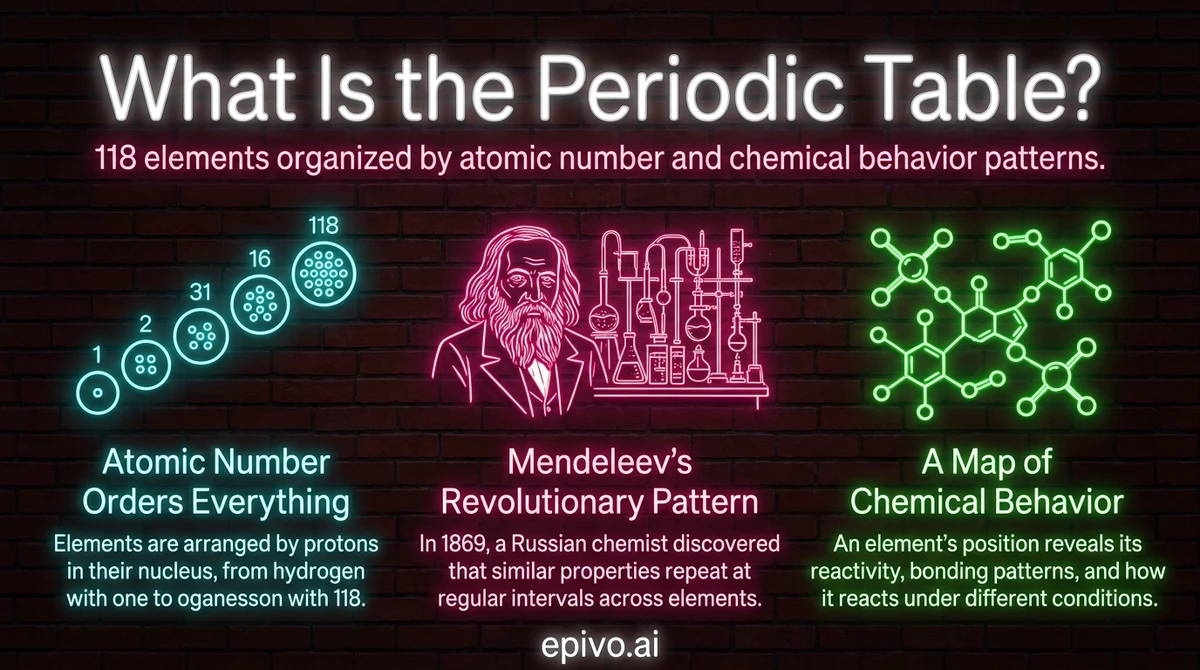
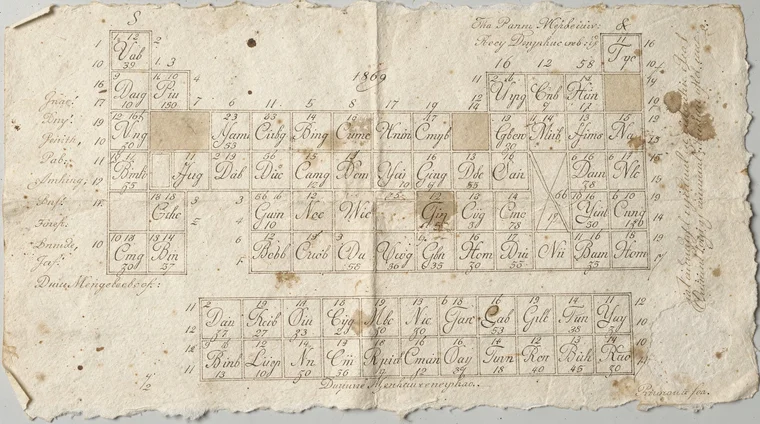
Russian chemist Dmitri Mendeleev published the first widely recognised periodic table in 1869. He arranged the 63 elements then known by atomic mass and noticed that similar properties recurred at regular intervals — a pattern he called periodicity.
Mendeleev's key insight was to leave gaps for elements not yet discovered. He predicted their properties precisely. When gallium (1875), scandium (1879), and germanium (1886) were discovered, they matched his predictions almost exactly. This validated the periodic table as a genuine pattern of nature, not just a classification tool.
The modern periodic table
The modern version, based on atomic number rather than mass, was established by Henry Moseley in 1913. It resolved inconsistencies in Mendeleev's arrangement. Today, the periodic table has 118 confirmed elements. The most recently named — nihonium, moscovium, tennessine, and oganesson — were confirmed in 2016. Scientists continue to synthesise new elements in particle accelerators, though these ultra-heavy elements exist for only fractions of a second.
Why the Periodic Table Matters
The periodic table is not just a list — it is a map of chemical behaviour. Knowing an element's position tells you about its reactivity, the bonds it will form, and how it will behave under different conditions.
Reading element symbols
Each cell in the periodic table shows the element's symbol (one or two letters), atomic number, and atomic mass. H is hydrogen. Fe is iron (from the Latin ferrum). Au is gold (from aurum). Scientists worldwide use the same symbols, making the periodic table a universal language of chemistry.
Applications in everyday life
The periodic table underpins materials science, drug development, and environmental chemistry. Silicon (Si) made the digital revolution possible. Lithium (Li) powers the batteries in electric vehicles and smartphones. Nitrogen (N) and phosphorus (P) are the basis of fertilisers that feed billions of people. Learn how DNA uses carbon, nitrogen, oxygen, and phosphorus in its structure.
Frequently asked questions
- How many elements are on the periodic table?
- There are 118 confirmed elements on the current periodic table. 94 occur naturally on Earth; the rest have only been created artificially in laboratories. Scientists occasionally synthesise new super-heavy elements, but these are extremely unstable and decay almost instantly. Elements up to about 126 are theoretically possible.
- Why is the periodic table called 'periodic'?
- The word 'periodic' refers to the repeating pattern of properties that Mendeleev noticed. When elements are arranged by atomic number, similar chemical properties recur at regular intervals — or periods. For example, every element in Group 1 (lithium, sodium, potassium...) reacts vigorously with water. The periodicity is why the table works as a predictive tool.
- What is an atomic number?
- The atomic number is the number of protons in the nucleus of an atom of that element. It uniquely identifies the element — no two elements have the same atomic number. Hydrogen has 1 proton. Carbon has 6. Gold has 79. The atomic number also determines how many electrons the neutral atom has, which governs its chemical behaviour.
- Are all elements on the periodic table stable?
- No. Many elements are radioactive — their nuclei are unstable and decay over time, releasing energy. Uranium and plutonium are well-known examples. Some synthetic elements are so unstable they exist for less than a millisecond before breaking apart. In general, elements with very high atomic numbers are less stable than lighter ones.