
What growth mindset means — and how it differs from a fixed mindset
A growth mindset is the belief that your abilities are not fixed — you can develop them through practice, effort, and the right strategies. Psychologist Carol Dweck at Stanford University spent decades researching how students think about their own intelligence. Her research found that students who believe they can improve consistently achieve more than those who believe their ability is set at birth.
Fixed mindset vs growth mindset
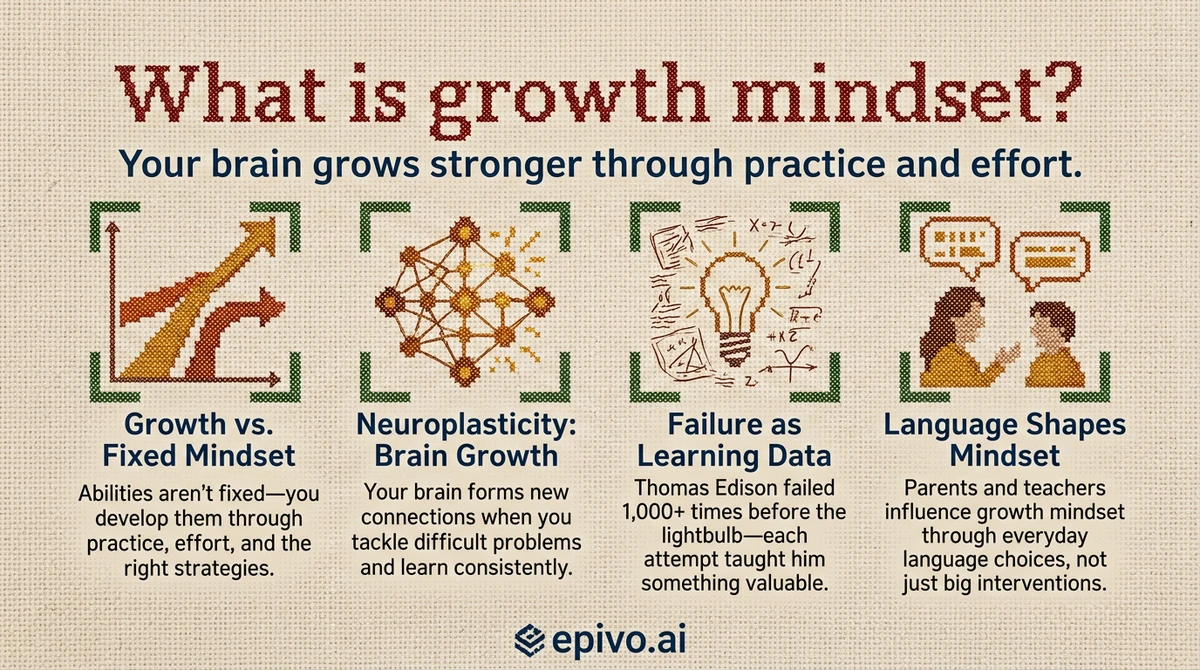
A fixed mindset says: I am either good at this or I am not. A growth mindset says: I am not good at this yet — but with practice I can improve. The word yet is remarkably powerful. It transforms I cannot do this into I cannot do this yet. In her TED Talk on the power of believing you can improve, Dweck explains that this small shift changes a student's entire relationship with difficulty.
Why mistakes are part of the process
Every time you make a mistake, your brain works harder to figure out what went wrong. That extra effort, therefore, actually helps you learn and remember better. Mistakes are not signs that you have failed — they are signs that you are trying something challenging.
The science behind growth mindset: how your brain actually changes
The science behind growth mindset is called neuroplasticity — the brain's ability to form new connections when we practise and learn. Every time you tackle a difficult problem, your brain builds stronger pathways. This is not a metaphor. Research shows measurable changes in neural connections after sustained learning.
Adolescence is the ideal window
The National Institute of Mental Health highlights that neuroplasticity is especially high during adolescence. Consequently, the habits young people build now create lasting changes in the brain's architecture. When a student practises persisting through difficulty — rather than giving up — they are literally strengthening their brain.
A famous example
Thomas Edison reportedly failed more than 1,000 times before successfully inventing the lightbulb. He described each attempt not as a failure, but as learning one more way that did not work. That, in essence, is growth mindset in action.

Image: Generated with AI (Epivo)
How to build a growth mindset — practical steps for students
Building a growth mindset is a skill, not a personality trait — it develops through repeated practice. However, the good news is that a few consistent habits make a significant difference.
First, use the word yet. When you think I cannot do this, add yet. Second, after a setback, ask: what can I learn from this? Third, focus on the process rather than the result. Notice when you tried a different strategy or asked for help — these actions are signs of a growth mindset in practice.
For students who want structured support, Epivo's wellbeing curriculum builds growth mindset habits directly into learning sessions. Students practise explaining their thinking — not just giving answers — which naturally develops persistence over time.

Image: Generated with AI (Epivo)
Did you know?
-
Thomas Edison failed over 1,000 times before inventing the lightbulb — he described each attempt as learning one more way that did not work.
PSHE Association: Programme of Study for PSHE Education -
Neuroplasticity — the brain's ability to grow and adapt — is especially high during adolescence, making it the most powerful window for building growth mindset habits.
National Institute of Mental Health: The Teen Brain — 7 Things to Know -
Carol Dweck's research found that students explicitly taught growth mindset showed measurably improved motivation and academic results compared to control groups.
Dweck, C. S. (2006). Mindset: The New Psychology of Success. Random House.
What parents can do to encourage a growth mindset at home
Parents have a significant influence on how their children think about learning. However, the impact often comes from small everyday choices in language rather than large interventions.
Avoid saying things like I was never good at maths either — this implies that ability is inherited. Instead, try: Let us figure this out together. When your child faces a setback, resist the urge to solve it immediately. Ask: What have you tried so far? What might work differently? Praise the effort rather than the result: You worked hard on that is more useful than You are so clever.
For additional support, Epivo's parent resources explain how the AI tutor applies growth mindset principles in every session — asking students to reflect on their thinking, not just check their answers.

Image: Generated with AI (Epivo)
Frequently asked questions
- What is growth mindset in simple terms?
- A growth mindset is the belief that intelligence and abilities are not fixed — they can develop through effort, practice, and learning from mistakes. Psychologist Carol Dweck developed the concept after decades of research. Students with a growth mindset achieve more and recover faster from setbacks than those with a fixed mindset.
- What is the difference between a fixed mindset and a growth mindset?
- A fixed mindset believes abilities are set at birth and cannot change. A growth mindset believes abilities can develop through effort. The difference is most visible when things get hard — a fixed mindset person gives up, while a growth mindset person asks what they can learn from the difficulty.
- How can students develop a growth mindset?
- The most effective steps are: adding 'yet' when facing difficulty, praising effort over outcome, treating mistakes as information rather than failure, and reflecting on what worked and what did not. Consistent practice builds these habits. Structured programmes like Epivo's wellbeing curriculum also help students apply growth mindset in real learning situations.
- Does growth mindset actually improve grades?
- Research by Carol Dweck found that students taught growth mindset showed measurably improved motivation, persistence, and academic results. The effect is strongest when teachers and parents consistently model growth mindset language and avoid praising fixed traits like being clever or naturally talented.
- At what age should children learn about growth mindset?
- Growth mindset principles can be introduced from around age 5 — for example, praising effort in drawing or sport. By age 8 to 10, children can understand the concept directly. Epivo's wellbeing curriculum introduces growth mindset from Grade 4, with age-appropriate language and practical activities.