
What is the science of happiness — and what does it study?
The science of happiness is a branch of positive psychology that uses experimental methods to understand what makes human beings feel that life is going well. Unlike philosophy or self-help, it produces testable, reproducible findings. Psychologist Ed Diener, who spent four decades studying subjective wellbeing at the University of Illinois, defined happiness as the combination of frequent positive emotions, infrequent negative emotions, and a sense of overall life satisfaction.
The science of happiness distinguishes between two types of wellbeing. Hedonic wellbeing refers to pleasure and the absence of pain — feeling good moment to moment. Eudaimonic wellbeing refers to living a meaningful, purposeful life — feeling that your existence has value and direction. Both matter, but research consistently shows that eudaimonic wellbeing produces greater long-term stability. People who pursue meaning and purpose alongside pleasure report higher and more enduring life satisfaction.
For anyone who wants to understand the psychology of wellbeing more deeply, the field now offers concrete, evidence-based tools — not vague advice. This is the core promise of the science of happiness.
Lyubomirsky's happiness model — 40% is within your control
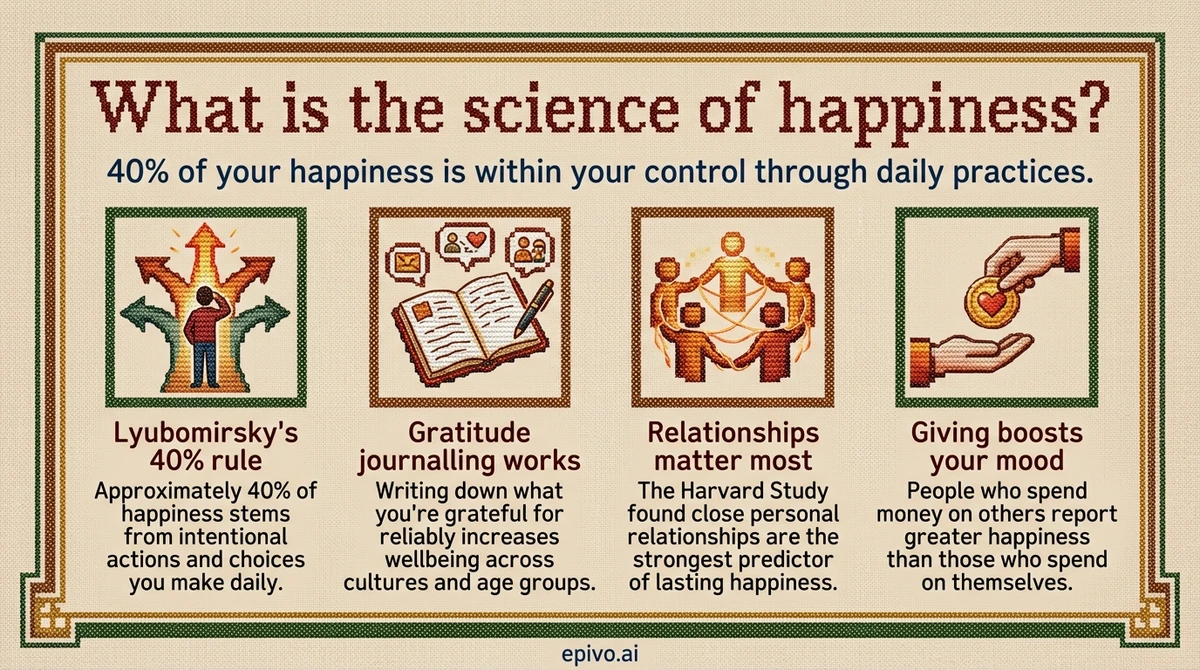
One of the most influential findings in the science of happiness comes from psychologist Sonja Lyubomirsky at the University of California, Riverside. Her research proposes that approximately 50% of a person's happiness is determined by a genetic 'set point' — a baseline level to which people tend to return after both positive and negative events. Around 10% is determined by life circumstances: income, location, relationship status. The remaining 40%, however, is determined by intentional activity — the things you choose to think and do.
The hedonic treadmill
Lyubomirsky's work helps explain a well-documented phenomenon called the hedonic treadmill. People adapt rapidly to new circumstances — a pay rise, a new home, even a major setback. Within months, emotional levels return towards the set point. Therefore, accumulating possessions or status produces less lasting happiness than many expect.
What the 40% means in practice
The 40% figure means that intentional behaviour matters enormously. Research shows that the activities with the highest impact on happiness include practising gratitude, nurturing close relationships, engaging in meaningful work or activities, exercising regularly, and performing acts of kindness for others. Importantly, these activities must be varied — repetition reduces their emotional impact over time.

Image: Generated with AI (Epivo)
Evidence-based practices that increase happiness
The science of happiness has identified several practices that reliably increase wellbeing across different cultures and age groups.
Gratitude journalling
Martin Seligman's research showed that writing three good things that happened each day, and reflecting on why they happened, produced measurable increases in happiness within two weeks — and the effect persisted for six months in some participants. Robert Emmons's independent studies at UC Davis confirmed and extended these findings.
Acts of kindness
Research by Lara Aknin at Simon Fraser University found that spending money on others produces more lasting happiness than spending it on oneself. Similarly, doing five acts of kindness in a single day produced a larger happiness boost than spreading the same acts across a week.
Social connection
The Harvard Study of Adult Development, the world's longest-running study of adult wellbeing, found that close relationships are the strongest predictor of happiness and health in later life. Researcher Robert Waldinger concluded: 'It's not just the number of friends you have — it's the quality of your relationships that matters.'
For structured learning that applies happiness science to personal development, visit For parents or explore Epivo's International curriculum.

Image: Generated with AI (Epivo)
Did you know?
-
Sonja Lyubomirsky's research found that approximately 40% of happiness is determined by intentional activities — choices about how we think and behave — rather than genetics or life circumstances.
The How of Happiness — Sonja Lyubomirsky -
The Harvard Study of Adult Development, running since 1938, identified close personal relationships as the single strongest predictor of happiness and physical health across a lifetime.
Harvard Study of Adult Development -
A study by Lara Aknin found that people who spent money on others reported greater happiness than those who spent the same amount on themselves — a finding replicated in 136 countries.
Spending money on others promotes happiness — Aknin et al.
What the latest research tells us about lasting happiness
Recent advances in the science of happiness have reinforced a consistent picture: lasting wellbeing depends far less on external circumstances than most people assume, and far more on internal orientation and social connection.
A 2023 book by Robert Waldinger and Marc Schulz, The Good Life, synthesises 80 years of Harvard happiness data into practical guidance. Their central finding: people who invest in relationships — who make time for friends, family, and community even when it feels inconvenient — consistently report higher wellbeing and live longer, healthier lives.
A second important finding concerns the role of meaning. Research by Michael Steger at Colorado State University shows that people who feel their life has meaning are not only happier but also more resilient to stress, less likely to experience depression, and more engaged in their communities.
Finally, the science of happiness has confirmed that happiness is a skill, not a fixed personality trait. Just as physical fitness improves with consistent training, psychological wellbeing improves with consistent practice. The tools are available — Greater Good Science Center at UC Berkeley provides free, research-based resources anyone can use. The question is simply whether we apply them.

Image: Generated with AI (Epivo)
Frequently asked questions
- What is the science of happiness?
- The science of happiness is a branch of positive psychology that studies the causes and conditions of human wellbeing using experimental methods. Key researchers include Ed Diener, Sonja Lyubomirsky, and Martin Seligman. It focuses on both feeling good (hedonic wellbeing) and living meaningfully (eudaimonic wellbeing).
- Can happiness be increased?
- Yes. Sonja Lyubomirsky's research shows that approximately 40% of happiness is determined by intentional activity — things we choose to do and think. Practices such as gratitude journalling, acts of kindness, regular exercise, and investing in close relationships all produce measurable, lasting increases in wellbeing.
- What is the hedonic treadmill?
- The hedonic treadmill describes the tendency for people to return to a baseline level of happiness after both positive events (a promotion, a new home) and negative events (illness, job loss). It helps explain why accumulating more possessions or status rarely produces lasting happiness.
- What is the difference between hedonic and eudaimonic happiness?
- Hedonic happiness refers to pleasure and the absence of pain — feeling good moment to moment. Eudaimonic happiness refers to living a meaningful, purposeful life. Research shows that eudaimonic wellbeing produces greater long-term life satisfaction and is more stable under adverse conditions.
- What does research say is the biggest factor in happiness?
- The Harvard Study of Adult Development found that the quality of close personal relationships is the single biggest predictor of long-term happiness and health. More than income, career success, or status, it is the depth of human connection that most reliably predicts a flourishing life.