The deliberate choice not to code
I was not avoiding coding out of fear. I was protecting the space I was good at.
For every company I have built, my role has been the same: What does this thing need to do? How does one part connect to another? What does a user experience from the moment they arrive to the moment they leave? These are not questions a developer asks. They are the questions a product person asks. And for thirty-five years, asking them well was enough to build real companies.
I have spent more time than most people in the gap between a business idea and working software — close enough to see the details, far enough back to see the whole.

What that actually looked like
In the 1990s, I built Envox internationally. Our software managed over a million phone lines worldwide. Half our customers were telcos — carriers across Asia, the United States, and Europe. The other half were enterprises integrating voice services into their operations.
I wrote the developer manuals. All thousand pages of them. I held the training courses for engineers integrating our platform into databases, speech recognition systems, and telecom infrastructure — without writing any of the integrations myself. I understood what the software needed to do, its structure, its failure modes, and the decisions that shaped it. I just didn't write it.
That is the product person's native state: fluent in what software should do, deliberately agnostic about how. Seven companies over thirty-five years. None went bankrupt. Three were acquired. The others wound down as more interesting projects came along.

What changed — summer 2025
I started working with AI-driven development in the summer of 2025 — as a side project, alongside my day job as CEO of Sonetel. First with Roo Code. Early results: one and a half to two times the output of a regular developer. Better — but on free time only, not yet transformative.
The move to Claude Code came late in 2025. The difference was immediate: more output, better quality, fewer problems caused by the AI itself. More reliable. The shift continued, gradually then suddenly. As my intuition built up — about what Claude does well and what it doesn't, about where to add guardrails and where to give it room — efficiency stopped being a multiplier and became something harder to describe.
The moment it became undeniable: early 2026, two projects completed in a week each.
The Sonetel website. Our old WordPress site had cost $25,000 just for the template in 2019, not counting UX design. It loaded slowly, damaged our Google rankings, and took weeks of consultant time to update even minor content. A year ago I estimated a rebuild would take six to nine months. It was rebuilt in five days — including an automatic translation pipeline with multi-step review and integrations with numerous APIs. The same project translated 5,000 pages into twelve languages. The AI token cost was $155, including double quality reviews. Traditional translation would have cost $300,000.
The product vision POC. Seeing is believing, and innovation has to be iterative. Instead of writing a document describing what Sonetel could do with AI for our 35,000 customers, Claude and I built the whole thing end-to-end in a week. Every integration in place. Every value delivered. With Claude it is possible to verify assumptions in reality — to validate that the customer value can indeed be delivered with existing technology. What I intended to show the board as a vision, they will be able to try as a working solution. Not even a team of fifty would have had a realistic chance of delivering it in that timeframe.
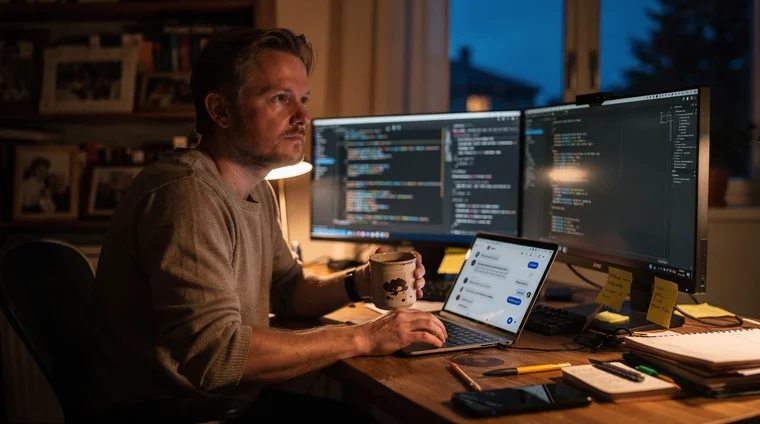
Storm development — what it actually feels like
I call it storm development. There is no better word for it.
Imagine a dozen exceptionally capable people in the same room. They know more than you about most things. They work at warp speed. Every few minutes, one of them comes to you for a thirty-second meeting — to agree on next steps, or to untie a knot — and then they are gone again. They are always in a good mood. They need your vision and guidance to move in the right direction; without that, they drift. But with it, they execute at a speed that has no equivalent in any traditional team structure.
The economics make the scale concrete. I run three Claude Max accounts. Together they cost $600 per month. They deliver the output of twenty to fifty people. The cost reduction compared to a traditional team is probably greater than 99 percent. And unlike a team of fifty, there is no communication overhead — no context lost in handoffs, no alignment meetings, no waiting for someone to be free.
A human team could not work this way. The efficiency is not simply about speed; it is structural. Communication between people is the rate-limiting step in any large organization. Remove it, and the ceiling on what one person can accomplish disappears.
Epivo — this platform — is one sustained example. I built not just the service itself but the automation to conduct ground research for new curriculums, validate educational content, and verify illustrative images against credible sources. That pipeline now runs for days, building entire curriculums with almost zero intervention from me, at a quality standard that is far more than good enough — which in this context is a genuinely high bar.
Epivo started as a hobby project in summer 2025. But the vision behind it is older: an idea from 2015. To build an AI tutor that could help every child forced to attend a school where teachers don't reliably show up, where education is about memorizing rather than thinking, where bright minds are quietly extinguished by a system that doesn't see them. New language model technology made that old dream theoretically possible. Storm development made it practically achievable.
For an entrepreneurial mind, this is euphoria.
Free at last
The constraint that shaped every entrepreneurial decision I have made for thirty-five years was people and resources. Ideas were always rationed by what a team could execute in a given timeframe. The gap between what I could imagine and what I could build was permanent — a negotiation I lost slowly, project by project, year by year.
That gap is now closed.
Ideas can be implemented as fast as they can be said. Epivo's vision sat dormant for ten years for two reasons. The resources were not there. And the technology was not ready — large language models capable of reasoning and building came later. Once they were mature enough, building with AI made it possible to test the idea with minimal investment. I could basically do everything myself. What would have required a team of engineers became something one person could prototype, validate, and ship. That is what the constraint being lifted actually looks like: not just moving faster, but finally being able to start.
I started seven companies over the course of a career and I am still the CEO of Sonetel — a company with 35,000 paying customers in 170 countries, listed on Nasdaq First North. I now see the possibility of starting several more companies every year, while giving more power and attention to the ones I already run. Not because the hours in the day changed, but because the leverage per hour changed fundamentally.

What this means for the world
The proportion of people on this planet currently using these tools and gaining these capabilities is still small. But the question is worth sitting with.
If a hundred times more ideas can become reality — because the resource constraint that stopped most of them is gone — what does that mean for innovation? For the problems that get solved? For the companies that get started by people who previously had every qualification to build something except access to the people needed to build it?
I am genuinely grateful to be alive in a period when this becomes possible. The entrepreneurial mind is, by nature, an optimist about what the world could be. For most of history, the gap between the vision and the reality was managed by accepting what resources would allow. That negotiation is over.
We have an interesting time ahead. The tools exist. This is the moment to get in.