Life along the Nile in ancient Egypt
Ancient Egypt was a civilisation that flourished along the Nile river in north-east Africa for more than 3,000 years, from around 3100 BCE to 30 BCE. It is one of the longest-lasting civilisations in human history.
The Nile river was the foundation of ancient Egyptian life. Every year, the river flooded and left behind rich, fertile soil — called the Black Land — where farmers grew wheat and barley. The surrounding desert, known as the Red Land, protected Egypt from most invasions. Without the Nile, ancient Egypt could not have existed.
Most ancient Egyptians were farmers. They grew crops, raised cattle, and fished the river. A smaller group of craftspeople made pottery, linen cloth, and jewellery. Merchants traded with neighbouring regions, exchanging grain, papyrus, and gold for timber, copper, and spices from as far away as modern Lebanon and Somalia.
Society in ancient Egypt was organised in a strict hierarchy. At the top was the pharaoh, followed by priests, nobles, and scribes. At the base were the farmers and labourers who built the great monuments that still stand today.
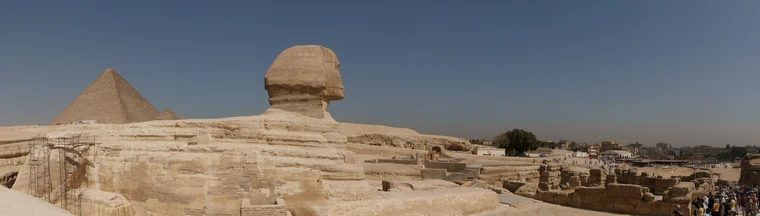
The Great Sphinx beside the Pyramid of Khufu at Giza. The pyramid, completed around 2560 BCE, contains over 2.3 million stone blocks and was the tallest structure in the world for nearly 4,000 years.. Image: Nina Aldin Thune, via Wikimedia Commons (CC BY-SA 4.0)
Pharaohs and the Great Pyramids of ancient Egypt
Pharaohs were the rulers of ancient Egypt. The ancient Egyptians believed that the pharaoh was a god in human form — a living link between the people and the divine. This belief gave pharaohs immense power over all aspects of life, from war and religion to taxation and justice.
The most famous monuments of ancient Egypt are the pyramids, built as tombs for pharaohs and their families. The Great Pyramid of Giza, constructed for Pharaoh Khufu around 2560 BCE, is the largest stone structure ever built. It contains more than 2.3 million stone blocks, each weighing an average of 2.5 tonnes. Despite being over 4,500 years old, it remains one of the Seven Wonders of the Ancient World.
Inside pyramids, pharaohs were buried with treasures, food, and everyday objects for use in the afterlife. Ancient Egyptians believed strongly in life after death. The process of mummification — carefully preserving the body — was practised for thousands of years and is one of the most distinctive features of ancient Egyptian culture.
Not all famous pharaohs were men. Hatshepsut, who ruled around 1473–1458 BCE, was one of Egypt's most successful pharaohs. She expanded trade routes and commissioned major building projects, yet her successor attempted to erase her from historical records.
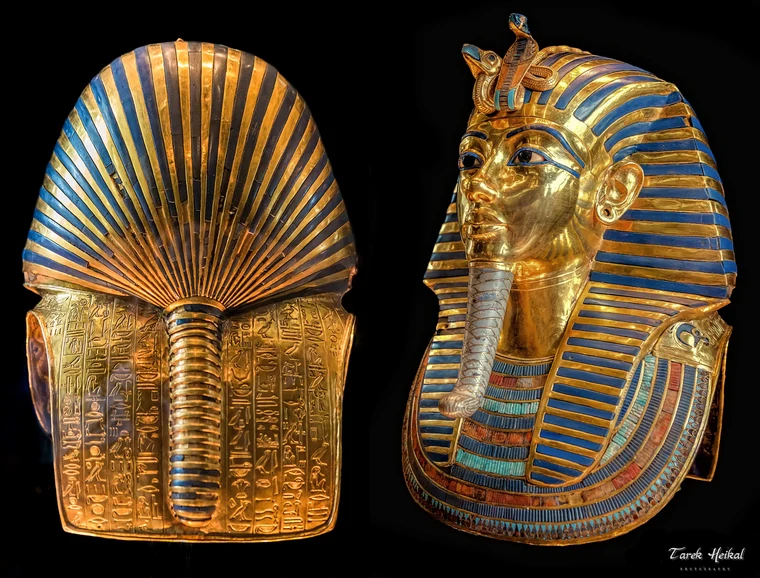
The golden funerary mask of Pharaoh Tutankhamun, discovered in his tomb in the Valley of the Kings in 1922. Now housed in the Egyptian Museum in Cairo, it is one of the most recognised artefacts of ancient Egypt.. Image: Roland Unger, via Wikimedia Commons (Public domain)
Hieroglyphics: ancient Egypt's written language
Ancient Egypt developed one of the world's earliest writing systems, known as hieroglyphics. Unlike an alphabet, hieroglyphics used more than 700 symbols — pictures of animals, plants, and everyday objects — to represent sounds, words, and ideas.
Hieroglyphics appeared on temple walls, tomb ceilings, and official documents. Only trained scribes could read and write them, which gave scribes significant status in Egyptian society. Children training as scribes spent years learning to recognise and reproduce these complex symbols using reed pens and papyrus paper.
For over a thousand years after ancient Egypt fell, nobody could read hieroglyphics. That changed in 1799, when French soldiers discovered the Rosetta Stone — a slab of black granite inscribed with the same decree in three different scripts, including hieroglyphics. By comparing the scripts, the scholar Jean-François Champollion finally unlocked their meaning in 1822. The Rosetta Stone is now displayed in the British Museum in London, where it remains one of the most visited objects in the world.
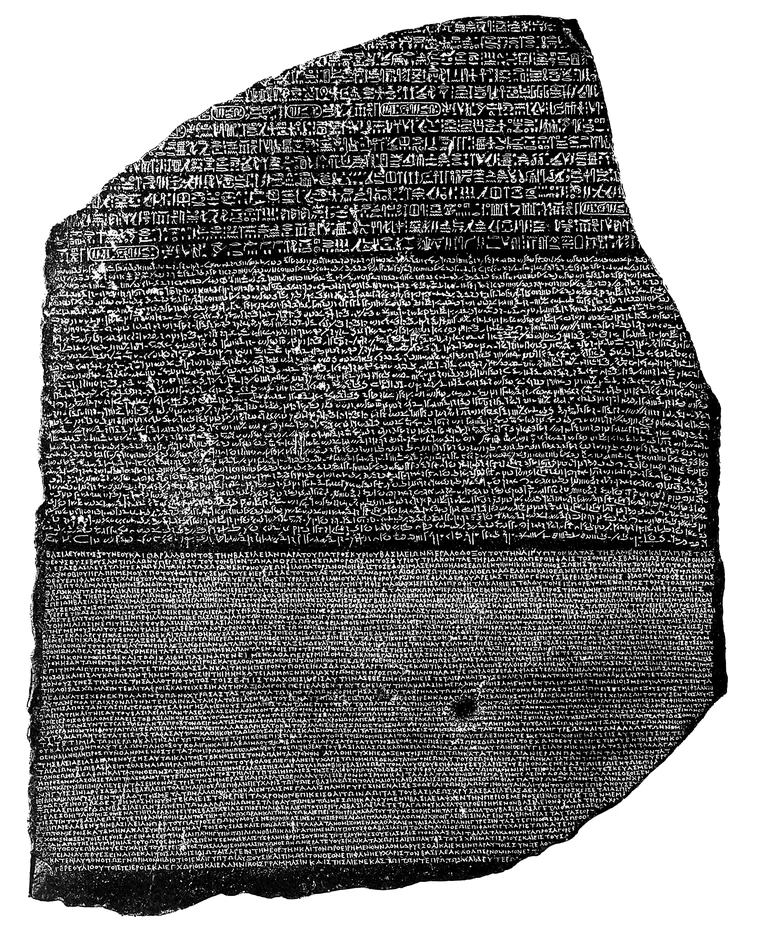
The Rosetta Stone on display at the British Museum in London. Inscribed in 196 BCE with the same decree in three scripts, it allowed Jean-Francois Champollion to decipher hieroglyphics in 1822.. Image: Hans Hillewaert, via Wikimedia Commons (CC BY-SA 4.0)
Did you know?
-
The Great Pyramid of Giza was the tallest human-made structure in the world for over 3,800 years, until the completion of Lincoln Cathedral in England around 1311 CE.
British Museum — Ancient Egypt -
Ancient Egyptians invented one of the world's first 365-day calendars, based on the annual flooding cycle of the Nile and the movement of the star Sirius.
Encyclopaedia Britannica — Ancient Egypt -
The ancient Egyptian civilisation lasted for more than 3,000 years — longer than the time between the fall of Rome and today.
National Geographic — Ancient Egypt
The legacy of ancient Egypt
Ancient Egypt ended as a unified civilisation when the Roman Empire conquered it in 30 BCE, following the death of Queen Cleopatra VII. However, its influence on later civilisations was enormous and continues to be visible today.
Many mathematical and astronomical discoveries made in ancient Egypt were later adopted by the Greeks and Romans. Egyptian knowledge of geometry helped later civilisations measure land and design buildings. The concept of a 365-day calendar also originated in ancient Egypt and forms the basis of the calendar we use today.
According to the Encyclopaedia Britannica, ancient Egypt's contributions to art, architecture, medicine, and science were foundational for Mediterranean civilisations that followed.
For students studying ancient civilisations as part of Epivo's International Curriculum, ancient Egypt is one of five key civilisations explored in grade 5. Understanding ancient Egypt provides essential context for topics including trade networks, the role of geography in civilisation, and the development of writing and governance. Many of the ideas and institutions that ancient Egypt pioneered — writing, centralised government, monumental architecture — shaped the civilisations that came after it. It also connects to later topics such as how the Roman Empire fell and the long arc of world history.
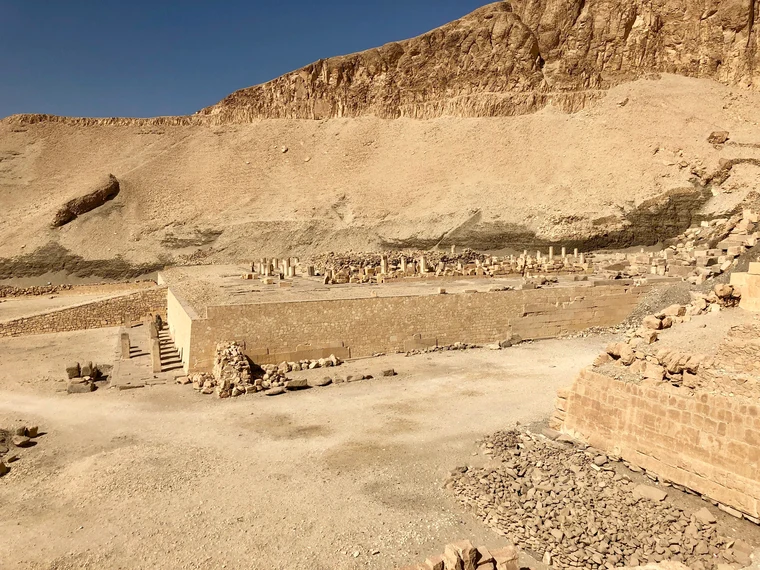
The Mortuary Temple of Hatshepsut at Deir el-Bahari near Luxor, built around 1470 BCE. Hatshepsut was one of ancient Egypt's most successful pharaohs, expanding trade and commissioning grand architecture.. Image: Bilal Detailz, via Wikimedia Commons (CC BY-SA 4.0)
Frequently asked questions
- How long did ancient Egypt last?
- Ancient Egypt lasted for over 3,000 years, from around 3100 BCE to 30 BCE when Rome conquered it. It is one of the longest-lasting civilisations in human history.
- Why were the pyramids built?
- Pyramids were built as tombs for pharaohs and their families. Ancient Egyptians believed in life after death, so they buried their rulers with treasures and supplies for the afterlife. The Great Pyramid of Giza was built for Pharaoh Khufu around 2560 BCE.
- What did ancient Egyptians use hieroglyphics for?
- Hieroglyphics were used to record religious texts, historical events, laws, and trade records. They appeared on temple walls, tombs, and papyrus scrolls. Only trained scribes could read and write them.
- Why was the Nile river so important to ancient Egypt?
- The Nile flooded every year, depositing rich soil ideal for farming. Without this fertile land, ancient Egypt could not have fed its population or built its cities. The river also served as the main route for trade and transport.
- When did ancient Egypt end?
- Ancient Egypt ended in 30 BCE when the Roman Empire conquered it following the death of Queen Cleopatra VII. However, Egyptian culture and religion continued to influence the Mediterranean world for centuries afterwards.