How did Hitler rise to power in the Weimar Republic?
Hitler rose to power because Germany's Weimar Republic was structurally weak, economically devastated, and politically fragmented. These conditions created an opening that extremist movements exploited.
The Weimar Republic was established in 1919 after Germany's defeat in World War 1. From the start, the new democracy faced enormous challenges. Its constitution used proportional representation, which produced coalition governments that struggled to pass legislation. Many Germans associated the republic with national humiliation, because its leaders had signed the armistice and accepted the Treaty of Versailles.
The Treaty of Versailles and national resentment
The Treaty of Versailles imposed harsh terms on Germany. According to Encyclopaedia Britannica, Germany lost 13% of its territory, had its military severely restricted, and was required to pay 132 billion gold marks in reparations. The treaty also included the "war guilt clause," which forced Germany to accept sole responsibility for the conflict. Many Germans viewed these terms as unjust. Politicians who had signed the treaty were labelled "November criminals" by nationalist groups. This widespread resentment became a powerful tool for extremist parties, including Hitler's National Socialist German Workers' Party (NSDAP).
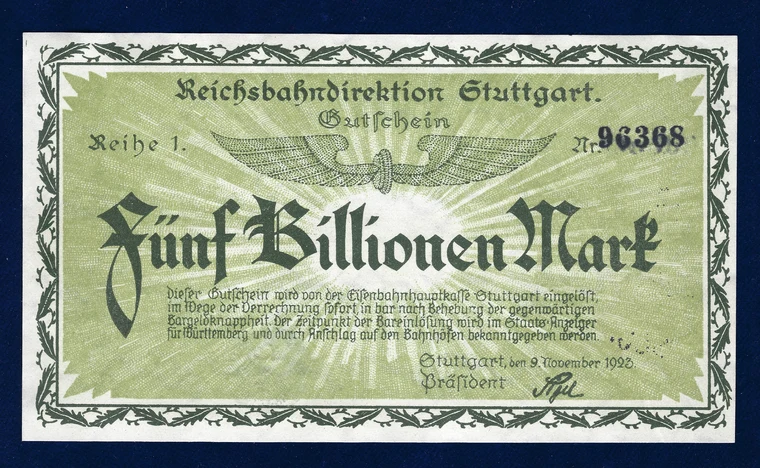
A 5 trillion mark Reichsbahn banknote from 1923 — hyperinflation destroyed middle-class savings and faith in the Weimar Republic.. Image: Deutsche Reichsbahn, via Wikimedia Commons (Public domain)
Economic collapse and the rise of extremism
Germany's economic crises provided the fuel for Hitler's political movement. Without mass unemployment and financial desperation, the NSDAP would likely have remained a fringe party.
In 1923, hyperinflation destroyed the German currency. Workers carried wheelbarrows of banknotes to buy bread. Savings became worthless overnight. Although the economy stabilised briefly in the mid-1920s, the Great Depression struck in 1929 and pushed Germany back into crisis. By 1932, unemployment had reached 6 million — roughly 30% of the workforce.
From the Beer Hall Putsch to electoral strategy
Hitler first attempted to seize power through force. In November 1923, he led the Beer Hall Putsch in Munich — a failed attempt to overthrow the Bavarian government. The coup collapsed within hours, and Hitler was arrested and sentenced to prison. However, his trial gave him a national platform. During his imprisonment, he wrote Mein Kampf, outlining his ideology.
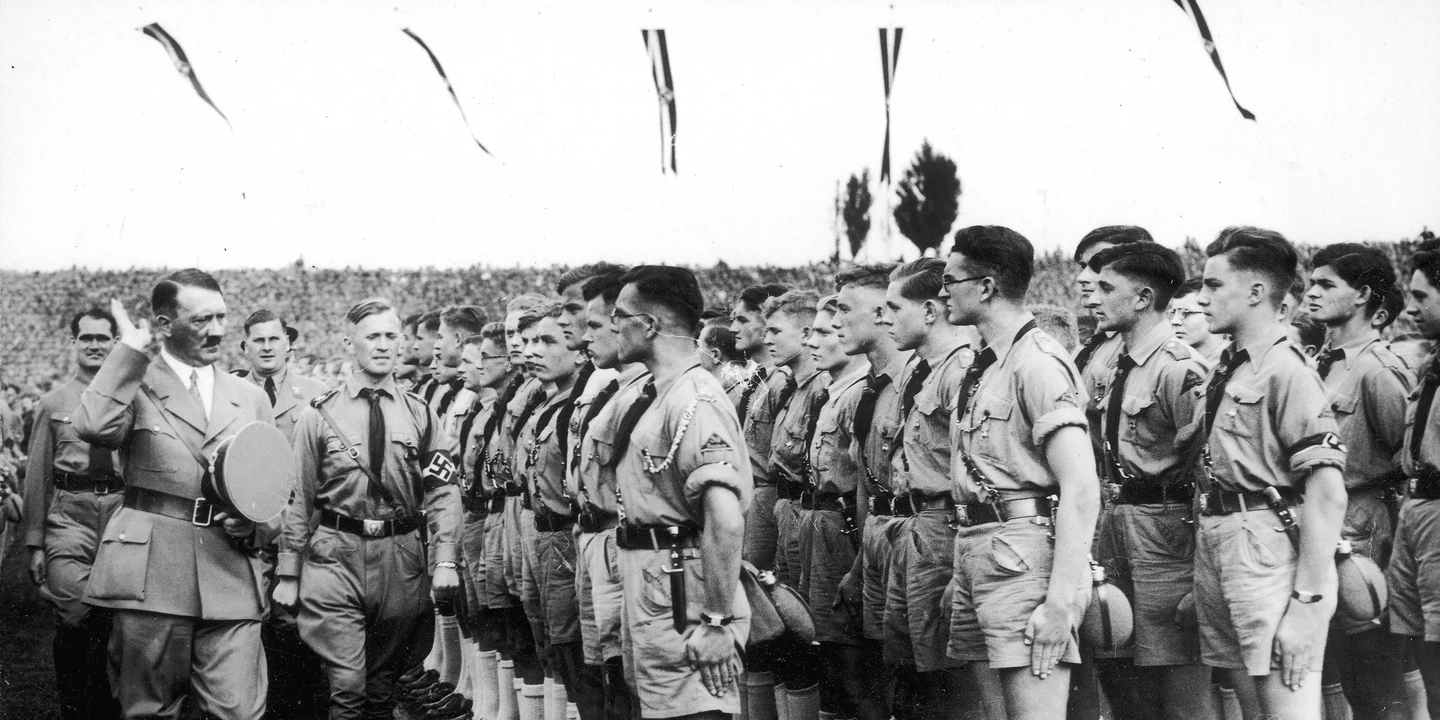
After his release, Hitler changed strategy. Instead of armed revolt, the NSDAP pursued power through elections. The party used propaganda, mass rallies, and scapegoating to attract voters. As a result, NSDAP seats in the Reichstag jumped from 12 in 1928 to 230 in July 1932, making it the largest party in parliament.
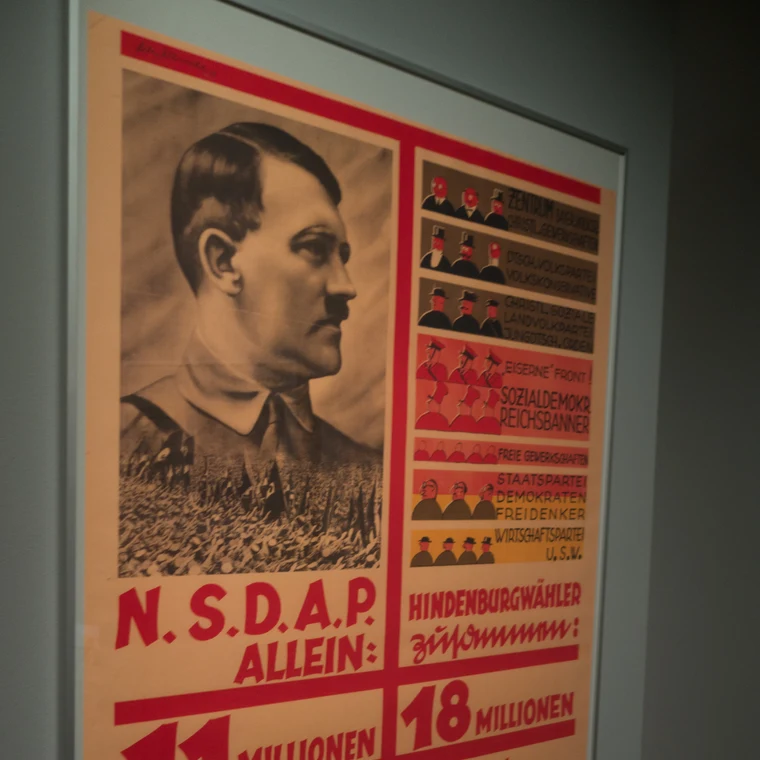
"Give the Führer your vote" — a 1932 NSDAP election poster. The party grew from 12 to 230 Reichstag seats in just 4 years.. Image: NSDAP / Münchner Stadtmuseum, via Wikimedia Commons (CC BY 2.0)
How did Hitler rise to power through the Enabling Act?
Hitler secured absolute power not through revolution, but by dismantling democracy from within its own institutions. On 30 January 1933, President Hindenburg appointed Hitler as Chancellor, believing conservative allies could control him.
Within weeks, Hitler moved to eliminate opposition. On 27 February 1933, the Reichstag building burned. Hitler blamed communists and persuaded Hindenburg to sign the Reichstag Fire Decree, which suspended civil liberties including freedom of speech, press, and assembly. Political opponents were arrested without trial.
The death of German democracy
On 23 March 1933, the Reichstag passed the Enabling Act by a vote of 444 to 94. According to the United States Holocaust Memorial Museum, this law allowed Hitler's government to pass legislation without parliamentary approval. In practice, it ended democratic governance in Germany. Only the Social Democrats voted against it — communist members had already been arrested or barred from attending.
Within months, Hitler banned all political parties except the NSDAP, dissolved trade unions, and placed the judiciary under party control. By August 1934, after Hindenburg's death, Hitler merged the offices of president and chancellor and declared himself Fuhrer. The causes of World War 2 trace directly to these events.
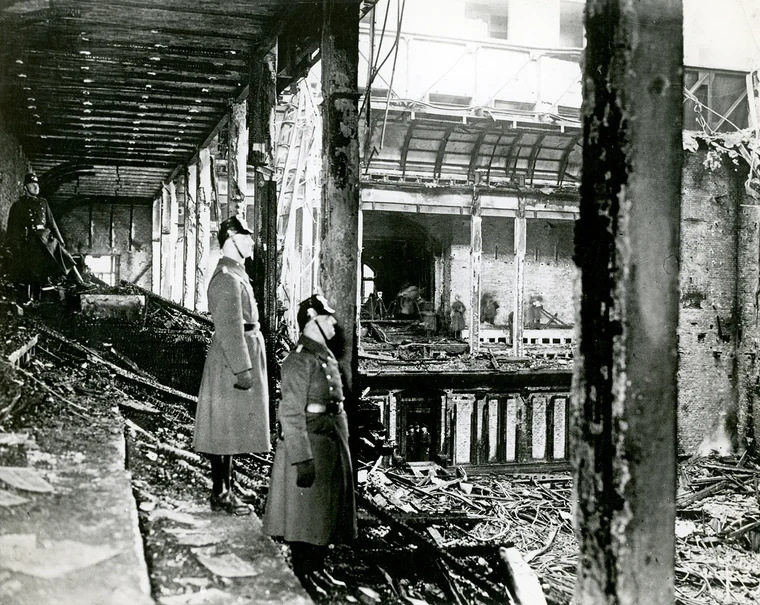
Interior of the Reichstag after the February 1933 fire — Hitler used the crisis to suspend civil liberties and pass the Enabling Act.. Image: Unknown photographer, via Wikimedia Commons (CC BY-SA 4.0)
Did you know?
-
In the July 1932 election, the NSDAP won 37.3% of the vote and 230 Reichstag seats — making it Germany's largest party, though it never won an outright majority in a free election.
Encyclopaedia Britannica — Nazi Party -
The Enabling Act of 23 March 1933 passed with 444 votes to 94. Only the Social Democrats voted against it — 81 Communist members had already been arrested or barred from attending.
United States Holocaust Memorial Museum — The Enabling Act -
By 1932, approximately 6 million Germans were unemployed — roughly 30% of the workforce. The economic crisis pushed millions of desperate voters toward extremist parties.
Encyclopaedia Britannica — Great Depression
Lessons from democratic failure
Understanding how Hitler rose to power reveals how democracies can fail when institutions weaken and citizens lose faith in the system. His rise was not the achievement of a single individual. It was the result of structural vulnerabilities that went unaddressed.
Several factors combined to destroy Weimar democracy. First, the constitution lacked strong protections against authoritarian takeover. Article 48 allowed the president to rule by decree in emergencies, and leaders used it frequently even before Hitler. Second, economic despair made voters receptive to radical promises. Third, mainstream politicians underestimated the threat and believed they could manage extremism by bringing it into government. Additionally, propaganda and the suppression of a free press made it harder for citizens to access reliable information.
The consequences were devastating. Hitler's regime led to World War 2, which killed over 70 million people, and to the Holocaust, the systematic murder of six million Jewish people and millions of others. These events demonstrate why protecting democratic institutions, maintaining economic stability, and recognising the warning signs of authoritarianism remain essential responsibilities for every generation. Studying this history helps us understand that democracy requires active defence — it cannot be taken for granted.

The Memorial to the Murdered Jews of Europe in Berlin — 2,711 concrete stelae commemorating the Holocaust.. Image: Sisu1959, via Wikimedia Commons (CC BY 2.0)
Frequently asked questions
- When did Hitler come to power?
- Hitler was appointed Chancellor of Germany on 30 January 1933. He consolidated total control by August 1934, when he combined the offices of president and chancellor after President Hindenburg's death and declared himself Fuhrer.
- Did Hitler win a democratic election?
- The NSDAP became the largest party in the Reichstag in July 1932 with 37.3% of the vote, but it never won an outright majority in a free election. Hitler was appointed Chancellor by President Hindenburg, not elected to the position directly.
- What was the Enabling Act?
- The Enabling Act was a law passed on 23 March 1933 that allowed Hitler's government to create laws without Reichstag approval. It effectively ended democratic governance in Germany and gave Hitler the legal framework to establish a dictatorship.
- What was the Beer Hall Putsch?
- The Beer Hall Putsch was a failed coup attempt by Hitler in Munich on 8-9 November 1923. He tried to overthrow the Bavarian government by force, but the attempt collapsed and Hitler was arrested. The event shifted his strategy toward gaining power through elections.
- How did the Treaty of Versailles help Hitler rise to power?
- The Treaty of Versailles imposed harsh reparations, territorial losses, and a war guilt clause on Germany. Many Germans resented these terms deeply. Hitler exploited this resentment by blaming the treaty on democratic leaders, which attracted voters to his nationalist movement.