
What makes an argument — and what does not
An argument is not a fight. In logic and rhetoric, an argument is a structured attempt to persuade someone of a conclusion by offering reasons. The key word is reasons. Without reasons, you have an assertion — a bare claim with nothing behind it.
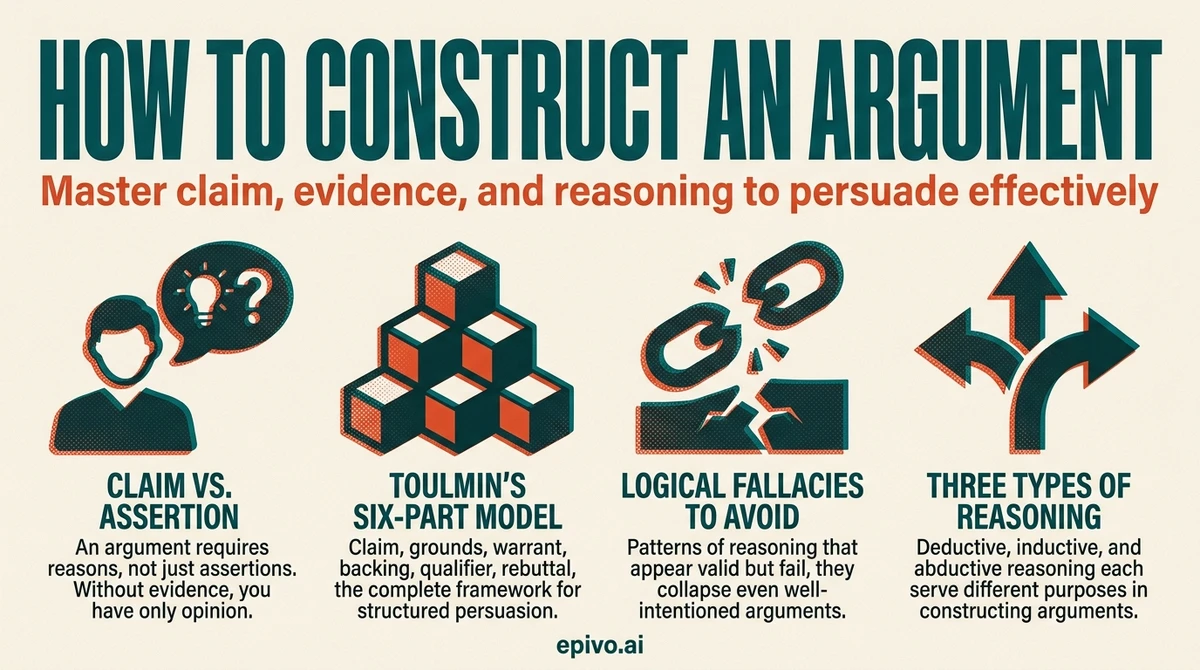
Philosopher Stephen Toulmin identified the essential parts of any argument in his 1958 book The Uses of Argument, which remains one of the most influential frameworks in academic writing, debate, and law. The Toulmin model breaks an argument into six components:
Claim — the conclusion you want your audience to accept. "School uniforms reduce bullying."
Grounds — the evidence or data that supports the claim. "A 2019 study of 1,200 students across 30 schools found a 23% reduction in reported bullying incidents after uniform adoption."
Warrant — the logical principle that connects the grounds to the claim. "When visible markers of social status are removed, peer hierarchies weaken, which reduces status-based targeting."
Backing — support for the warrant itself, when it is not self-evident. "Research in social psychology shows that status symbols drive in-group/out-group distinctions."
Qualifier — words like "probably" or "in most cases" that acknowledge limits. "In most school environments..."
Rebuttal — the conditions under which the claim would not hold. "Unless bullying is driven by factors other than appearance, such as academic rivalry."
Many arguments in everyday life skip the warrant entirely — people assume the link between evidence and conclusion is obvious when it is not. Making the warrant explicit is what separates a rigorous argument from a superficially plausible one. This is also at the heart of critical thinking: examining not just what people say, but the logical structure holding it together.
Step-by-step: how to build an argument from scratch
Whether you are writing an essay, preparing for a debate, or making a case in a meeting, the process of constructing a strong argument follows a reliable sequence.
Step 1 — Define your claim. Start with a clear, specific, and debatable thesis. "Climate change is real" is too broad and not sufficiently contestable in most contexts. "Carbon taxes are the most cost-effective policy tool for reducing emissions in industrialised economies" is a claim that requires argument.
Step 2 — Gather your evidence. Good arguments rest on solid grounds. The four main types of evidence are: empirical data (statistics, study results), expert authority (citations from credentialed specialists), case examples (concrete illustrations), and analogies (comparisons to better-understood situations). Each type has strengths and weaknesses. Empirical data is powerful but can be cherry-picked. Expert authority is compelling but depends on genuine expertise and consensus. Case examples are vivid but may not generalise. Analogies can clarify but can also mislead if the parallel breaks down.
Step 3 — Establish your warrant. Ask yourself: why does this evidence support this claim? If you cannot answer that in plain language, your warrant is missing or weak. Write it out explicitly, even if you later decide not to include it verbatim in your final piece.
Step 4 — Anticipate counterarguments. A common mistake is to treat opposition as an obstacle rather than a resource. Identifying the strongest objections to your position — what philosopher Daniel Dennett calls "steelmanning" — forces you to refine your argument. In his book Intuition Pumps and Other Tools for Thinking (2013), Dennett contrasts steelmanning with strawmanning: engaging with a weakened caricature of an opposing view rather than its strongest form. Good arguers steelman; poor arguers strawman.
Step 5 — Construct your rebuttal. Once you have identified genuine counterarguments, respond to them directly. You can concede part of the objection while maintaining your core claim, offer evidence that outweighs the objection, or show that the objection rests on a false assumption.
Step 6 — Qualify your claim honestly. Few arguments are universal. Adding appropriate qualifiers — "in most cases", "given current evidence", "for secondary school students" — makes your argument more credible, not weaker. Overreach invites refutation.
This structure maps onto the classical argument form rooted in Aristotle's Rhetoric: thesis, evidence, reasoning, counterargument, rebuttal, conclusion. Two and a half millennia later, it remains the backbone of persuasive writing in schools, courts, and legislatures.

Image: Generated with AI (Epivo)
Types of reasoning — deductive, inductive, and abductive
Understanding how to construct an argument also means understanding what kind of reasoning you are using. The three main types are deductive, inductive, and abductive reasoning, and confusing them is a common source of error.
Deductive reasoning moves from general principles to specific conclusions. The classic example is a syllogism: "All humans are mortal. Socrates is a human. Therefore, Socrates is mortal." If the premises are true and the form is valid, the conclusion must be true. Deductive arguments are either valid or invalid — there is no middle ground. The problem is that most real-world arguments require us to establish our premises, which we cannot always do with certainty.
Inductive reasoning moves from specific observations to general conclusions. "The sun has risen every day in recorded history. Therefore, it will rise tomorrow." Inductive conclusions are probabilistic, not certain — they are supported by evidence but not logically guaranteed. This is the foundation of empirical science. Most arguments about policy, history, and social behaviour are inductive.
Abductive reasoning selects the most plausible explanation from among competing hypotheses given the available evidence. Doctors use abductive reasoning when diagnosing: the patient has fever, fatigue, and a sore throat — the most plausible explanation is a viral infection. It is sometimes called "inference to the best explanation."
Knowing which type of reasoning your argument relies on matters because each type has different vulnerabilities. Deductive arguments can fail if premises are false or the form is invalid. Inductive arguments can fail if the sample is unrepresentative. Abductive arguments can fail if a better explanation is being overlooked. Diane Kuhn's 1991 research in The Skills of Argument found that most people — including adults — conflate argument with assertion, and rarely distinguish between evidence and theory. Developing awareness of these distinctions is a significant upgrade to your reasoning.

Image: Generated with AI (Epivo)
Logical fallacies that undermine arguments
Even well-intentioned arguments can collapse because of logical fallacies — patterns of reasoning that appear valid but are not. Douglas Walton's Informal Logic: A Pragmatic Approach (2008) catalogues dozens of fallacies, but a core set appears again and again in academic writing, political debate, and everyday conversation.
Ad hominem — attacking the person making an argument rather than the argument itself. "You cannot trust her position on tax policy — she was convicted of fraud." The personal history may be relevant to credibility in some cases, but it does not refute the argument.
Strawman — misrepresenting an opponent's position to make it easier to attack. If someone argues for stricter gun control and you respond by saying "My opponent wants to disarm every law-abiding citizen," you are attacking a position they did not take.
Appeal to authority — treating an expert's opinion as conclusive rather than as evidence. Expert testimony carries weight, but only when the expert is genuinely credentialed in the relevant area and when there is no significant expert disagreement on the question.
False dichotomy — presenting two options as the only possibilities when others exist. "You are either with us or against us." Real situations almost always involve more than two choices.
Slippery slope — claiming that one event will inevitably lead to a chain of negative consequences without demonstrating the links. "If we legalise cannabis, people will move on to harder drugs and society will collapse."
Circular reasoning — using the conclusion as a premise. "The Bible is true because God wrote it, and we know God wrote it because the Bible says so."
Being alert to cognitive biases goes hand in hand with spotting fallacies. Confirmation bias, for instance, makes us more likely to accept fallacious reasoning when it supports our existing beliefs. Slowing down and examining the structure of an argument — rather than just its conclusion — is the antidote.

Image: Generated with AI (Epivo)
Did you know?
-
Diane Kuhn's research found that most adults cannot reliably distinguish between evidence and theory — they treat an argument's conclusion as its own justification.
The Skills of Argument — Kuhn (1991) -
Stephen Toulmin's six-part argument model — claim, grounds, warrant, backing, qualifier, rebuttal — was originally designed to analyse legal reasoning but is now taught in secondary schools and universities worldwide.
The Uses of Argument — Toulmin (2003) -
A 2015 meta-analysis of 341 studies found that critical thinking skills — including argumentation — improve most when students receive explicit, direct instruction rather than absorbing them incidentally.
Strategies for Teaching Students to Think Critically — Abrami et al. (2015)
Putting it together: writing and speaking arguments that persuade
Knowing the components of an argument is necessary but not sufficient. The final step is learning to arrange those components in a way that actually persuades an audience.
In writing, the most common structure is the classical five-part essay: introduction with thesis, body paragraphs each developing one piece of evidence with explicit reasoning, acknowledgement and rebuttal of counterarguments, and a conclusion that restates the thesis in light of what has been established. This is not just a school convention — it reflects how audiences actually process arguments. Readers need to know your claim before they can evaluate your evidence; they need to see the reasoning, not just the data; and they need to feel you have taken opposing views seriously.
In speaking and debate, the same principles apply but timing matters more. Competitive debaters are trained to lead with their strongest argument, not build up to it — because audiences form impressions quickly and attention wanes. They also learn to respond to opponents point by point rather than pivoting to a new topic, which signals that you cannot answer the objection.
One underrated skill is signposting: explicitly telling your audience where you are in the argument. "My first reason is... My second reason is... The strongest objection to this view is... Here is why that objection does not succeed..." This reduces cognitive load and makes your reasoning easier to follow.
Finally, acknowledge uncertainty honestly. Arguments that claim more than the evidence supports are easier to refute and harder to trust. Qualifying your claims appropriately — "the evidence suggests", "in the cases studied", "one plausible interpretation is" — signals intellectual honesty and actually increases rather than decreases persuasive power.
Constructing good arguments is, at its core, a form of respect: for truth, for your audience, and for the people who disagree with you. It is also a learnable skill — and one that pays dividends across every domain of life, from academic essays to career decisions to civic participation.

Image: Generated with AI (Epivo)
Frequently asked questions
- What is the difference between an argument and an assertion?
- An assertion is a bare claim with no supporting reasons. An argument provides a claim plus the evidence, reasoning, and logical connections that justify it. Without reasons, you have an opinion; with structured reasons, you have an argument.
- What are the main parts of an argument?
- The Toulmin model identifies six parts: claim (your conclusion), grounds (evidence), warrant (the logical link between evidence and claim), backing (support for the warrant), qualifier (limits on the claim), and rebuttal (conditions where the claim would not hold).
- What is the difference between deductive and inductive arguments?
- Deductive arguments move from general principles to certain conclusions — if the premises are true and the form is valid, the conclusion must follow. Inductive arguments move from specific observations to probable general conclusions, as in empirical science.
- What is steelmanning and why does it matter?
- Steelmanning means engaging with the strongest possible version of an opposing argument, rather than a weakened caricature. It leads to more robust arguments because it forces you to address real objections rather than easy ones — and it demonstrates intellectual honesty to your audience.
- How do I avoid logical fallacies in my arguments?
- Learn the common fallacies — ad hominem, strawman, appeal to authority, false dichotomy, slippery slope, circular reasoning — and check your own reasoning against them before presenting it. Asking "does my evidence actually support my claim, or am I assuming the connection?" catches many errors early.
- Can argument-construction skills be taught, or is it a natural talent?
- Research clearly shows argumentation is a learnable skill. A major 2015 meta-analysis found that explicit, direct instruction — being taught how to argue, not just given topics to argue about — produces significant and measurable improvements in reasoning quality at all ages.