
The core of critical thinking
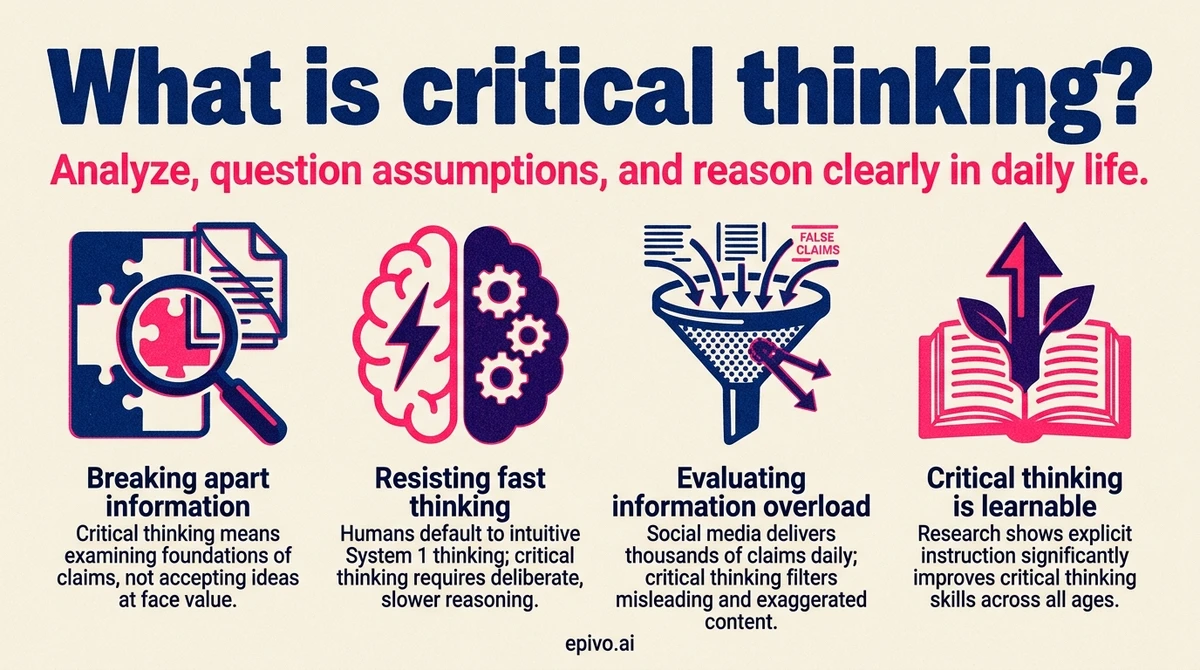
Critical thinking is not just being skeptical or contrarian. It is a structured way of engaging with information — breaking it apart, examining its foundations, and judging whether it holds up.
Philosophers Richard Paul and Linda Elder, in their Miniature Guide to Critical Thinking, define critical thinking through eight elements of reasoning: purpose, question at issue, information, interpretation and inference, concepts, assumptions, implications, and point of view. Every time you reason through a problem, all eight are in play — whether you notice them or not.
When you encounter a news article claiming that a new diet cures diabetes, a critical thinker asks: What is the source of this claim? What evidence supports it? What assumptions does it rest on? What are the implications if it is true — or false? This is not cynicism; it is intellectual due diligence.
Critical thinking sits at the top of Bloom's Taxonomy — the influential framework for cognitive learning developed by Benjamin Bloom and revised by Anderson and Krathwohl in 2001. Analysis, evaluation, and synthesis are classified as higher-order thinking skills, distinct from the lower-order tasks of remembering or understanding. In other words, critical thinking is what you do with knowledge, not just how much of it you have.
It connects deeply to philosophy, which has trained people to reason carefully for over two thousand years — from Socrates questioning Athenian citizens to modern logicians formalizing the rules of valid argument.
Why critical thinking matters more than ever
We live in an era of information overload. Social media feeds deliver thousands of claims per day — many of them misleading, exaggerated, or outright false. The ability to evaluate information rather than simply absorb it has never been more important.
Daniel Kahneman's research on dual-process theory, popularized in Thinking, Fast and Slow (2011), offers a compelling explanation for why this is hard. System 1 thinking is fast, intuitive, and automatic — it is how you recognize a face or catch a ball. System 2 thinking is slow, deliberate, and effortful — it is how you solve a math problem or weigh a difficult decision. Critical thinking is System 2 work. It requires us to override our instincts and habits, which takes real effort.
This is why cognitive biases are so pervasive. Confirmation bias leads us to seek out information that confirms what we already believe. Availability bias makes us overweight vivid, recent examples. Anchoring bias causes us to rely too heavily on the first piece of information we encounter. Knowing these biases exist is the first step to counteracting them — but knowing is not enough. You need a practice.
In the workplace, employers consistently rank critical thinking among the most valued skills they look for in candidates. The ability to identify problems clearly, evaluate options systematically, and communicate reasoning is what separates good employees from great ones. These skills transfer across every field: medicine, law, engineering, business, education.

Image: Generated with AI (Epivo)
How to develop critical thinking skills
The good news: critical thinking is learnable. A landmark 2015 meta-analysis by Philip Abrami and colleagues, published in the Review of Educational Research, examined 341 studies and found that critical thinking skills are best developed through explicit instruction — that is, being directly taught how to think, not just what to think.
Here are the core practices:
Question your assumptions. Every argument rests on assumptions — beliefs taken for granted without examination. The Socratic method, developed by the ancient Greek philosopher Socrates, involves persistently asking "why" until the assumptions beneath an argument are exposed. When someone says "this policy will create jobs," a Socratic response asks: What do we mean by "jobs"? What evidence supports this? What are we assuming about how the economy works?
Evaluate the evidence. Not all evidence is equal. Peer-reviewed studies carry more weight than anecdotes. Large randomized trials carry more weight than small observational studies. Consider the source, the method, the sample size, and whether the findings have been replicated.
Identify logical fallacies. Ad hominem attacks, straw man arguments, false dichotomies, slippery slope reasoning — these patterns appear everywhere, from political debates to everyday conversations. Learning to name them makes them easier to spot.
Consider multiple perspectives. Paul and Elder emphasize point of view as a key element of reasoning. Every argument is made from a particular vantage point. Actively seeking out opposing views — and trying to steelman them — builds a more complete picture.
Reflect on your own reasoning. Metacognition, or thinking about your own thinking, is a core habit of critical thinkers. After making a decision, ask: Was my reasoning sound? What did I miss? What would have changed my mind?

Image: Generated with AI (Epivo)
Critical thinking in everyday life
Critical thinking does not only happen in classrooms or boardrooms. It shows up in the most ordinary moments — if you are paying attention.
Consider evaluating a news article. A critical thinker first identifies the source: Is this an established outlet with editorial standards, or an unfamiliar website? They look for primary sources: Does the article link to the original study or just summarize it? They check the reasoning: Does the headline accurately reflect the body of the article, or is it clickbait? They ask about what is missing: What perspectives are absent?
Consider making a major decision — whether to take a job, move to a new city, or choose a course of study. A critical thinker defines the actual question they are trying to answer, gathers relevant information, considers the assumptions built into each option, thinks through the implications, and checks whether emotions are distorting the analysis.
Even in a simple disagreement with a friend or family member, critical thinking means listening to understand rather than to rebut, checking whether the other person's position is being accurately represented, and being willing to update your own view if the evidence warrants it.
These are not abstract academic exercises. They are practical habits that make you more effective, more fair-minded, and less likely to be misled.

Image: Generated with AI (Epivo)
Did you know?
-
A 2015 meta-analysis of 341 studies found that explicit instruction in critical thinking significantly improves reasoning skills across age groups and subjects.
Abrami et al. (2015) — Review of Educational Research -
Daniel Kahneman's research shows that humans default to fast, intuitive "System 1" thinking — making deliberate critical analysis an effortful but trainable skill.
Kahneman, D. (2011) — Thinking, Fast and Slow -
The World Economic Forum consistently ranks critical thinking and analysis among the top skills employers will need most in the coming decade.
World Economic Forum — Future of Jobs Report
How to teach critical thinking
Parents and teachers often ask what is critical thinking and how to cultivate it in young people. The research points to a consistent answer: model it, make it explicit, and give students real practice.
Modeling means thinking aloud. When a parent evaluates a purchase or a teacher works through a problem, narrating the reasoning process — "I am noticing this source has a clear financial interest in this outcome, so I want to check it against an independent source" — shows students what the internal monologue of a critical thinker sounds like.
Making it explicit means teaching the vocabulary and structure: what an assumption is, what evidence looks like, what a logical fallacy is, what it means to evaluate a source. Students cannot apply skills they have never been taught.
Practice means exposure to real problems — not just contrived textbook examples, but current events, ethical dilemmas, historical controversies, and scientific debates. Discussion-based learning, Socratic seminars, and argument mapping exercises have all been shown to be effective.
Epivo's AI tutor is built around exactly this kind of learning. Rather than presenting information for students to memorize, it asks questions, surfaces assumptions, and guides learners through reasoning step by step — the way a skilled human tutor would. Whether the topic is philosophy, history, or science, the underlying skill being practiced is always the same: how to think.

Image: Generated with AI (Epivo)
Frequently asked questions
- What is the simplest definition of critical thinking?
- Critical thinking is the practice of actively analyzing, evaluating, and questioning information rather than accepting it at face value. It involves examining evidence, identifying assumptions, and reasoning carefully before drawing conclusions.
- Is critical thinking a skill you are born with or can you learn it?
- It is primarily a learned skill. Research, including a major 2015 meta-analysis, shows that people develop critical thinking most effectively through explicit instruction and deliberate practice, not innate talent.
- What is the difference between critical thinking and being critical?
- Being critical often means finding fault. Critical thinking means evaluating reasoning carefully — which can lead you to agree with something, disagree, or conclude you need more information. It is about accuracy and fairness, not negativity.
- How does critical thinking relate to cognitive biases?
- Cognitive biases are systematic errors in thinking that can lead us astray — confirmation bias, anchoring, and availability bias are common examples. Critical thinking is the set of practices that helps us recognize and counteract these biases.
- What are some practical ways to improve critical thinking?
- Ask "why" more often, seek out opposing views, evaluate sources before trusting them, look for evidence rather than anecdotes, learn common logical fallacies, and reflect on your own reasoning after making decisions.
- Why is critical thinking important for students?
- Students who think critically perform better academically, are less susceptible to misinformation, and are better prepared for careers. It is a foundation skill that applies to every subject and every stage of life beyond school.