Why source evaluation matters more than ever
Every day, billions of people share articles, statistics, and claims online — and not all of it is accurate. The ability to evaluate sources separates informed citizens from those who are misled by propaganda, advertising dressed up as news, and well-intentioned but factually wrong information.
The stakes are real. Misinformation about health, politics, science, and history has contributed to vaccine hesitancy, electoral confusion, and radicalisation. A 2016 Stanford History Education Group study found that 82% of middle schoolers could not distinguish sponsored content from genuine news articles — a finding that alarmed educators and researchers alike. If students cannot identify a paid advertisement masquerading as journalism, they struggle with far more sophisticated forms of deception.
Source evaluation is closely connected to media literacy — the broader skill of understanding how media works, who produces it, and what interests it serves. It is also a core component of critical thinking: before you can reason carefully about a topic, you need to know whether your premises are trustworthy.
Fortunately, researchers have developed practical frameworks that make source evaluation learnable. These are not vague instructions to 'think carefully' — they are concrete, step-by-step methods that work.
The SIFT method: a practical starting point
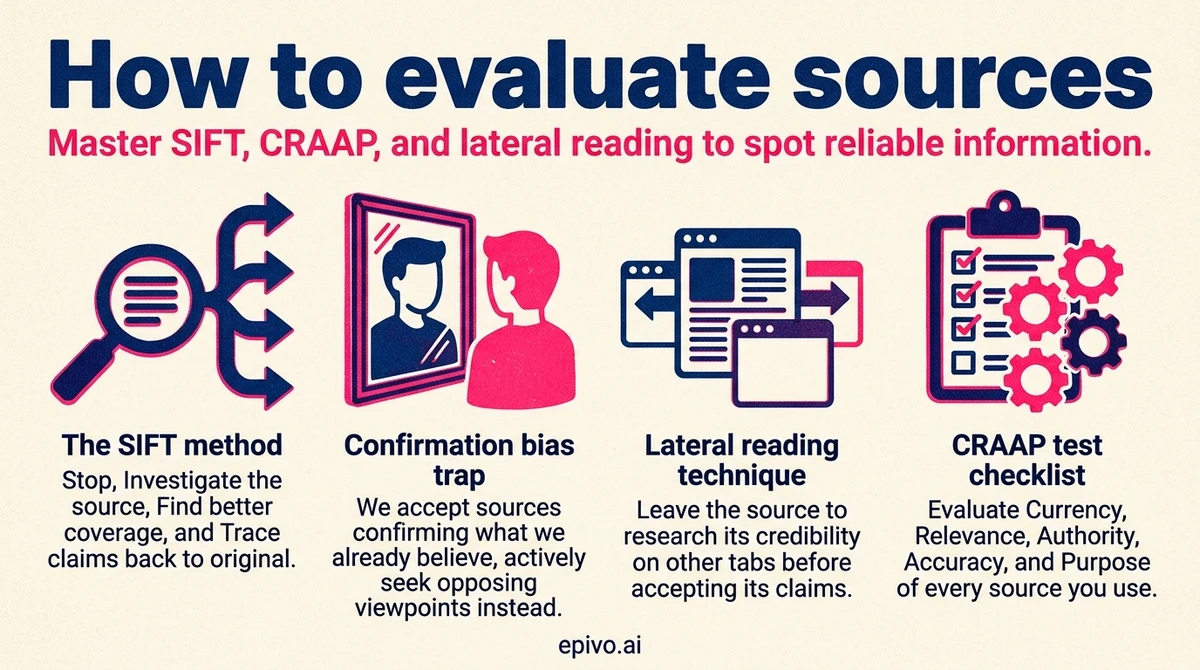
The SIFT method was developed by Mike Caulfield at Washington State University as a simple, memorable framework for evaluating online information. SIFT stands for four moves: Stop, Investigate the source, Find better coverage, and Trace claims.
Stop — Before you read, share, or act on a piece of content, pause. Ask yourself whether you recognise the source. If you feel a strong emotional reaction — outrage, excitement, disbelief — that is often a signal to slow down. Emotional content is frequently engineered to bypass critical thinking.
Investigate the source — Do not evaluate a source solely by reading it. Open a new browser tab and search for the source itself. What do others say about it? Is it a recognised news organisation, an advocacy group, a satirical site, or something unknown? A quick background check takes thirty seconds and prevents significant errors.
Find better coverage — If a claim seems important, look for how other reputable sources cover it. If only one outlet is reporting a dramatic story, that absence of corroboration is itself a red flag. Consensus among multiple independent sources increases credibility.
Trace claims, quotes, and media — When you encounter a striking statistic or quote, trace it back to its origin. Many claims are accurately reported at their source but distorted or stripped of context by the time they are reshared. Going back to the original study, speech, or report reveals what was actually said.
Caulfield's research shows that the most effective readers use what he calls lateral reading — opening new tabs to search about a source rather than reading through it from top to bottom. This is the strategy used by professional fact-checkers, and it is faster and more reliable than trying to assess a source's credibility from its own content alone.

Image: Generated with AI (Epivo)
The CRAAP test and types of sources
The CRAAP test is a checklist developed in library science that asks five questions about any source: Currency, Relevance, Authority, Accuracy, and Purpose.
Currency — When was the source published or last updated? Timeliness matters more for some topics (medical research, current events) than others (historical analysis, classic literature). A 2009 guide to social media platforms will be largely obsolete; a 1990 history of the Roman Empire may be as valid as ever.
Relevance — Does the source actually address your question? A study on adult patients tells you little about childhood development. Make sure the source matches the scope, audience, and level of your inquiry.
Authority — Who created the source, and what are their credentials? A cardiologist's opinion on heart disease carries more weight than a celebrity's. Look for author qualifications, institutional affiliations, and editorial oversight. Anonymous sources require far greater scrutiny.
Accuracy — Can the claims be verified? Does the source cite its own sources? Are there references you can check? Peer-reviewed academic research goes through independent expert review before publication — a process that significantly (though not perfectly) reduces errors and bias.
Purpose — Why was the source created? Sources can be designed to inform, persuade, sell, or entertain — and these purposes affect what they include and exclude. A tobacco company's research on smoking risks has an obvious conflict of interest. Government agencies, think tanks, and advocacy groups all have perspectives that shape their output.
Understanding the hierarchy of source types also helps. Primary sources are original materials — raw data, original research, eyewitness accounts, historical documents, speeches. Secondary sources analyse or interpret primary sources — textbooks, review articles, biographies. Tertiary sources compile information from secondary sources — encyclopaedias, databases, reading lists. Each level involves more interpretation and potential distortion. For rigorous research, always try to find and assess primary sources rather than relying on someone else's summary.
Image: Generated with AI (Epivo)
Red flags and common mistakes when evaluating sources
Even careful readers make predictable errors. Understanding the most common mistakes helps you avoid them.
Confirmation bias is the tendency to accept sources that confirm what you already believe and reject those that challenge it. It is one of the biggest obstacles to good source evaluation. The solution is to actively seek out credible sources that disagree with your initial position — not to abandon your view, but to test it rigorously.
Domain confusion means treating all websites with the same extension as equally credible. A .edu domain signals a university, but students and staff publish on university servers too. A .gov domain signals a government body, but governments have their own agendas. Domain extensions are a starting point, not a verdict.
Over-reliance on Wikipedia is a related trap. Wikipedia is an excellent starting point for orientation — its articles link to primary sources and flag contested claims. But it should rarely be cited as a final source, because anyone can edit it and accuracy varies significantly by topic and article.
Headline reading is the habit of sharing or acting on content based on the headline alone, without reading the article. Studies consistently show that headlines are often misleading — more dramatic than the content warrants, or technically accurate but stripped of essential context.
Red flags in sources themselves include: no named author or publication, no dates, no citations for specific claims, aggressive or sensational language, heavy reliance on anonymous sources, and URLs designed to mimic legitimate news outlets (such as ABCnews.com.co instead of abcnews.go.com).
Peer-reviewed research, published in academic journals and vetted by independent experts before publication, is generally more reliable than non-peer-reviewed content — though peer review is not a guarantee of truth, and some fields have struggled with replication crises that expose weaknesses in the process. Understanding these limitations is part of mature source evaluation.

Image: Generated with AI (Epivo)
Did you know?
-
A 2016 Stanford History Education Group study found that 82% of middle schoolers could not distinguish sponsored content from real news articles — revealing a widespread gap in source evaluation skills among young people.
Stanford History Education Group — Evaluating Information: The Cornerstone of Civic Online Reasoning (2016) -
Research by Sam Wineburg and Sarah McGrew at Stanford found that professional fact-checkers read laterally — searching about a source in new tabs — rather than reading through a source from top to bottom, making them far more accurate and efficient at identifying unreliable content.
Wineburg & McGrew — Lateral Reading and the Nature of Expertise, Teachers College Record (2019) -
Peer review, the process by which independent experts assess research before publication, is the cornerstone of scientific credibility — though studies have shown even peer-reviewed journals occasionally publish findings that fail to replicate.
National Institutes of Health — The Role of Peer Review in Scientific Publication
How to build source evaluation into your everyday research
Knowing the frameworks is one thing — making them a habit is another. Here are practical steps for building source evaluation into everyday research and study.
Start every research session with a brief check of your sources before you read them in depth. Use the SIFT method's first move — Stop — as a mental speed bump before accepting any new claim as true. This takes seconds and becomes faster with practice.
Create a short checklist based on CRAAP that you apply to each significant source: Who wrote this? When? Why? Can I verify the key claims elsewhere? You do not need to apply the full checklist to every sentence you read, but any source you plan to cite or act on deserves this scrutiny.
Practise lateral reading. When you encounter an unfamiliar publication or organisation, open a new tab and search its name alongside terms like 'bias,' 'funding,' 'ownership,' or 'controversy.' Websites like Media Bias/Ad Fontes Chart and AllSides offer systematic ratings of news outlet reliability and political lean.
For academic research, use databases that index peer-reviewed literature — Google Scholar, PubMed (for health sciences), JSTOR (for humanities and social sciences), and your library's institutional access. These filter for sources that have undergone editorial and expert review.
Finally, embrace uncertainty. Knowing how to evaluate sources does not mean always finding a definitive answer — sometimes the honest conclusion is that the evidence is mixed, the research is limited, or experts genuinely disagree. Being comfortable saying 'I'm not sure — the evidence is unclear' is itself a mark of intellectual maturity and good critical thinking.
Source evaluation is not a one-time skill you learn and forget. It is a practice that sharpens over time, and one that pays dividends across every domain of life — from academic research to medical decisions, from following the news to evaluating a business claim. The ability to distinguish what is reliable from what is not is, in the end, a form of intellectual self-defence.

Image: Generated with AI (Epivo)
Frequently asked questions
- What is the easiest way to evaluate sources quickly?
- Use the SIFT method: Stop before sharing, Investigate the source with a quick search, Find better coverage from other outlets, and Trace claims back to their origin. These four steps take under two minutes and catch the most common reliability problems.
- What does it mean to evaluate a source?
- Evaluating a source means assessing whether it is credible, accurate, relevant, and free from significant bias. This involves checking who created it, when, why, and whether its claims are supported by verifiable evidence from other independent sources.
- What is the CRAAP test?
- The CRAAP test is a library science checklist covering Currency (how recent?), Relevance (does it match your question?), Authority (who wrote it and why should you trust them?), Accuracy (are claims verifiable?), and Purpose (why was it created?). Each question helps reveal a different dimension of source quality.
- Is Wikipedia a reliable source?
- Wikipedia is a useful starting point for orientation and finding links to primary sources, but it should not be cited as a final authority. Article quality varies widely, and anyone can edit pages. Follow Wikipedia's footnotes to the original sources, and evaluate those instead.
- What is lateral reading and why does it work?
- Lateral reading means searching about a source in new browser tabs rather than reading through the source itself. Professional fact-checkers use it because assessing what others say about a publication is faster and more reliable than trying to judge a source from its own content.
- How do I know if a source is peer-reviewed?
- Peer-reviewed sources appear in academic journals where independent experts evaluate submissions before publication. You can check via Google Scholar, your library database filters, or the journal's own website. Databases like PubMed and JSTOR index peer-reviewed literature by default.