What is Neo-Confucianism and why did it emerge?
By the Tang dynasty (618-907 CE), Buddhism had become the most influential philosophy in China. Buddhist monasteries attracted the brightest minds, and Confucianism seemed unable to answer the metaphysical questions — about the nature of reality, mind, and existence — that Buddhism addressed with sophisticated theories.
A group of Song dynasty (960-1279) scholars set out to change this. They believed that Confucian ethics were superior to Buddhist withdrawal from the world, but they recognised that Confucianism needed a stronger philosophical foundation. Their project was ambitious: to reaffirm Confucian moral values while constructing a metaphysical framework that could compete with Buddhist thought.
These scholars turned to overlooked Confucian texts — especially the Great Learning, the Doctrine of the Mean, the Analects, and the Mencius — and reinterpreted them as a coherent philosophical system. The result was Neo-Confucianism: a tradition that kept the ethical core of Confucianism while adding a theory of reality, human nature, and moral cultivation that answered Buddhism on its own terms.
Li and qi: the metaphysics of Neo-Confucianism
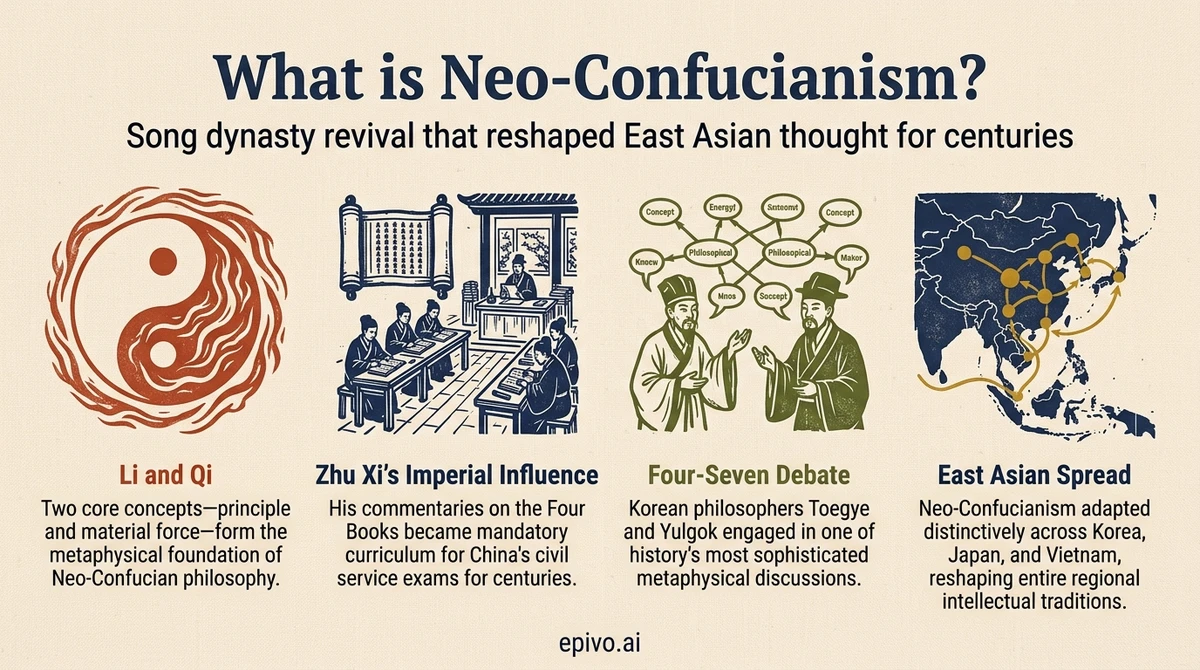
At the heart of Neo-Confucianism are two concepts: li (principle) and qi (material force). Understanding these is essential to grasping what is Neo-Confucianism as a philosophical system.
Zhu Xi and the investigation of things
Zhu Xi (1130-1200) is the most influential Neo-Confucian thinker. He argued that every object and event in the universe contains li — an underlying principle or pattern that makes it what it is. Qi is the material stuff that gives things their physical form. A tree has the li of "treeness" but is made actual by qi.
For Zhu Xi, li is primary and qi is secondary. Moral development requires understanding the principles embedded in the world. His method was gewu — the "investigation of things." By carefully studying nature, history, and human affairs, a person gradually uncovers the principles governing reality and aligns their conduct with them.
Zhu Xi organised the Four Books (Analects, Mencius, Great Learning, Doctrine of the Mean) into a curriculum that became the basis of China's civil service examinations for over five centuries.
Wang Yangming and innate knowledge
Wang Yangming (1472-1529) challenged Zhu Xi's approach. He argued that moral knowledge is not found by investigating external things but is already present within every person. He called this liangzhi — innate moral knowledge or "the good knowing."
Wang insisted on the unity of knowledge and action: if you truly know something is right, you will act on it. Failure to act proves that your knowledge is incomplete. This made Neo-Confucianism more accessible — you did not need years of scholarly study to become moral. You needed to listen to your conscience and act accordingly.
Image: Generated with AI (Epivo)
The spread to Korea and Japan
Neo-Confucianism did not remain a Chinese phenomenon. It spread across East Asia and was adapted in distinctive ways.
Korea: Toegye, Yulgok, and the Four-Seven Debate
Neo-Confucianism became the official state philosophy of Korea's Joseon dynasty (1392-1897). Two Korean philosophers — Yi Hwang (Toegye, 1501-1570) and Yi I (Yulgok, 1536-1584) — developed the tradition in ways that went beyond their Chinese predecessors.
Toegye emphasised li (principle) as active and capable of generating moral emotions. Yulgok argued that only qi (material force) could be active, and that li provides pattern but not movement. Their disagreement became the famous Four-Seven Debate: are the four moral beginnings (compassion, shame, deference, moral judgement) different in kind from the seven ordinary emotions (joy, anger, sadness, fear, love, hate, desire)?
This debate was not merely academic. It addressed a fundamental question about human nature: do we have a distinct moral capacity, or is morality simply one expression of our ordinary emotional life? Korean philosophy is deeply shaped by this conversation.
Japan: Official Tokugawa philosophy
In Japan, Hayashi Razan (1583-1657) promoted Zhu Xi's Neo-Confucianism as the official philosophy of the Tokugawa shogunate (1603-1868). Neo-Confucian ideas about social hierarchy and loyalty reinforced the rigid class structure of samurai, farmers, artisans, and merchants. Japanese thinkers also engaged with Wang Yangming's ideas, which influenced reformers and even some of the activists who later overthrew the Tokugawa regime.
Image: Generated with AI (Epivo)
Did you know?
-
Zhu Xi's commentaries on the Four Books became the required curriculum for China's imperial civil service examinations from 1313 until the system was abolished in 1905.
Stanford Encyclopedia of Philosophy — Neo-Confucianism -
The Four-Seven Debate between Korean philosophers Toegye and Yulgok is considered one of the most sustained philosophical exchanges in pre-modern East Asian history, spanning decades of correspondence.
Internet Encyclopedia of Philosophy — Korean Philosophy -
Wang Yangming developed key parts of his philosophy while serving as a provincial official in remote Guizhou — exiled there after criticising a powerful court eunuch.
Wikipedia — Wang Yangming
Why this tradition matters today
Understanding what is Neo-Confucianism helps students grasp ideas that continue to shape modern East Asia. The emphasis on education, moral self-cultivation, and the connection between knowledge and action remains influential in the educational cultures of China, South Korea, and Japan.
Neo-Confucianism also offers valuable perspectives on questions that Western philosophy addresses differently. Is moral knowledge something you discover through study, or something you already possess? Can you truly know something without acting on it? How do reason and emotion relate in moral life?
The tradition demonstrates how philosophies evolve. Neo-Confucianism was not a simple return to the past — it was a creative response to Buddhist challenges that transformed Confucianism into something new while preserving its ethical core. This pattern of revival and adaptation is relevant to any student thinking about how traditions change over time.
Epivo's International Curriculum covers Neo-Confucianism as part of a journey through Chinese, Korean, and Japanese philosophical traditions, placing it in dialogue with other global philosophies.

Image: Generated with AI (Epivo)
Frequently asked questions
- What is the difference between Confucianism and Neo-Confucianism?
- Classical Confucianism, founded by Confucius around 500 BCE, focuses on ethics, social relationships, and good governance. Neo-Confucianism, developed from the 11th century onwards, keeps these ethical concerns but adds a metaphysical framework — theories about principle (li) and material force (qi) that explain the nature of reality and human nature.
- Who was Zhu Xi?
- Zhu Xi (1130-1200) was the most influential Neo-Confucian philosopher. He synthesised earlier Song dynasty thought into a comprehensive system centred on the investigation of things (gewu) and the primacy of principle (li). His commentaries on the Four Books became the standard curriculum for Chinese civil service examinations for nearly six centuries.
- What was the Four-Seven Debate?
- The Four-Seven Debate was a philosophical exchange between Korean Neo-Confucians Toegye and Yulgok in the 16th century. They disagreed about whether the four moral beginnings (compassion, shame, deference, moral judgement) are fundamentally different from the seven ordinary emotions. The debate explored whether humans have a distinct moral capacity or whether morality arises from ordinary emotional life.
- How did Neo-Confucianism respond to Buddhism?
- Neo-Confucians believed Buddhism's focus on withdrawal from the world undermined social responsibility. They constructed a metaphysical system using the concepts of li (principle) and qi (material force) to match Buddhism's philosophical sophistication while reaffirming Confucian values of family, governance, and ethical engagement with the world.
- Is Neo-Confucianism still relevant today?
- Neo-Confucian ideas continue to shape education systems, family values, and cultural attitudes across East Asia. Its emphasis on moral self-cultivation, the connection between knowledge and action, and the value of education resonates in contemporary Chinese, Korean, and Japanese societies.