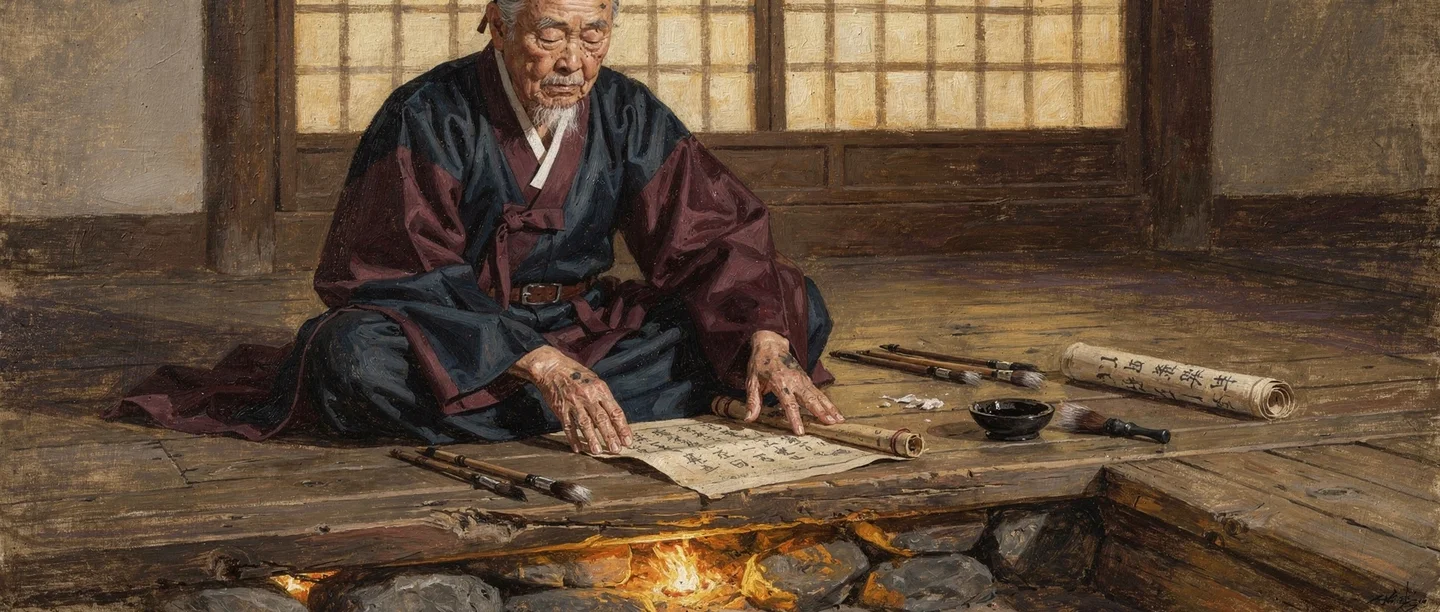
Korean Buddhist Foundations of Korean Philosophy
Korean philosophy began with the arrival of Buddhism from China in the 4th century CE. Korean monks did not simply adopt Chinese teachings. Instead, they transformed Buddhist ideas into something distinctly Korean.
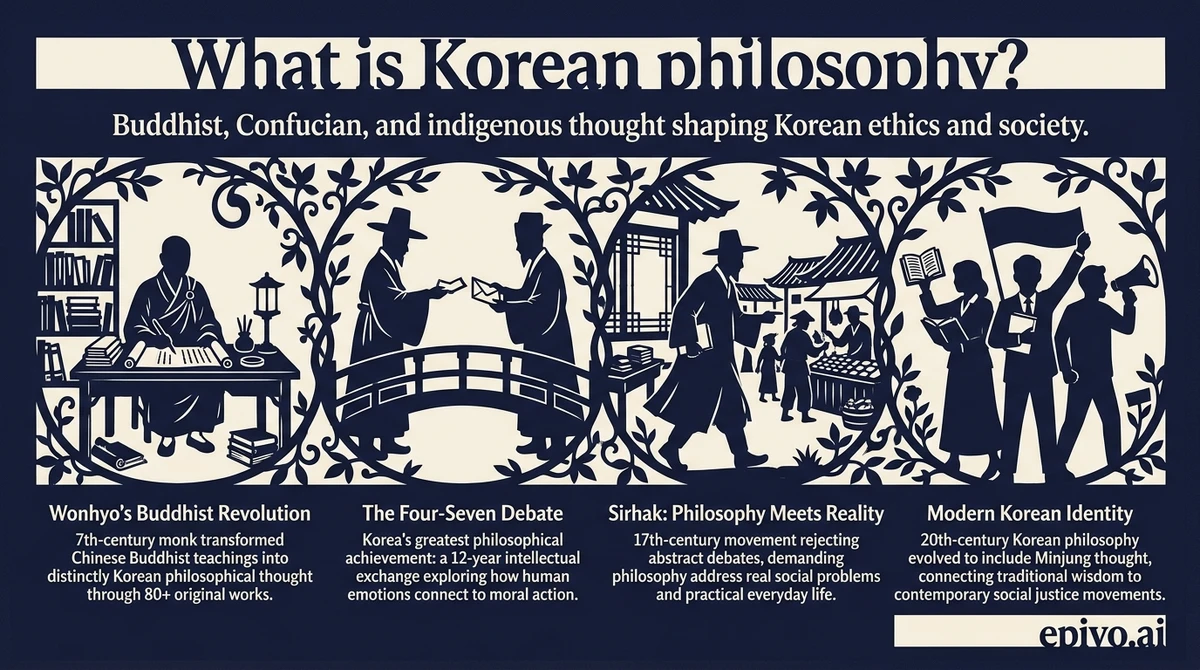
Wonhyo (617-686) is the most influential figure in early Korean philosophy. He argued that seemingly contradictory Buddhist schools actually shared a deeper harmony. His concept of hwajaeng (reconciliation of disputes) offered a bold claim. Apparent conflicts between philosophical positions arise from limited perspectives, not genuine contradiction. This synthesising approach became a defining feature of Korean thought for centuries afterward.
In the 12th century, Chinul (1158-1210) founded Korean Son Buddhism. Son is the Korean form of Chan (Zen) Buddhism, yet Chinul developed a unique Korean approach. He argued that sudden enlightenment and gradual cultivation must go together. A person might experience sudden insight into their true nature. However, they still need disciplined practice to live from that insight. The Stanford Encyclopedia of Philosophy notes that Chinul's synthesis remains central to Korean Buddhist practice today. This tradition of creative synthesis also connects Korean philosophy to the broader history of philosophy worldwide.
The Four-Seven Debate: Korean Philosophy's Greatest Contribution
The Four-Seven debate is widely considered Korean philosophy's most original intellectual achievement. It concerns the nature of human emotions and their relationship to moral action.
During the Joseon dynasty (1392-1897), Korea adopted Neo-Confucianism as its official state ideology. Korean scholars studied the Chinese thinker Zhu Xi intensely. In fact, they pushed his ideas in directions Chinese philosophers had not explored. The debate centres on a question from Confucian tradition. Are the Four Beginnings (compassion, shame, courtesy, moral judgment) fundamentally different from the Seven Emotions (joy, anger, sadness, fear, love, hatred, desire)?
Toegye Yi Hwang (1501-1570) argued that the Four Beginnings arise from li (principle or moral pattern). The Seven Emotions, he claimed, arise from gi (material energy). Therefore, some emotions are inherently moral and others are morally neutral. His rival Yulgok Yi I (1536-1584) disagreed. Yulgok insisted that li and gi can never operate independently. In his view, all emotions involve both principle and material energy working together. The Internet Encyclopedia of Philosophy calls this debate one of the most sophisticated analyses of moral psychology in world philosophy.
The debate continued for generations and shaped Korean intellectual life profoundly. It was not merely academic. Understanding what is Korean philosophy requires grasping this debate. How a society understands emotions determines how it approaches education, governance, and moral development.
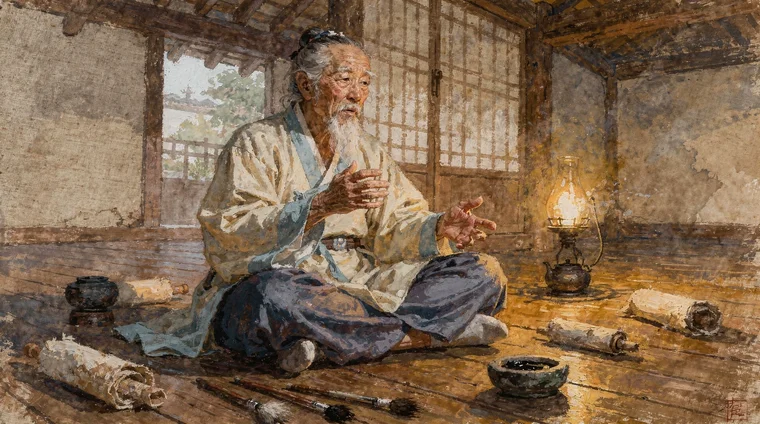
Image: Generated with AI (Epivo)
Sirhak and Donghak: Practical Learning and Korean Identity
By the 17th century, some Korean thinkers felt that Neo-Confucian debates had become too abstract. They launched the Sirhak (Practical Learning) movement, demanding that philosophy address real social problems.
Dasan Jeong Yakyong (1762-1836) was the most important Sirhak philosopher. He challenged the orthodox Neo-Confucian interpretation of human nature. He also argued for concrete reforms: land redistribution, better administration, and technological advancement. Dasan wrote over 500 volumes across philosophy, science, engineering, and governance. His work represents a distinctly Korean form of Enlightenment thinking that developed independently from European parallels.
In 1860, Choe Je-u founded Donghak (Eastern Learning) as a direct response to Western and Japanese encroachment. Donghak taught that every person carries the divine within them, a concept expressed as in nae cheon (humans are heaven). This idea challenged the rigid social hierarchies of Joseon Korea and inspired the Donghak Peasant Revolution of 1894. Donghak philosophy combined elements of Confucianism, Buddhism, and Korean shamanism into something entirely new.
During the Japanese colonial period (1910-1945), Korean philosophy became a form of resistance. Thinkers like Park Eun-sik and Ham Sok-hon worked to preserve Korean identity through writing. They persisted even as colonial authorities suppressed Korean language and culture.

Image: Generated with AI (Epivo)
Did you know?
-
Wonhyo wrote over 80 works on Buddhist philosophy in the 7th century, making him one of the most prolific philosophers in East Asian history.
Stanford Encyclopedia of Philosophy — Korean Philosophy -
The Four-Seven debate between Toegye and Yulgok lasted over 12 years through formal letters and produced some of the most detailed analyses of emotions in world philosophy.
Internet Encyclopedia of Philosophy — Korean Neo-Confucianism -
Dasan Jeong Yakyong wrote more than 500 volumes during his 18-year exile, covering philosophy, governance, engineering, and medicine.
Encyclopaedia Britannica — Korean Philosophy
Modern Korean Philosophy and Its Global Significance
Korean philosophy continued to evolve through the 20th century and into the present day. Anyone asking what is Korean philosophy must also consider its modern chapters. After liberation from Japan in 1945 and the Korean War (1950-1953), South Korean thinkers developed Minjung philosophy. Minjung means 'the people.' This movement argued that ordinary people — not elites — are the true subjects of history.
Minjung philosophy drew on Korean Buddhism, Donghak thought, and Western critical theory. It challenged authoritarian rule during the 1970s and 1980s. It provided intellectual foundations for South Korea's democracy movement, showing how philosophy can drive real political change.
Today, Korean philosophy attracts growing attention from scholars worldwide. Korean philosophy emphasises reconciling opposites and analysing the connection between emotions and morality. Its tradition of linking thought to social action offers fresh perspectives that Western philosophy lacks. Encyclopaedia Britannica argues that Korean philosophy deserves recognition as a major independent tradition. It is far more than a branch of Chinese thought.
Image: Generated with AI (Epivo)
Frequently asked questions
- How is Korean philosophy different from Chinese philosophy?
- Korean philosophy draws heavily on Chinese traditions, especially Confucianism and Buddhism. However, Korean thinkers developed original ideas that Chinese philosophers did not pursue. The Four-Seven debate, Wonhyo's hwajaeng method, and Donghak are all distinctly Korean contributions. Korean philosophy also emphasises practical application and emotional cultivation in ways that differ from Chinese approaches.
- What is the Four-Seven debate in Korean philosophy?
- The Four-Seven debate was a 16th-century philosophical exchange about whether moral emotions (the Four Beginnings) are fundamentally different from ordinary emotions (the Seven Emotions). Toegye argued they have different sources, while Yulgok argued all emotions involve both moral principle and material energy. This debate became Korean philosophy's most original contribution to world thought.
- Who are the most important Korean philosophers?
- Key figures include Wonhyo (7th century, Buddhist synthesis), Chinul (12th century, Korean Son Buddhism), Toegye Yi Hwang and Yulgok Yi I (16th century, Neo-Confucian Four-Seven debate), Dasan Jeong Yakyong (18th-19th century, Sirhak movement), and Choe Je-u (19th century, Donghak founder). Each shaped a different era of Korean thought.
- What is Sirhak in Korean philosophy?
- Sirhak means Practical Learning. It was a 17th-19th century movement that criticised abstract Neo-Confucian speculation and called for philosophy to address real social problems. Sirhak thinkers advocated land reform, technological development, and administrative improvements. Dasan Jeong Yakyong was the movement's leading figure.
- Is Korean philosophy still relevant today?
- Korean philosophy is increasingly studied worldwide. Its methods of reconciling opposing viewpoints, its analysis of the relationship between emotions and morality, and its tradition of linking philosophy to social justice remain relevant. Minjung philosophy influenced South Korea's democracy movement, and Korean philosophical concepts now contribute to global conversations about ethics and governance.