
Origins of Zen Buddhism: From China to Japan
To understand what is Zen Buddhism, we must start with its origins. Zen traces its roots to Chan Buddhism, which developed in China during the 6th and 7th centuries. According to tradition, the Indian monk Bodhidharma brought meditation-centred Buddhist practice to China around 520 CE. Chan blended Indian Buddhist meditation with elements of Chinese Daoism, creating a distinctive approach that valued direct experience over textual study.
Chan Buddhism reached Japan in the 12th and 13th centuries. Two Japanese monks played a central role in this transmission. Eisai (1141-1215) introduced the Rinzai school after studying in China. Dogen (1200-1253) later founded the Soto school after his own training there. Both schools took root in Japan and developed into the forms of Zen Buddhism practised today.
The word 'Zen' itself comes from the Japanese pronunciation of the Chinese word 'Chan,' which in turn derives from the Sanskrit 'dhyana,' meaning meditation or contemplation. Therefore, the very name of the tradition points to its core practice: seated meditation as a path to awakening.
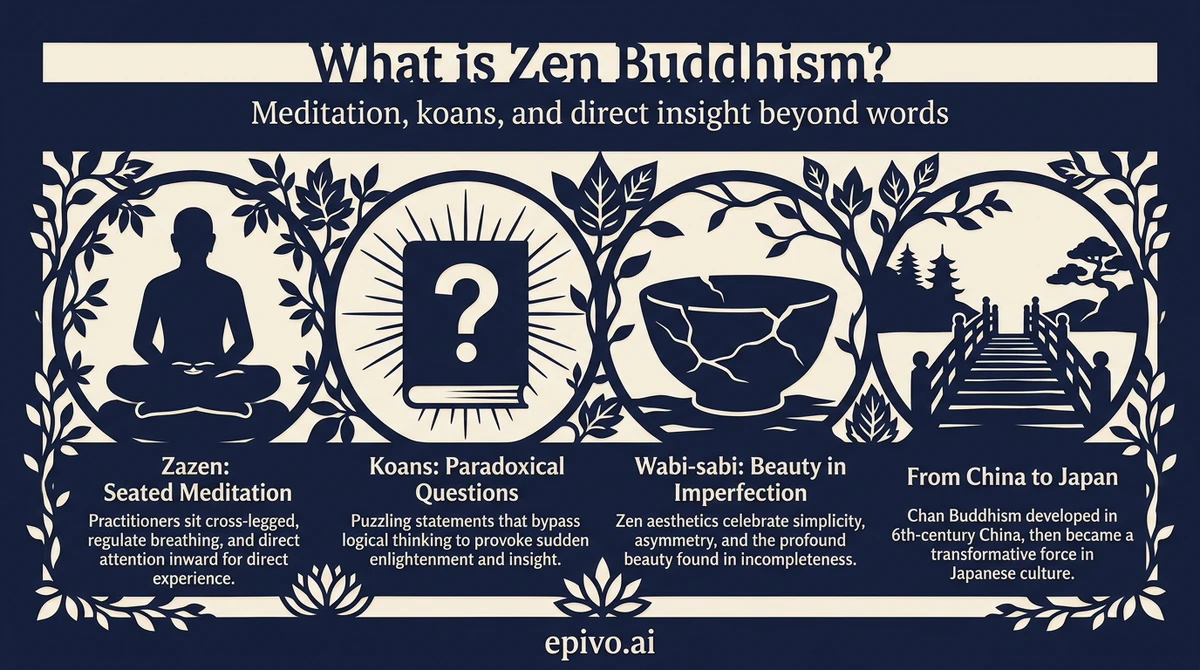
Zen Practices: Zazen, Koans, and the Two Schools
Zazen, or seated meditation, is the foundation of all Zen practice. Practitioners sit in a cross-legged posture, regulate their breathing, and direct attention inward. However, the two main schools of Zen Buddhism approach meditation differently.
Soto Zen and shikantaza
Dogen's Soto school teaches shikantaza, which translates as 'just sitting.' In this practice, the meditator sits without focusing on any object, mantra, or goal. Dogen taught that zazen is not a means to achieve enlightenment but is itself the expression of enlightenment. Soto Zen emphasises gradual cultivation through daily meditation and mindful attention to ordinary activities.
Rinzai Zen and koan practice
The Rinzai school, by contrast, uses koans as a central training method. A koan is a paradoxical question or statement that cannot be solved through logical reasoning. Famous examples include 'What is the sound of one hand clapping?' and 'What was your original face before your parents were born?' A teacher assigns a koan to a student, who must demonstrate genuine insight during private interviews. As the Internet Encyclopedia of Philosophy explains, koans push practitioners beyond conceptual thinking toward direct, intuitive understanding.
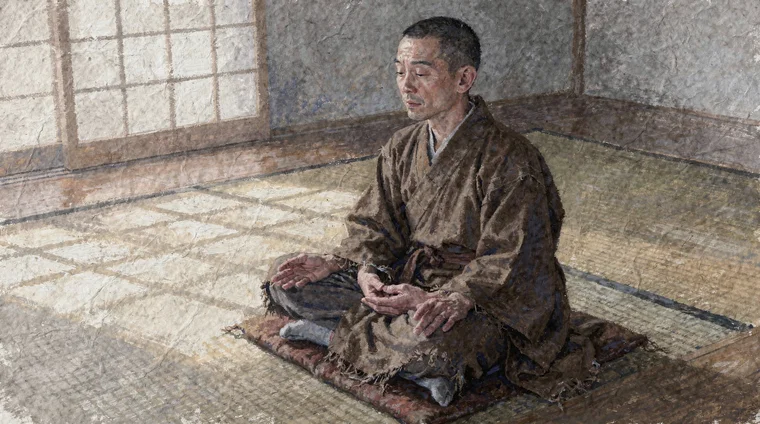
Image: Generated with AI (Epivo)
Core Concepts in Zen Buddhism
Understanding what is Zen Buddhism also requires exploring its core philosophical ideas, which distinguish it from other Buddhist traditions.
Emptiness (sunyata) is a central concept. In Zen, all things lack a fixed, independent self-nature. This does not mean nothing exists. Instead, it means that everything arises through interdependent conditions. Understanding emptiness frees practitioners from rigid attachments to ideas, possessions, and even the self.
Beginner's mind (shoshin) refers to approaching experience with openness and curiosity, free from assumptions. Shunryu Suzuki, a 20th-century Zen teacher, wrote: 'In the beginner's mind there are many possibilities, but in the expert's mind there are few.' This concept encourages continuous learning and humility.
Non-attachment is the practice of engaging fully with life without clinging to outcomes. Zen does not teach detachment from the world. Rather, it teaches full participation without possessiveness. These ideas connect Zen to broader philosophical traditions. The ancient Greek Stoics similarly distinguished between what we can and cannot control, as explored in ancient Greek philosophy.
Direct experience stands at the heart of Zen. The tradition famously distrusts purely intellectual understanding. Zen teachings point toward knowledge gained through practice and personal insight, not through reading or argument alone.

Image: Generated with AI (Epivo)
Zen's Influence on Japanese Culture and the West
Zen Buddhism shaped Japanese culture more deeply than almost any other single force. Its aesthetic values — simplicity, asymmetry, naturalness, and the beauty of imperfection (wabi-sabi) — are visible across Japanese art, architecture, and daily life.
The Japanese tea ceremony (chado) reflects Zen principles of mindful attention and finding depth in simple actions. Zen gardens, with their carefully raked gravel and minimal stone arrangements, embody the Zen emphasis on contemplation and empty space. In addition, Zen influenced calligraphy, ink painting, flower arranging (ikebana), and Noh theatre. Martial arts such as kendo, archery, and judo also absorbed Zen ideas about presence, discipline, and the unity of mind and body.
Zen reached Western audiences primarily through the work of D.T. Suzuki (1870-1966), a Japanese scholar who wrote extensively in English. His books introduced Zen to European and American intellectuals during the mid-20th century. Suzuki influenced writers, artists, and musicians, including the Beat poets and composer John Cage. Today, Zen meditation centres operate worldwide, and Zen concepts like mindfulness have entered mainstream Western culture. For many newcomers, the question of what is Zen Buddhism leads first to a meditation cushion rather than a textbook. The relationship between Eastern and Western philosophical traditions continues to generate productive dialogue.
Confucian values of self-cultivation and moral discipline also shaped Japanese Zen, since Confucianism deeply influenced East Asian culture alongside Buddhism.

Image: Generated with AI (Epivo)
Frequently asked questions
- What is the difference between Zen Buddhism and other forms of Buddhism?
- Zen emphasises meditation and direct personal experience over scripture study and ritual. While Theravada Buddhism focuses on monastic discipline and Tibetan Buddhism includes elaborate visualisation practices, Zen strips away complexity. It points to awakening through simple, sustained meditation practice and everyday mindfulness.
- What is a koan in Zen Buddhism?
- A koan is a paradoxical question or story used as a meditation tool in Rinzai Zen. Examples include 'What is the sound of one hand clapping?' Koans cannot be answered through logic. They are designed to push the practitioner beyond conceptual thinking toward direct, intuitive insight.
- Do you have to be religious to practise Zen meditation?
- No. Many people practise zazen (seated Zen meditation) without adopting Buddhist beliefs. Zen centres worldwide welcome secular practitioners. The core practice of focused, silent sitting has documented benefits for concentration and stress reduction, regardless of religious commitment.
- What does wabi-sabi mean in Zen culture?
- Wabi-sabi is a Japanese aesthetic concept rooted in Zen Buddhism. It finds beauty in imperfection, impermanence, and incompleteness. A cracked tea bowl, a weathered wooden gate, or an asymmetrical garden arrangement all express wabi-sabi. The concept reflects the Zen understanding that nothing is permanent or perfect.
- Who brought Zen Buddhism to the West?
- D.T. Suzuki (1870-1966) was the most influential figure in introducing Zen to Western audiences. His English-language books on Zen reached European and American readers from the 1920s onward. Later teachers such as Shunryu Suzuki and Thich Nhat Hanh helped establish Zen meditation practice in Western countries.