
What is the Talmud and what does it contain?
The Talmud is built from two layers. The first is the Mishnah, a compilation of Jewish oral law organised into six orders (sedarim) covering agriculture, festivals, family law, civil law, temple rituals, and purity. The Mishnah was codified around 200 CE by Rabbi Judah ha-Nasi and his circle of scholars. It brought centuries of oral tradition into a written, structured form for the first time.
The second layer is the Gemara, a vast body of commentary, analysis, and debate on the Mishnah. Generations of rabbis discussed, questioned, and expanded on each passage of the Mishnah — often disagreeing sharply with one another. The Gemara records these arguments, preserving minority opinions alongside majority rulings.
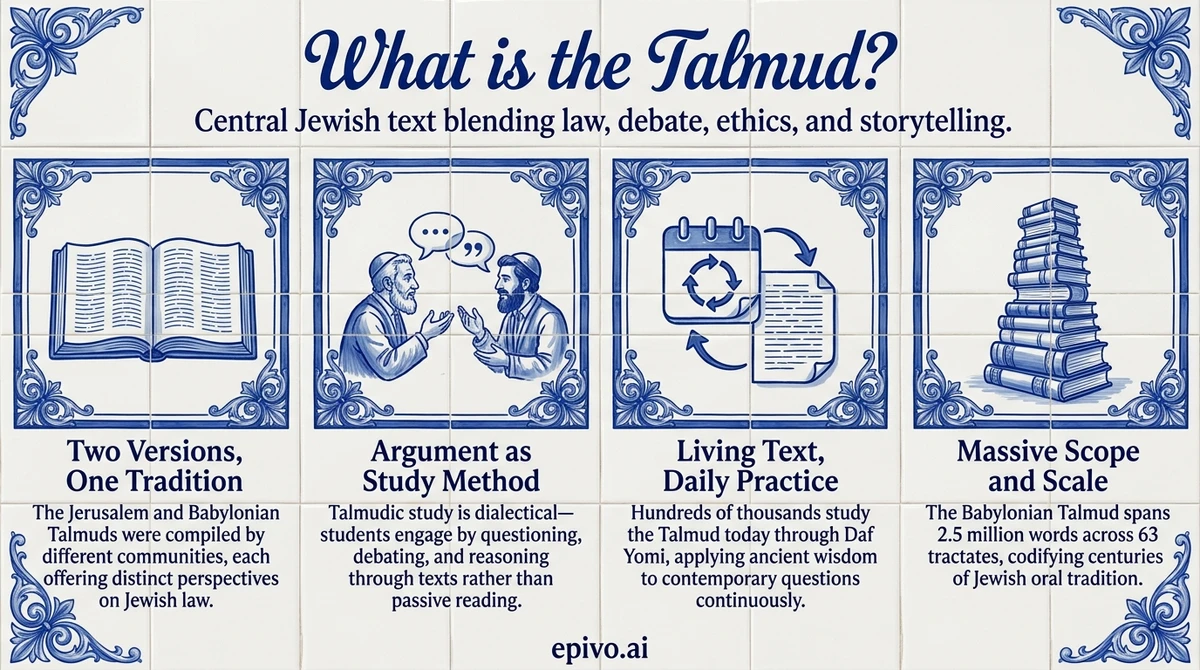
Together, the Mishnah and Gemara form the Talmud. The text is organised into 63 tractates (masekhtot) across the six orders. Each tractate addresses a specific area of law or life — from Shabbat observance to business ethics, from marriage to criminal justice.
What makes the Talmud distinctive is that it does not simply state rules. It shows how scholars reason through problems, weigh evidence, and arrive at conclusions. The process of reasoning matters as much as the result. As the Stanford Encyclopedia of Philosophy notes, the Talmud is as much a record of intellectual method as it is a legal code.
Two versions: Babylonian and Jerusalem
There are actually two versions of the Talmud, produced by different communities.
The Jerusalem Talmud (Yerushalmi)
The Jerusalem Talmud was compiled by scholars in the Land of Israel, primarily in academies at Tiberias and Caesarea. It was completed around 400 CE. It covers most of the Mishnah's six orders but is shorter and less polished than its Babylonian counterpart. Scholars believe its editing was cut short by political instability and the decline of the Jewish community in Roman Palestine.
The Babylonian Talmud (Bavli)
The Babylonian Talmud was compiled by scholars in the great academies of Mesopotamia — particularly Sura and Pumbedita (in modern-day Iraq). It was completed around 500 CE and is roughly three times the length of the Jerusalem Talmud. The Bavli is more thoroughly edited, more wide-ranging in its discussions, and includes more aggadah — the narrative, ethical, and philosophical material that sits alongside legal analysis.
When people refer to "the Talmud" without qualification, they almost always mean the Babylonian Talmud. It became the authoritative text for Jewish philosophical and legal tradition and remains the primary text studied in yeshivot (academies of Jewish learning) worldwide.
Image: Generated with AI (Epivo)
How the Talmud is studied
Talmud study is unlike reading any ordinary book. The text is not meant to be read passively — it is meant to be argued with.
Dialectical reasoning
The Talmud's method is dialectical: a statement is made, then challenged, then defended, then challenged again from a different angle. Scholars call this the sugya — a sustained unit of argumentation that can stretch across many pages. A single legal question might generate a discussion involving rabbis who lived centuries apart, as if they were debating face to face.
This method teaches students to consider multiple perspectives, anticipate objections, and distinguish between strong and weak arguments. It is one of the oldest systematic traditions of critical thinking in world philosophy.
Chevruta: paired study
The traditional method of Talmud study is chevruta — learning in pairs. Two students sit together with a passage and argue through it, challenging each other's readings and testing interpretations. This practice is central to the yeshiva tradition and reflects the Talmud's own method: knowledge is produced through dialogue, not received in silence.
Halakha and aggadah
The Talmud contains two broad categories of material. Halakha is the legal content — rulings, procedures, and debates about how Jewish law should be applied. Aggadah is everything else — stories, parables, ethical reflections, historical anecdotes, and even discussions of medicine, astronomy, and dreams. According to My Jewish Learning, roughly one-third of the Babylonian Talmud is aggadah.

Image: Generated with AI (Epivo)
Did you know?
-
The Babylonian Talmud contains approximately 2.5 million words across 63 tractates, making it one of the largest religious texts ever compiled.
Wikipedia — Talmud -
The Mishnah was codified around 200 CE by Rabbi Judah ha-Nasi, bringing centuries of oral tradition into written form for the first time.
My Jewish Learning — Talmud 101 -
The Daf Yomi cycle — a programme of studying one page of Talmud per day — takes approximately seven and a half years to complete the entire Babylonian Talmud.
Wikipedia — Daf Yomi
Why this ancient text still matters today
The Talmud is not a historical artefact. It remains a living text — studied daily by hundreds of thousands of people and continuously applied to new questions.
Influence on Jewish law and ethics
Jewish law (halakha) as practised today is derived primarily from the Talmud. Questions about Shabbat observance, dietary laws, business ethics, and family relationships are resolved by consulting Talmudic precedent and the commentaries built upon it. Major medieval scholars like Rashi (1040–1105) and the Tosafists wrote line-by-line commentaries on the Talmud that are still printed alongside the original text on every page.
Influence on broader intellectual life
The Talmud's methods of argumentation have influenced fields far beyond Jewish studies. Legal scholars have noted parallels between Talmudic reasoning and common-law case analysis. The tradition of preserving dissenting opinions mirrors practices in modern appellate courts. The emphasis on questioning authority and testing ideas through debate resonates with broader traditions in philosophy and human rights discourse.
Daf Yomi: a global study movement
Since 1923, the Daf Yomi programme has encouraged Jews worldwide to study one page (daf) of Talmud per day. The entire cycle takes about seven and a half years. Hundreds of thousands of participants follow the programme, creating a shared global conversation around the same text on the same day.

Image: Generated with AI (Epivo)
Frequently asked questions
- What is the Talmud in simple terms?
- The Talmud is the central text of Rabbinic Judaism. It combines the Mishnah (a collection of Jewish oral law compiled around 200 CE) with the Gemara (centuries of rabbinic commentary and debate). It covers law, ethics, philosophy, and storytelling across 63 tractates.
- What is the difference between the Torah and the Talmud?
- The Torah refers to the five books of Moses (Genesis, Exodus, Leviticus, Numbers, Deuteronomy) — the foundational written scripture of Judaism. The Talmud is the record of oral law and rabbinic discussion that interprets and expands upon the Torah. Jewish tradition regards both as essential: the Torah as the written law, the Talmud as the oral law.
- How long does it take to study the entire Talmud?
- The Daf Yomi programme — studying one page per day — takes about seven and a half years to complete the entire Babylonian Talmud. However, serious Talmud study is not about finishing; scholars may spend weeks or months on a single tractate, returning to the same passages throughout their lives.
- Is the Talmud only about religious law?
- No. While legal analysis (halakha) forms the core of the Talmud, roughly one-third of the Babylonian Talmud consists of aggadah — narrative material including stories, ethical teachings, parables, historical accounts, and discussions of science, medicine, and dreams. The Talmud is as much a work of philosophy and literature as it is a legal code.
- Why are there two Talmuds?
- The two Talmuds were produced by different scholarly communities. The Jerusalem Talmud (Yerushalmi) was compiled in the Land of Israel around 400 CE. The Babylonian Talmud (Bavli) was compiled in Mesopotamia around 500 CE. The Babylonian version is longer, more thoroughly edited, and became the authoritative text for mainstream Jewish law and practice.