
Biblical and Talmudic Foundations of Jewish Philosophy
Jewish philosophy begins not in a university but in sacred texts. The Hebrew Bible poses profound philosophical questions about justice, suffering, and the nature of God. The Book of Job, for example, asks why the innocent suffer — a question philosophers call theodicy. Ecclesiastes questions whether human effort has lasting meaning. These texts do not offer neat answers. Instead, they model a habit of questioning that defines Jewish philosophical thought.
After the destruction of the Second Temple in 70 CE, the rabbis of the Talmud developed a legal and ethical reasoning tradition called halakha. Halakha governs daily life through detailed interpretation of biblical commandments. However, Talmudic debate is also philosophical. Rabbis argued about free will, divine providence, and the limits of human knowledge.
This tradition established a distinctive feature of Jewish philosophy: thinking through law. In contrast to Greek philosophy, which often separates theory from practice, Jewish thinkers have consistently connected abstract ideas to concrete ethical obligations. The dialogue between ancient Greek thought and Jewish reasoning would become central to medieval Jewish philosophy.
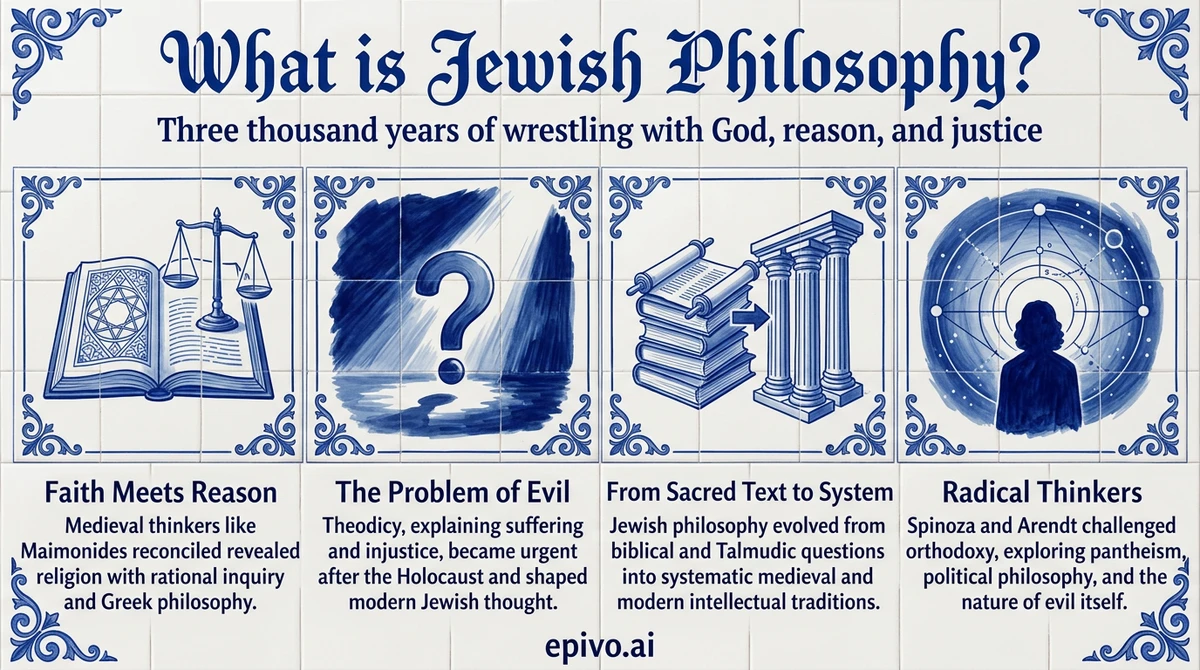
Medieval Jewish Philosophy: Faith Meets Reason
The medieval period produced the most systematic works of Jewish philosophy. These thinkers faced a central question: how does revealed religion relate to rational inquiry?
Saadia Gaon
Saadia Gaon (882–942) wrote The Book of Beliefs and Opinions, the first major work of Jewish philosophy. He argued that reason and revelation cannot truly conflict. When they appear to disagree, he maintained, we must reinterpret the scriptural passage. This principle shaped centuries of Jewish thought.
Judah Halevi
Judah Halevi (c. 1075–1141) took a different approach. In his dialogue The Kuzari, he argued that Jewish faith rests not on philosophical proof but on the historical experience of an entire people at Mount Sinai. He valued lived religious experience over abstract reasoning.
Maimonides
Moses Maimonides (1138–1204) is the most influential Jewish philosopher in history. His Guide for the Perplexed reconciled Aristotelian philosophy with Jewish theology. According to the Stanford Encyclopedia of Philosophy, Maimonides argued that many biblical descriptions of God are metaphorical and that reason is essential for understanding scripture. His legal code, the Mishneh Torah, remains authoritative in Jewish law today.

Image: Generated with AI (Epivo)
Jewish Philosophy in the Modern Era
The modern period transformed Jewish philosophy through encounters with science, secularism, and political emancipation.
Spinoza and the Enlightenment
Baruch Spinoza (1632–1677) broke radically with tradition. He rejected the idea of a personal God and argued that God and nature are identical. The Amsterdam Jewish community excommunicated him in 1656. Despite this, Spinoza became one of the most important philosophers of the Enlightenment. His ideas about biblical criticism, democracy, and freedom of thought influenced thinkers across Europe.
Martin Buber
Martin Buber (1878–1965) developed a philosophy of dialogue. His most famous work, I and Thou (1923), argues that authentic human existence depends on genuine encounter with others. Buber distinguished between treating people as objects to be used and meeting them as full subjects. His ideas influenced theology, psychology, and education.
Emmanuel Levinas
Emmanuel Levinas (1906–1995) placed ethics at the centre of philosophy. Drawing on both Talmudic study and phenomenology, he argued that our responsibility to others comes before all other philosophical questions. According to Encyclopaedia Britannica, Levinas saw the face of the other person as an ethical demand that cannot be ignored.

Image: Generated with AI (Epivo)
Did you know?
-
Maimonides' Guide for the Perplexed (c. 1190) was originally written in Arabic and later translated into Hebrew. It influenced not only Jewish thought but also Christian theologians including Thomas Aquinas.
Stanford Encyclopedia of Philosophy — Maimonides -
Baruch Spinoza was excommunicated from the Amsterdam Jewish community in 1656 at the age of 23. The ban was never lifted, but Spinoza is now widely regarded as one of the founders of modern philosophy.
Stanford Encyclopedia of Philosophy — Spinoza -
Hannah Arendt coined the phrase 'the banality of evil' in her 1963 report on the trial of Adolf Eichmann, arguing that great evil can be committed by ordinary people following orders without thinking.
Internet Encyclopedia of Philosophy — Hannah Arendt
Key Themes in Jewish Philosophy Today
To understand what is Jewish philosophy at a deeper level, it helps to examine the themes that connect its ancient and modern periods.
The problem of evil — theodicy — became especially urgent after the Holocaust. How can one believe in a just God after the murder of six million Jews? Thinkers like Emil Fackenheim and Richard Rubenstein offered radically different responses. Fackenheim argued that Jews have a duty not to grant Hitler a posthumous victory by abandoning faith. Rubenstein questioned whether traditional theology could survive Auschwitz at all. This debate remains one of the most important in contemporary Jewish philosophy.
The relationship between faith and reason is another enduring theme. Jewish philosophy has never fully separated the two. Even the most rationalist thinkers, like Maimonides, worked within a framework of religious commitment. In addition, the dialogue between Jewish and Western philosophy continues to produce new insights in ethics, political theory, and the philosophy of religion.
Hannah Arendt (1906–1975) brought Jewish philosophical concerns into political thought. Her analysis of totalitarianism and her concept of the banality of evil transformed how we understand political violence and moral responsibility. Arendt insisted that thinking itself is a moral act — an idea rooted in the Jewish tradition of questioning and debate.
For students exploring these questions, Jewish philosophy offers a powerful example of how a living tradition engages critically with the biggest questions human beings face. Its emphasis on ethical obligation, textual reasoning, and the courage to question makes it essential reading for anyone studying world philosophy.

Image: Generated with AI (Epivo)
Frequently asked questions
- What is the main idea of Jewish philosophy?
- Jewish philosophy explores the relationship between faith and reason, ethical obligation, and the nature of God. It is distinguished by its emphasis on law (halakha), textual interpretation, and the connection between abstract ideas and concrete moral action.
- Who is the most important Jewish philosopher?
- Moses Maimonides (1138–1204) is widely considered the most influential Jewish philosopher. His Guide for the Perplexed reconciled Aristotelian reasoning with Jewish theology and shaped both Jewish and Christian thought for centuries.
- How does Jewish philosophy differ from Western philosophy?
- Jewish philosophy shares many questions with Western philosophy but approaches them through scriptural interpretation and legal reasoning. It emphasises ethics and communal responsibility, and it treats the dialogue between faith and reason as a central concern rather than a problem to resolve.
- What is theodicy in Jewish philosophy?
- Theodicy is the attempt to explain why evil and suffering exist if God is just and powerful. The Holocaust made this question especially urgent for Jewish thinkers. Responses range from reaffirming faith to fundamentally rethinking the concept of God.
- Why was Spinoza excommunicated?
- Baruch Spinoza was excommunicated from the Amsterdam Jewish community in 1656 for views considered heretical. He rejected a personal God, denied the divine origin of the Torah, and argued that God and nature are the same. Despite this, he became a foundational figure in modern philosophy.