The Origins of Islamic Philosophy
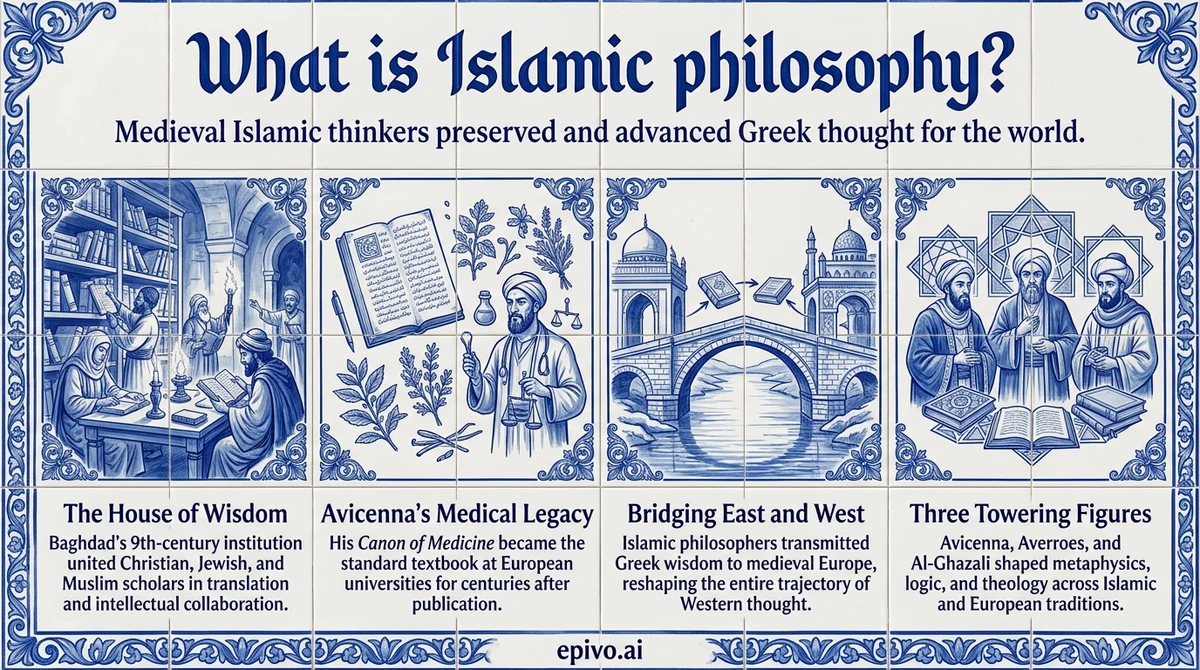
Islamic philosophy — known as falsafa — emerged in the 8th century when Muslim scholars began translating ancient Greek texts into Arabic. This movement centred on Baghdad's famous House of Wisdom, where scholars of different faiths worked together to preserve and expand human knowledge.
The catalyst was a massive translation effort. Works by Aristotle, Plato, Galen, and Euclid were rendered into Arabic, often via Syriac intermediaries. As a result, Islamic scholars gained access to the full breadth of ancient Greek thought. They did not merely copy these ideas, however. They debated, refined, and extended them.
Alongside falsafa, a distinct tradition called kalam (rational theology) developed. Kalam thinkers used logical reasoning to defend and explore Islamic beliefs. The Mu'tazilites, for example, argued that God's justice required human free will — a position they defended using Greek philosophical tools. This interplay between faith and reason became the defining tension of Islamic philosophy.
Al-Kindi (c. 801–873), often called the first Arab philosopher, pioneered the effort to harmonise Greek philosophy with Islamic theology. He argued that philosophy and revelation were complementary paths to truth — a bold claim that shaped centuries of debate.
The Great Thinkers: Avicenna, Averroes, and Al-Ghazali
Islamic philosophy produced several thinkers whose influence reached far beyond the Islamic world. Three stand out above all others.
Avicenna (Ibn Sina, 980–1037)
Avicenna was a Persian polymath — philosopher, physician, and scientist. His Canon of Medicine remained a standard medical textbook in European universities until the 17th century. In philosophy, his proof of God's existence through the distinction between essence and existence became foundational. He developed sophisticated theories of the soul, knowledge, and the nature of reality.
Al-Ghazali (1058–1111)
Al-Ghazali was perhaps the most influential Muslim thinker after Muhammad. In his famous work The Incoherence of the Philosophers, he attacked the claims of falsafa philosophers — arguing that philosophy could not prove key theological truths like the creation of the world or the immortality of the soul. His critique did not reject reason entirely, but insisted on its limits. He also championed Sufism (Islamic mysticism) as a path to genuine knowledge of God.
Averroes (Ibn Rushd, 1126–1198)
Averroes, a Spanish-Muslim philosopher from Cordoba, wrote The Incoherence of the Incoherence — a direct rebuttal to Al-Ghazali. He argued that philosophy and religion could not contradict each other because both seek truth. His detailed commentaries on Aristotle earned him the title "The Commentator" in medieval Europe. According to the Stanford Encyclopedia of Philosophy, Averroes had a greater impact on Christian and Jewish philosophy than on later Islamic thought.

Image: Generated with AI (Epivo)
How Islamic Philosophy Shaped the West
The transmission of Islamic philosophy to medieval Europe is one of the most important chapters in intellectual history. It fundamentally altered the course of Western thought.
During the 12th and 13th centuries, scholars in Spain and Sicily translated Arabic philosophical and scientific texts into Latin. Toledo became a centre of this translation movement. Through these translations, European thinkers gained access to Aristotle's complete works — texts that had been lost to the Latin-speaking world for centuries.
Thomas Aquinas, the most important medieval Christian philosopher, relied heavily on Averroes's commentaries on Aristotle. The structure of Aquinas's arguments about faith and reason mirrors the debates that Islamic philosophers had conducted for three centuries before him.
Moreover, Islamic contributions extended beyond philosophy. Al-Khwarizmi's mathematical innovations gave us the word "algorithm." Ibn al-Haytham pioneered the scientific method through his work on optics. These intellectual achievements laid groundwork for the Enlightenment and the Scientific Revolution.
As the British Library's collection guide notes, Islamic philosophy served as the essential bridge between classical antiquity and the European Renaissance.

Image: Generated with AI (Epivo)
Did you know?
-
The House of Wisdom in Baghdad (founded c. 830 CE) employed Christian, Jewish, and Muslim scholars who translated virtually the entire Greek philosophical and scientific corpus into Arabic.
Encyclopaedia Britannica — House of Wisdom -
Avicenna's Canon of Medicine was used as a medical textbook at European universities including Montpellier and Leuven until the mid-1600s — roughly 600 years after it was written.
Stanford Encyclopedia of Philosophy — Ibn Sina -
Between the 9th and 13th centuries, more philosophical and scientific works were produced in Arabic than in any other language in the world.
British Library — Islamic Philosophy
Why Islamic Philosophy Matters Today
Studying Islamic philosophy matters for several reasons. First, it corrects a common distortion in how intellectual history is taught. The standard narrative — "Greeks, then darkness, then Renaissance" — ignores the centuries of vibrant scholarship in the Islamic world that made the Renaissance possible.
Second, Islamic philosophy demonstrates that the relationship between faith and reason is not a simple opposition. Thinkers like Al-Kindi, Avicenna, and Averroes showed that rational inquiry and religious commitment can coexist and enrich each other. Al-Ghazali showed that critique of philosophy can itself be philosophically sophisticated.
Third, many questions that Islamic philosophers wrestled with remain alive today. Can reason prove God's existence? Do humans have free will? What is the relationship between scientific knowledge and moral truth? These are not merely historical curiosities — they are questions that thoughtful people of every background continue to debate.
Finally, understanding Islamic philosophy helps students appreciate the genuinely global nature of the philosophical tradition. Philosophy is not exclusively Western. It is a shared human enterprise that has flourished across cultures and centuries.
Image: Generated with AI (Epivo)
Frequently asked questions
- What is Islamic philosophy in simple terms?
- Islamic philosophy is the tradition of rational inquiry that developed in the Islamic world from the 8th century onward. Scholars used Greek philosophical methods to explore questions about God, knowledge, existence, and ethics within an Islamic intellectual context.
- Who were the most important Islamic philosophers?
- The most influential include Al-Kindi, Al-Farabi, Avicenna (Ibn Sina), Al-Ghazali, and Averroes (Ibn Rushd). Each made distinctive contributions to metaphysics, theology, logic, and the debate over the relationship between reason and faith.
- How did Islamic philosophy influence Europe?
- Arabic translations of Greek texts were translated into Latin in 12th-century Spain and Sicily. European thinkers like Thomas Aquinas built directly on the work of Averroes and Avicenna. Without Islamic philosophy, medieval Europe would have lacked access to Aristotle.
- What is the difference between falsafa and kalam?
- Falsafa refers to the tradition of philosophical inquiry inspired by Greek sources. Kalam is rational theology — using logical arguments to defend and explore Islamic doctrines. Both use reason, but kalam starts from religious premises while falsafa starts from philosophical ones.
- Is Islamic philosophy still relevant today?
- Absolutely. Its questions about faith and reason, free will, and the nature of knowledge remain central to modern philosophy and theology. It also offers an important corrective to the myth that philosophy is an exclusively Western tradition.