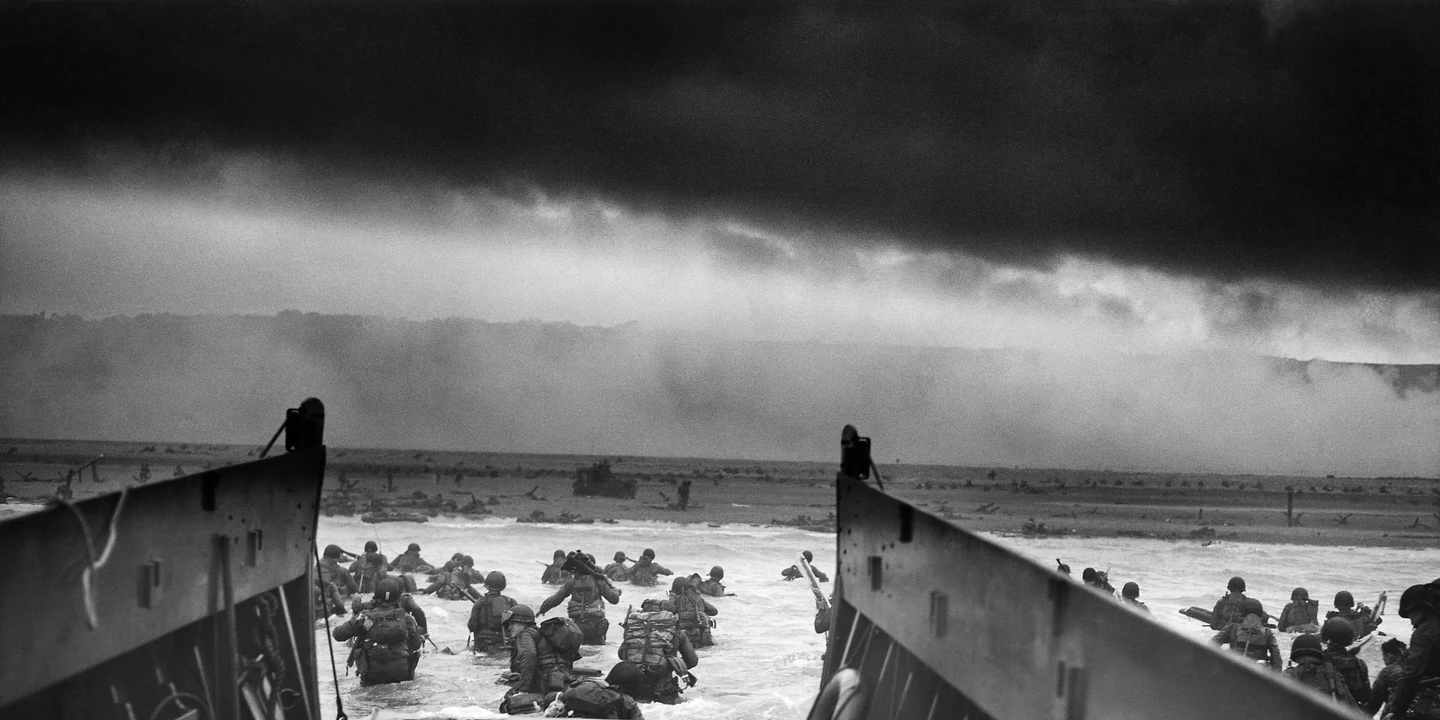
What was D-Day and why did it happen?
D-Day was the Allied invasion of German-occupied France, launched on 6 June 1944 under the codename Operation Overlord. By 1944, Nazi Germany controlled most of Western Europe, and the Allies needed to open a second front to relieve pressure on the Soviet Union in the East.
Planning for D-Day began in 1943. The operation required enormous coordination between the United States, Britain, Canada, and forces from occupied nations such as France, Poland, and Norway. General Dwight D. Eisenhower served as Supreme Allied Commander. According to Encyclopaedia Britannica, Eisenhower delayed the invasion by one day due to severe weather in the English Channel. On the morning of 6 June, the skies cleared just enough to proceed.
The deception that made D-Day possible
Before the invasion, the Allies carried out Operation Bodyguard — an elaborate deception campaign designed to convince the Germans that the main attack would target Pas-de-Calais, not Normandy. The plan included fake radio traffic, inflatable tanks, and a fictitious army group supposedly led by General George Patton. As a result, Hitler kept crucial Panzer divisions near Calais even after the Normandy landings began. This deception played a critical role in the invasion's success.
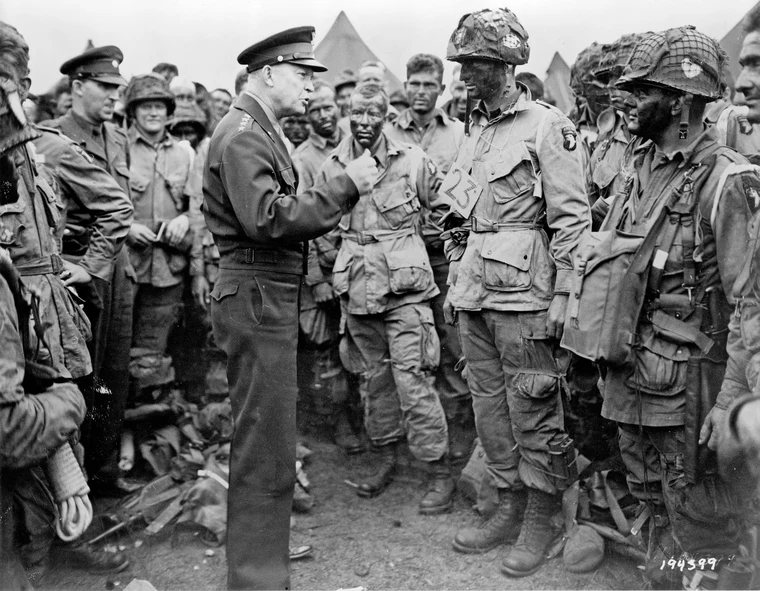
Eisenhower addresses paratroopers of the 101st Airborne Division at Greenham Common on the evening before D-Day, 5 June 1944.. Image: U.S. Army Signal Corps, via Wikimedia Commons (Public domain)
The five Normandy landing beaches
The D-Day landings took place across five beaches, each assigned to a different Allied force. Together, they stretched roughly 80 kilometres along the French coast.
Utah and Omaha (American sectors)
Utah Beach, on the western flank, saw relatively light resistance. Strong currents pushed the landing craft nearly two kilometres south of the intended zone, but this accident placed troops in a less defended area. Casualties at Utah were comparatively low — around 200 men.
Omaha Beach was a different story. American soldiers faced steep cliffs, concrete bunkers, and heavy German fire. According to the National WWII Museum, casualties at Omaha exceeded 2,000 on the first day alone. For hours, the outcome hung in the balance. The beach was so dangerous that commanders briefly considered abandoning it.
Gold, Juno, and Sword (British and Canadian sectors)
British forces landed at Gold and Sword beaches, while Canadian troops assaulted Juno Beach. At Gold, the British 50th Division overcame initial resistance and advanced several kilometres inland by nightfall. At Juno, Canadian forces faced rough seas and fortified positions, suffering heavy casualties in the first hour before breaking through. At Sword Beach, British commandos linked up with airborne troops who had landed hours earlier to secure key bridges. By the end of 6 June, the Allies had established a foothold across all five beaches.
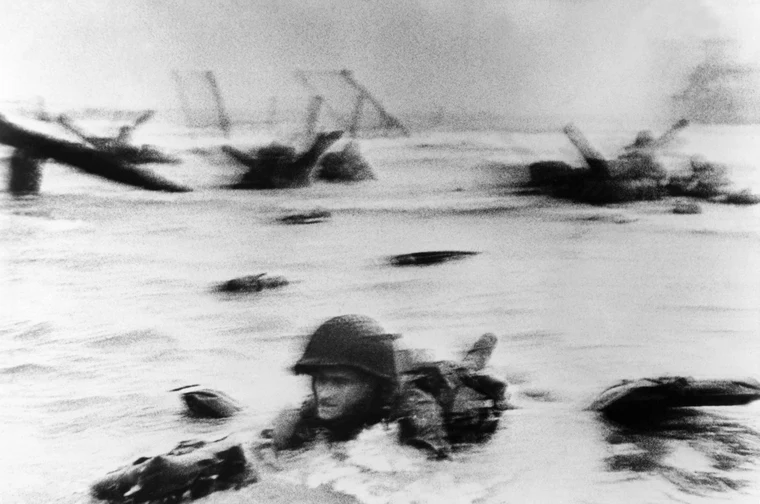
Troops from the US 1st Infantry Division take cover behind beach obstacles on Omaha Beach. The landing at Omaha was the bloodiest of the five D-Day beaches, with over 2,000 American casualties on the first day.. Image: Robert Capa / US Army Signal Corps, via Wikimedia Commons (Public domain)
The airborne assault before the beach landings
Hours before the first D-Day troops reached the beaches, Allied paratroopers dropped behind German lines under cover of darkness. Their mission was to secure bridges, destroy artillery positions, and prevent German reinforcements from reaching the coast.
The American 82nd and 101st Airborne Divisions parachuted into the flooded fields behind Utah Beach. Many paratroopers landed far from their drop zones due to heavy anti-aircraft fire and low cloud cover. Despite the chaos, small groups formed and captured key crossroads. Meanwhile, British 6th Airborne Division seized Pegasus Bridge over the Orne Canal in one of the war's most celebrated operations — a glider assault that lasted just ten minutes.
In addition to paratroopers, Allied bombers and naval guns pounded German defences throughout the night. The bombardment, while devastating, had mixed results. At Omaha Beach, most bombs fell too far inland to destroy the coastal fortifications. Nevertheless, the combined airborne and naval operations disrupted German communications and slowed their response to the beach landings.
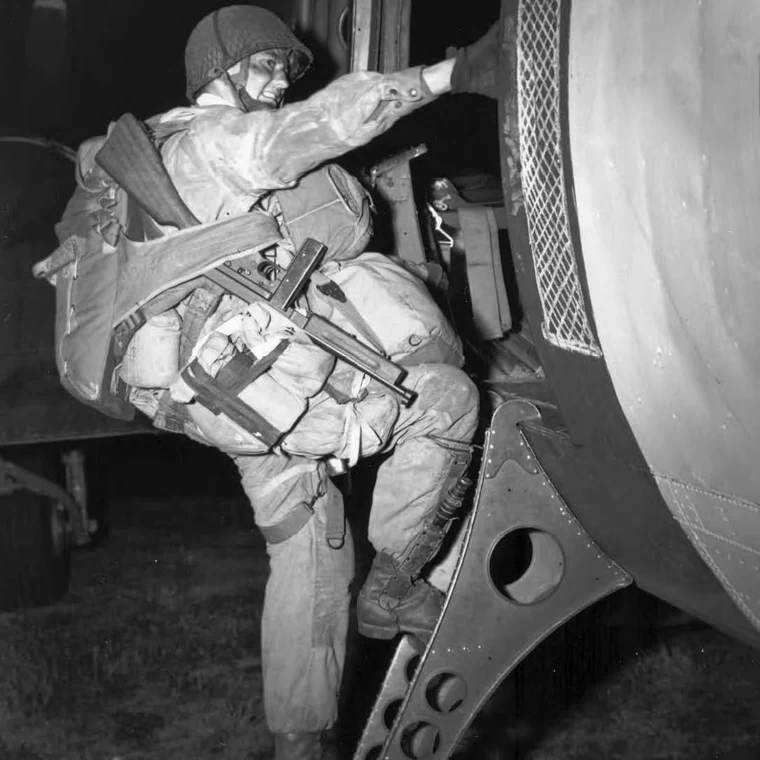
Paratroopers from the US 101st Airborne Division check their equipment before boarding C-47 transport aircraft on the evening of 5 June 1944. Over 13,000 American paratroopers jumped into Normandy in the hours before dawn.. Image: US Army Signal Corps, via Wikimedia Commons (Public domain)
Did you know?
-
Over 156,000 Allied troops landed in Normandy on 6 June 1944. They crossed the English Channel in nearly 7,000 vessels — the largest armada ever assembled.
Encyclopaedia Britannica — Normandy Invasion -
Allied casualties on D-Day are estimated at over 10,000, including approximately 4,414 confirmed dead. German casualties on 6 June are estimated at between 4,000 and 9,000.
National WWII Museum — D-Day -
The term 'D-Day' is a standard military designation for the start date of any operation. It became permanently associated with 6 June 1944 because of the invasion's enormous scale and historical significance.
Imperial War Museums — What is D-Day?
How D-Day changed World War 2
D-Day opened a second front in Europe, forcing Germany to fight a two-front war it could not sustain. Within weeks, the Allies broke out of Normandy and began liberating France.
Paris was liberated on 25 August 1944, just 80 days after the landings. From Normandy, Allied forces swept eastward toward Germany while Soviet armies advanced from the east. The resulting pressure on two fronts drained German resources and accelerated the collapse of the Nazi regime.
The liberation of occupied territories also exposed the full horror of the Holocaust. As Allied soldiers advanced, they discovered concentration and extermination camps. These discoveries shocked the world and shaped the post-war commitment to human rights and international justice.
D-Day's success was not inevitable. The invasion could have failed at Omaha Beach, or the German response could have been faster without the Allied deception. Understanding the causes of World War 2 helps explain why this single day carried such enormous consequences for the outcome of the conflict. Had the landings failed, the war in Europe might have lasted years longer, with incalculable human cost.
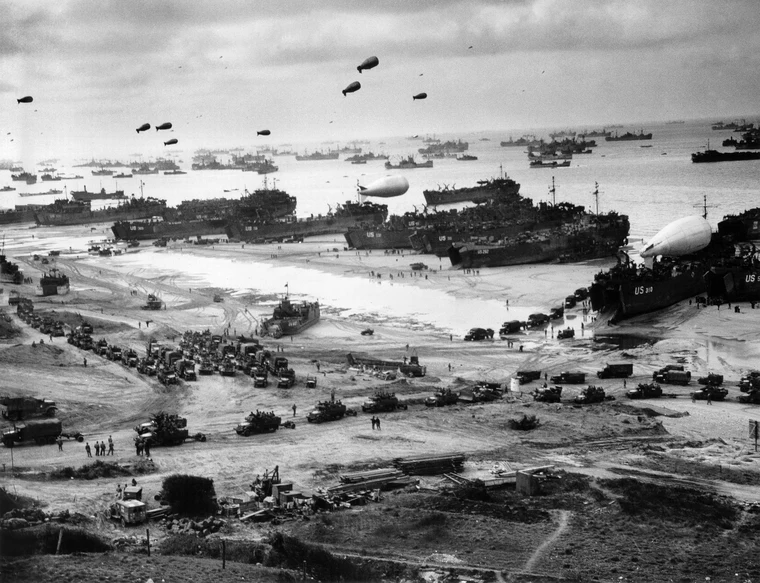
Supply operations at Omaha Beach after D-Day — ships, barrage balloons, and vehicles sustaining the Allied advance inland.. Image: U.S. Coast Guard / National Archives, via Wikimedia Commons (Public domain)
Frequently asked questions
- What does D-Day stand for?
- D-Day is a standard military term meaning the designated start date of an operation. The 'D' does not stand for a specific word. It became permanently associated with 6 June 1944 due to the scale and significance of the Normandy invasion.
- How many soldiers landed on D-Day?
- Over 156,000 Allied troops landed in Normandy on 6 June 1944. This included approximately 73,000 Americans, 62,000 British, and 21,000 Canadians, along with forces from France, Poland, Norway, and other Allied nations.
- Which beach was the deadliest on D-Day?
- Omaha Beach was the deadliest. American troops there faced steep cliffs, fortified bunkers, and concentrated German fire. Over 2,000 casualties occurred at Omaha on the first day, more than at any other landing beach.
- Why did the Allies choose Normandy for the invasion?
- Normandy was within range of Allied fighter planes based in England and had suitable beaches for landing craft. The Germans also expected the invasion at Pas-de-Calais, the closest point to England, so Normandy offered an element of surprise.
- What happened after D-Day?
- After D-Day, the Allies expanded the Normandy beachhead and broke through German lines in late July 1944. Paris was liberated on 25 August. Allied forces then advanced eastward, eventually crossing the Rhine into Germany in early 1945.