How Sound Is Produced and Travels
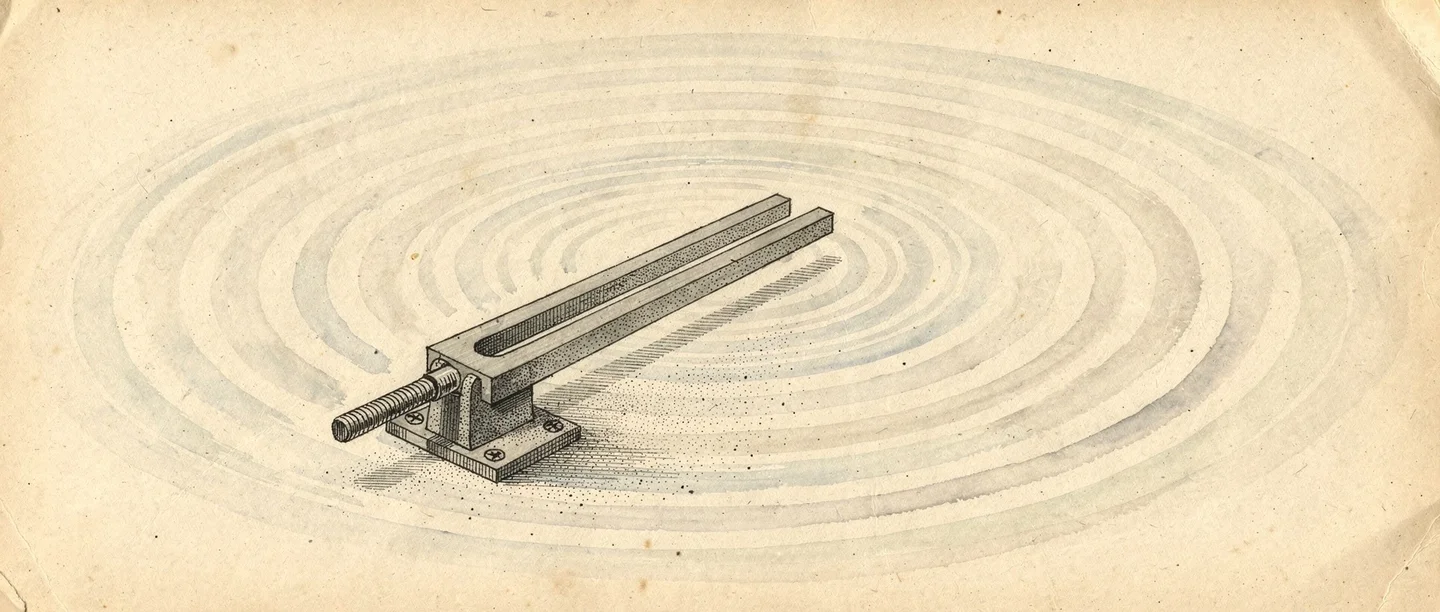
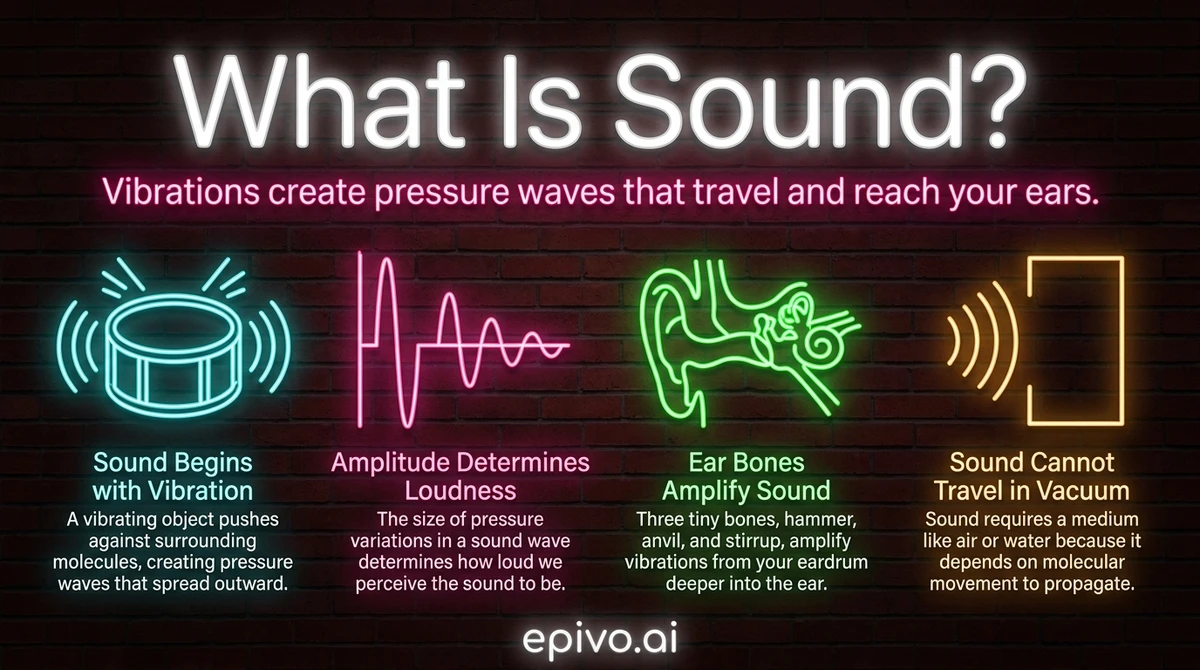
Sound begins with a vibrating object. A speaker cone moves back and forth. A vocal cord trembles. A drum membrane bounces. Each vibration pushes against the molecules of the surrounding medium, creating areas of compression (high pressure) followed by areas of rarefaction (low pressure). This alternating pattern moves outward as a longitudinal wave.
Sound needs a medium to travel. In air at room temperature, sound travels at about 343 metres per second. In water it travels about four times faster. In steel, it can reach 5,000 m/s. In the vacuum of space, there is no medium — so sound cannot travel at all.
Frequency and pitch
The frequency of a sound is how many pressure cycles pass a point per second, measured in hertz (Hz). High-frequency sound waves have more cycles per second and are perceived as high-pitched. Low-frequency waves are heard as low-pitched. Humans typically hear sounds between 20 Hz and 20,000 Hz. Dogs and bats detect much higher frequencies.
Amplitude, Loudness, and the Decibel Scale
The amplitude of a sound wave is the size of the pressure variation — how much the molecules are compressed and rarefied. Greater amplitude means more energy in the wave. We experience amplitude as loudness.
Loudness is measured in decibels (dB) on a logarithmic scale. A whisper is about 30 dB. Normal conversation is around 60 dB. A concert near the speakers might reach 110 dB. Prolonged exposure above about 85 dB can damage hearing. The scale is logarithmic, so 70 dB is ten times more intense than 60 dB, not just slightly louder.
Resonance
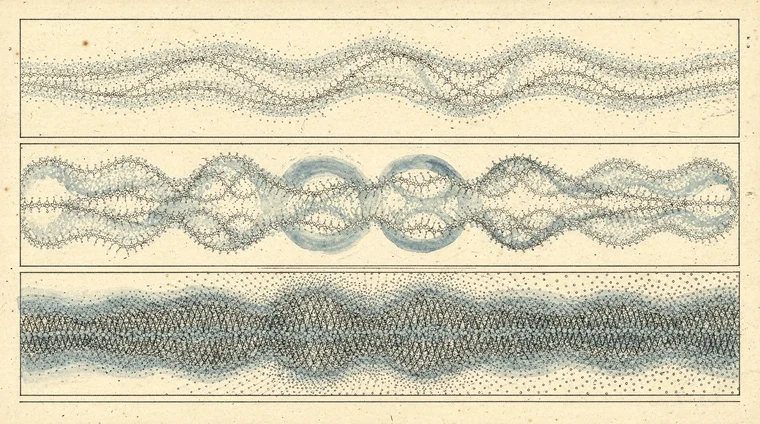
Resonance occurs when an object vibrates at its natural frequency in response to an external sound of the same frequency. A wine glass can shatter when a singer hits the right note. Bridges have collapsed when marching soldiers matched the bridge's resonant frequency. Engineers always account for resonance when designing structures near sources of sound or vibration.
How We Hear and How Sound Is Used
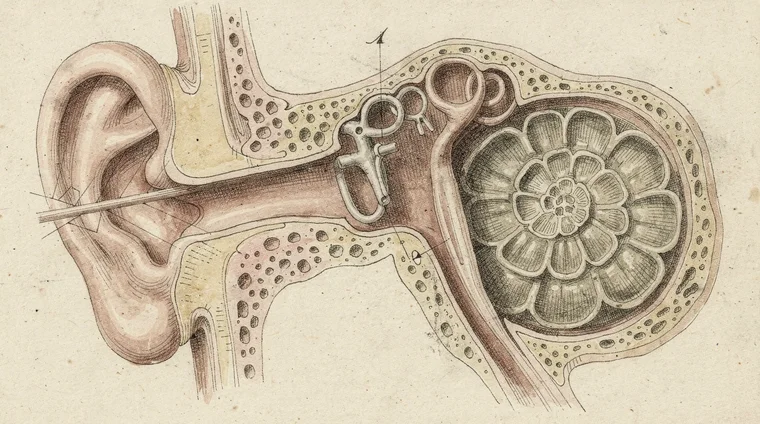
The outer ear funnels sound waves down the ear canal to the eardrum — a thin membrane that vibrates in response. These vibrations are amplified by three tiny bones (the hammer, anvil, and stirrup) and transmitted to the cochlea, a fluid-filled spiral. Hair cells in the cochlea convert the vibrations into electrical signals that the brain interprets as sound.
Ultrasound and sonar
Sounds above 20,000 Hz are called ultrasound — too high for humans to hear. Bats use ultrasound echolocation to navigate and hunt. Medical ultrasound uses these high-frequency sound waves to produce images of soft tissue inside the body. Sonar works the same way underwater: a ship sends out a pulse of sound and measures the echo to detect objects.
Music and acoustics
Musical notes are sounds with regular, periodic waveforms. The timbre (quality) of an instrument comes from overtones — higher-frequency sound waves that accompany the fundamental note. The study of how it behaves in spaces — architectural acoustics — determines whether a concert hall sounds brilliant or muddy.
Frequently asked questions
- Does sound travel faster in air or water?
- Water. Sound travels at about 343 m/s in air at room temperature, but at around 1,480 m/s in water — over four times faster. Sound travels faster in denser materials because molecules are closer together and can pass vibrations more quickly. In steel, sound reaches about 5,000 m/s. This is why whales can communicate across ocean basins.
- Why can't we hear sounds in space?
- It is a mechanical wave — it needs molecules to pass its vibrations through. Space is very nearly a vacuum: there are too few molecules for sound to travel. Films and TV shows show explosions in space making loud sounds, but this is artistic licence. Space is completely silent, which is one reason spacewalking astronauts must communicate by radio.
- What is the difference between sound and noise?
- In everyday language, noise means unwanted sound. In physics, 'noise' refers to a sound with no regular pattern — a random mixture of frequencies. Musical notes have regular, repeating waveforms. A roaring highway or crashing cymbals is irregular — the waveform has no predictable pattern, making it hard to identify as a specific pitch.
- What causes an echo?
- An echo is a reflection of sound. When a wave strikes a hard surface — a cliff, building, or empty hall — some energy bounces back toward the source. If the surface is far enough away, the echo arrives with a noticeable delay. Closer surfaces return the reflection so quickly that the brain blends it with the original signal.