
What confidence in children actually means
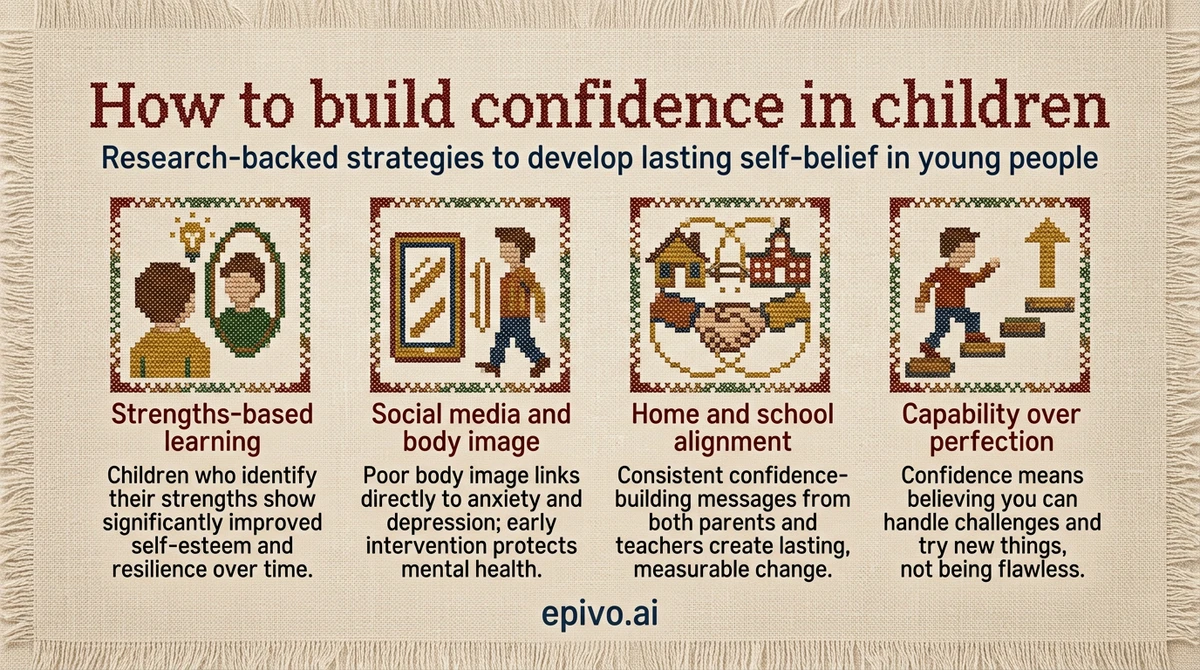
Knowing how to build confidence in children begins with understanding what confidence actually is. Confidence is the belief that you are capable. It means being able to handle challenges, try new things, and recover when things go wrong. It is closely linked to self-esteem — the broader sense of your own value as a person. However, the two are distinct: a child can feel capable at football but doubt themselves in the classroom.
Confidence is built, not born
Research consistently shows that confidence is not a fixed trait — it develops through experience, feedback, and the support of trusted adults. Children who receive accurate information about their strengths and identity develop higher self-esteem and lower rates of anxiety and depression. The PSHE Association identifies strengths-based education as a key protective factor for young people's mental health.
The role of personal strengths
A personal strength is something you are naturally good at or enjoy doing well — a skill like drawing or solving puzzles, or a character trait like patience or curiosity. Knowing your strengths helps you feel confident and gives you a clearer sense of how you contribute to the world around you.
What undermines confidence — and how to protect against it
Several common factors erode confidence in children, and understanding them helps parents and teachers intervene early.
Social media and body image
The NHS identifies poor body image as directly linked to low self-esteem, anxiety, and depression. Social media is a significant driver — many young people compare themselves to edited images and feel they fall short. Teaching children to understand that images are often altered helps protect them from unfair self-comparison.
Praise that backfires
Interestingly, the wrong kind of praise can undermine confidence. Telling a child you are so clever makes them fear being seen as not clever when they struggle. Research by Carol Dweck shows that praising effort rather than ability — saying you worked really hard on that instead of you are gifted — builds more durable confidence. Therefore, how adults respond to both success and failure matters enormously.
For more structured support, Epivo's wellbeing curriculum builds strengths identification and self-esteem directly into its programme for Grades 4 to 8.

Practical strategies for building confidence in children at home
Building confidence in children requires consistent action over time — there is no single intervention that produces instant results. However, several strategies have strong evidence behind them.
First, help your child identify their strengths. Ask them: What do you find easy that others find hard? What activities make you feel proud? Second, encourage them to set small, achievable goals using the SMART framework — Specific, Measurable, Achievable, Relevant, and Time-bound. Achieving even a small goal reinforces the belief that effort produces results. Third, model self-compassion yourself. Children who see adults treat their own mistakes with kindness learn to do the same.
For parents seeking guidance on how to build confidence in children through daily routines, the Epivo wellbeing programme gives students structured practice identifying strengths and reflecting on progress in every session.

Did you know?
-
Poor body image is linked to low self-esteem, anxiety, and depression. Many young people feel pressure from social media to look a certain way — even though most images they see are digitally altered.
NHS: Body Image and Self-Esteem -
Children who receive strengths-based education — learning to identify what they are good at — show significantly higher self-esteem and lower rates of anxiety compared to those in standard programmes.
PSHE Association: Programme of Study for PSHE Education
How schools and parents can work together on confidence
The best way to build confidence in children is when home and school send the same messages. When a child hears you are capable at home and receives strengths-based feedback at school, those messages reinforce each other.
For parents, the most powerful shifts are often small: asking what went well today instead of did anything go wrong, allowing children to make age-appropriate choices, and letting them solve problems rather than immediately rescuing them. Each time a child navigates a challenge — even imperfectly — their sense of capability grows.
For families who want structured support alongside school, the Epivo wellbeing programme helps students identify their strengths, set goals, and reflect on their progress in personalised AI tutoring sessions — building the habits that underpin lasting confidence.

Frequently asked questions
- How to build confidence in children at home?
- The most effective strategies are: helping children identify their personal strengths, praising effort rather than ability, encouraging small achievable goals, and modelling self-compassion. Allowing children to solve problems independently — rather than rescuing them immediately — also builds a lasting sense of capability over time.
- What causes low confidence in children?
- Common causes include repeated failure without support, comparison to peers or social media ideals, praise focused on fixed traits like cleverness, and environments where mistakes are treated as failures rather than learning opportunities. Body image concerns and social pressure are significant factors from around age 10 onwards.
- What is the difference between confidence and self-esteem?
- Self-esteem is a global sense of your own value as a person. Confidence is belief in your ability to do specific things. A child can have high confidence in sport but low confidence in the classroom. Building both requires helping children find areas of genuine competence and teaching them to approach new challenges with curiosity.
- How long does it take to build confidence in a child?
- Confidence builds gradually through consistent positive experiences over months and years — not days. However, specific strategies like strengths identification and goal-setting can produce noticeable shifts in self-perception within a few weeks. The foundation is daily interactions: how adults speak to and about a child matters enormously.
- Can an AI tutor help build confidence in children?
- Yes — a well-designed AI tutor like Epivo builds confidence by giving children a safe space to try, make mistakes, and learn without fear of judgement. Every session includes reflection on what the student understood and what they found challenging — reinforcing the growth mindset habits that underpin confidence.