
What meaning and purpose are — and why they matter
Meaning refers to a sense that one's existence has value and direction — that what you do matters, connects to something larger, and reflects who you are. Purpose is the motivational component: a sense of aim and forward movement. While related, meaning and purpose are distinguishable. Meaning is primarily retrospective — it makes sense of experience. Purpose is primarily prospective — it orientates behaviour towards the future.
Researcher Michael Steger at Colorado State University defines meaning in life as consisting of three components: comprehension (life feels coherent and understandable), purpose (life feels directed and motivating), and mattering (one feels significant to others and the world). His Meaning in Life Questionnaire has been used in hundreds of studies and consistently shows that meaning predicts wellbeing, resilience, and mental health over and above other factors.
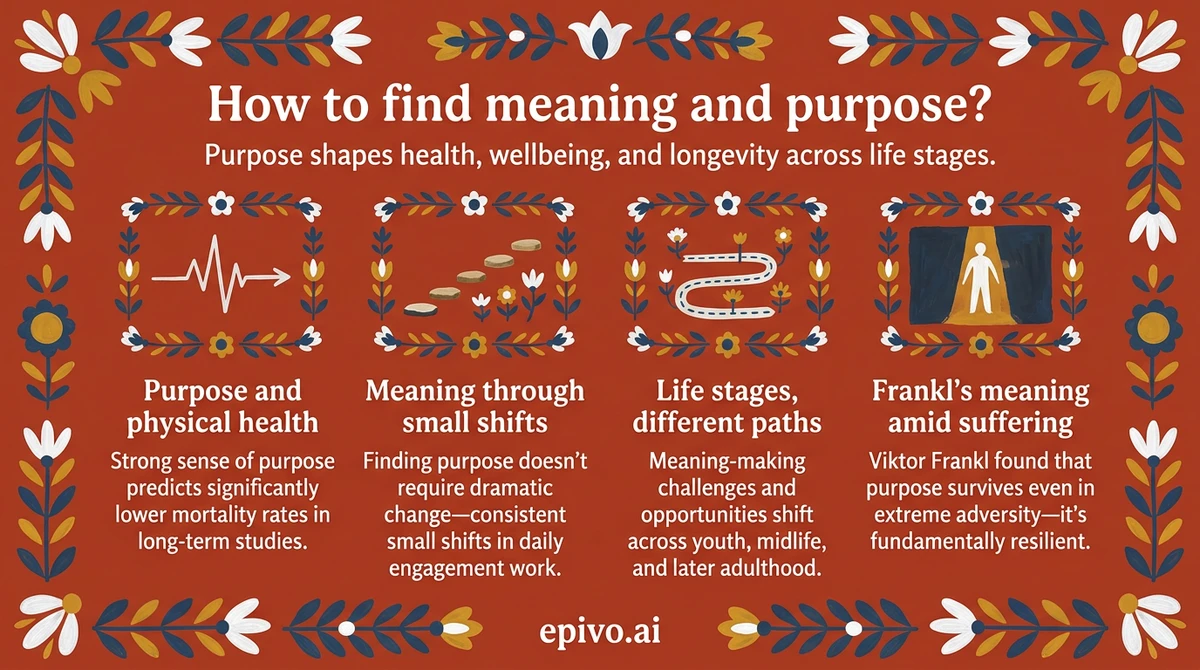
For many people, the real challenge is not to define meaning in theory but to find meaning in practice — to identify what genuinely matters in their particular life and to act accordingly. The psychological importance of meaning and purpose is not new. Viktor Frankl, Austrian psychiatrist and Holocaust survivor, published Man's Search for Meaning in 1946, arguing that the primary human motivation is the search for meaning — not pleasure or power. Drawing on his experience in Nazi concentration camps, Frankl observed that even under extreme deprivation, those who maintained a sense of purpose showed far greater psychological survival. His approach, known as logotherapy, became one of the most influential contributions to existential psychology.
How to find meaning and purpose — approaches that work
The research on meaning points to several reliable pathways. None of them requires a dramatic life change — most operate through small, consistent shifts in how we engage with what is already present.
Clarify your values
Meaning often crystallises when actions align with deeply held values. Research by Steger and others shows that value clarification — writing down what matters most to you and why — significantly increases reported meaning, even when external circumstances do not change. This is because meaning is often already present, but unnoticed without deliberate reflection.
Invest in relationships and contribution
The strongest predictor of meaning in population studies is connection to others — the sense that you matter to people and that you contribute to something beyond yourself. Seligman's PERMA model includes Meaning as a distinct element, defined as 'belonging to and serving something larger than the self.' This may be family, community, profession, art, or faith.
Engage with challenge and growth
Flow states — described in a related article on flow — are closely linked to meaning. People report their highest sense of meaning during activities that stretch their abilities and demand full engagement. Furthermore, research shows that facing and overcoming difficulty is a more reliable source of meaning than comfort or ease.
Use the ikigai framework
The Japanese concept of ikigai ('reason for being') offers a practical framework: the intersection of what you love, what you are good at, what the world needs, and what you can sustain. Although not a formal academic construct, ikigai aligns closely with the psychological literature on purpose and is used widely in personal development contexts.

Image: Generated with AI (Epivo)
Purpose and health — what long-term studies show
Beyond psychological wellbeing, purpose has measurable physical health consequences. This is one of the more surprising findings in the meaning research literature.
A study by Patrick Hill and Nicholas Turiano published in Psychological Science followed over 6,000 adults for 14 years. Those who reported a stronger sense of purpose were significantly less likely to die during the follow-up period — even after controlling for positive emotions, retirement status, and depression. The relationship held across all age groups.
Similarly, the Rush Memory and Aging Project, which followed elderly adults in the United States, found that a greater sense of purpose was associated with a lower risk of Alzheimer's disease, better sleep, and lower rates of disability. Researchers concluded that purpose provides a buffer against cognitive and physical decline.
The mechanism is partly neurological. Purpose activates the brain's reward circuits and sustains motivation. It also reduces the physiological stress response — people with a sense of purpose show lower cortisol levels and less cardiovascular reactivity to stress.
These findings have a practical implication: learning how to find meaning and purpose is not merely a philosophical exercise. It is, in measurable terms, one of the most significant investments available for long-term health. Visit For parents to explore how Epivo supports this kind of development, or discover Epivo's International curriculum for structured learning that engages these questions directly.

Image: Generated with AI (Epivo)
Did you know?
-
Viktor Frankl, in Man's Search for Meaning, argued from his experience in Nazi concentration camps that the primary human motivation is the search for meaning — and that purpose sustains psychological survival even under extreme conditions.
Man's Search for Meaning — Viktor Frankl -
A 14-year study of over 6,000 adults found that those with a stronger sense of purpose were significantly less likely to die during the study period — a finding that held across all age groups and after controlling for multiple confounding factors.
Purpose in Life and Mortality — Hill and Turiano, Psychological Science -
Michael Steger's research shows that meaning in life — feeling that existence is coherent, purposeful, and significant — is one of the strongest predictors of psychological wellbeing, resilience, and mental health across cultures.
Meaning in Life Questionnaire — Michael Steger
Meaning at different life stages
How to find meaning and purpose shifts across the life course. Research by Erik Erikson and later by Dan McAdams suggests that different life stages present different meaning-making challenges.
In young adulthood, meaning is often pursued through identity formation — discovering who you are through relationships, work, and exploration. In midlife, meaning frequently shifts towards generativity — a focus on leaving a legacy, raising children, mentoring others, or contributing to society. In later life, research shows that meaning increasingly derives from integration — making sense of one's life as a coherent whole.
The practical implication is that meaning is not a destination to be found once and kept forever. It requires ongoing renewal as circumstances, relationships, and capacities change. Research by Steger shows that the presence of meaning and the search for meaning are distinct — people can have meaning while still searching for more, and the search itself is a healthy, meaningful activity.
For students and young adults, engaging with these questions early — through philosophy, literature, conversation, and structured reflection — builds the psychological foundation that sustained meaning requires. This is why courses in psychology, ethics, and humanities are not merely academic: they address directly the question of how to live well. Explore Epivo's International curriculum for courses that engage these questions through structured, evidence-based learning.

Image: Generated with AI (Epivo)
Frequently asked questions
- How do you find meaning and purpose in life?
- Research suggests four reliable approaches: clarify your values in writing, invest in relationships and contribution, engage with activities that challenge and stretch you, and reflect on what you uniquely care about. Viktor Frankl argued that meaning cannot be given — it must be found through lived experience and honest reflection.
- What is the difference between meaning and purpose?
- Meaning is primarily retrospective — it makes sense of experience and reflects why life matters. Purpose is primarily prospective — it provides direction and motivation for action. Both are related but distinct. Most psychologists agree that a full sense of wellbeing requires both: life that is coherent and life that is aimed.
- Does having a sense of purpose affect your health?
- Yes. Studies show that a strong sense of purpose is associated with longer life, lower risk of Alzheimer's disease, better sleep, and reduced cardiovascular stress reactivity. The Rush Memory and Aging Project and a 14-year study by Hill and Turiano both found purpose predicts physical health independently of emotional wellbeing.
- What is Viktor Frankl's logotherapy?
- Logotherapy is a psychotherapeutic approach developed by Viktor Frankl, based on the premise that the primary human drive is the search for meaning. Unlike Freudian therapy, it focuses not on the past but on the future — helping people find a reason to live and act. It is particularly used with people experiencing existential crisis or loss.
- What is ikigai?
- Ikigai is a Japanese concept meaning 'reason for being' — the intersection of what you love, what you are good at, what the world needs, and what you can sustain. While not a formal academic construct, it aligns closely with psychological research on purpose and offers a practical framework for personal reflection.