
What causes burnout at work?
Burnout does not appear overnight. It builds gradually when the conditions of work consistently deprive people of what they need to function well. Researchers have identified several core drivers.
Chronic imbalance between demands and resources
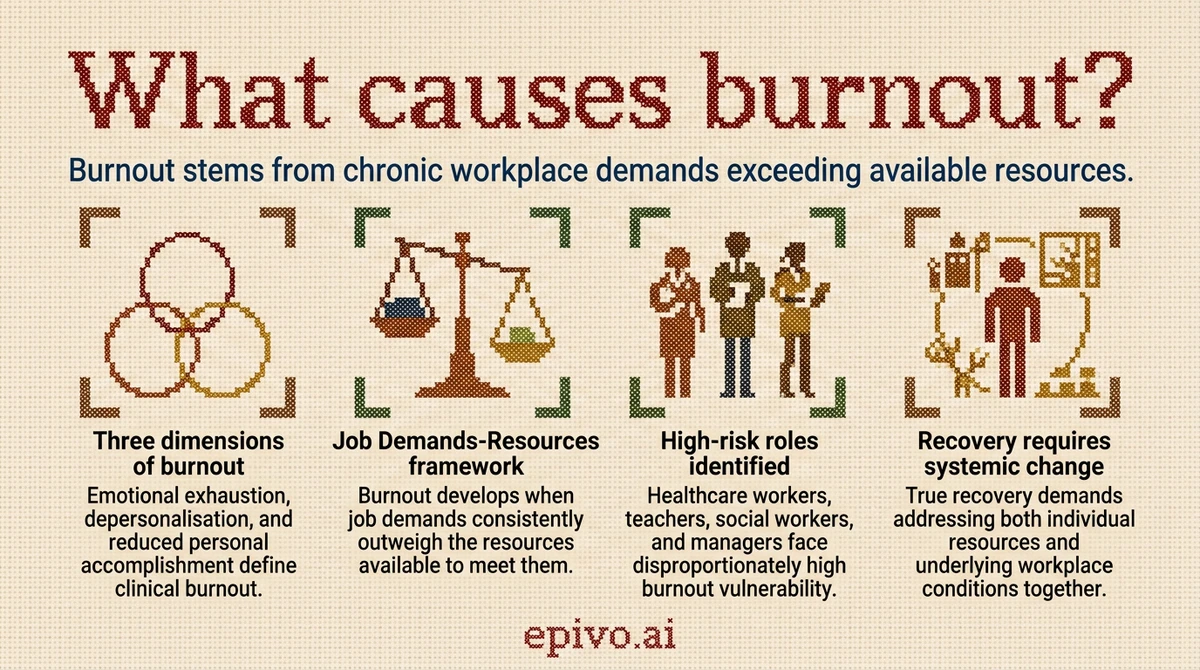
The Job Demands-Resources (JD-R) model is one of the most influential frameworks for understanding what causes burnout. Schaufeli and Bakker developed it to model how demands and resources interact. According to this model, burnout occurs when job demands outpace available resources. Those demands include workload, time pressure, and emotional labour. Resources include autonomy, social support, feedback, and skill development opportunities. When the scales tip too far, exhaustion follows. As the authors write in the Journal of Occupational and Organizational Psychology, sustained demand-resource imbalance is the primary pathway to burnout.
Blocked intrinsic motivation
Deci and Ryan's Self-Determination Theory identifies three core psychological needs. These are autonomy (control over your work), competence (feeling effective), and relatedness (meaningful connection with colleagues). When any of these needs are systematically blocked — through micromanagement, impossible targets, or isolation — motivation erodes. Burnout risk then rises sharply.
A lack of psychological safety and recognition
Workplaces where effort goes unrecognised or values conflict with daily practice create fertile ground for burnout. Punishing mistakes compounds the effect. People who feel invisible or undervalued exhaust their emotional reserves faster than those who feel seen and supported.
For professionals looking to understand the psychology of work more deeply, Epivo's curriculum covers motivation, burnout, and leadership. Sessions are AI-guided and interactive.
The three dimensions of burnout
The most widely used clinical definition of burnout comes from psychologist Christina Maslach. In her landmark work with Michael Leiter, The Truth About Burnout (Jossey-Bass, 1997), she described burnout as a three-dimensional syndrome.
1. Emotional exhaustion
Emotional exhaustion is the central feature of burnout. It is the feeling of being completely drained — of having nothing left to give. Unlike ordinary tiredness, emotional exhaustion does not resolve with a single night of sleep. It accumulates over weeks and months of sustained high demand.
2. Depersonalisation
Depersonalisation — sometimes called cynicism — describes a growing psychological distance from work and the people in it. A once-engaged professional begins to treat colleagues or clients as objects rather than people. This is not a character flaw; it is a self-protective response to prolonged depletion.
3. Reduced personal accomplishment
The third dimension is a collapse in the sense of effectiveness. Even when tasks are completed, they no longer feel meaningful or competent. This is distinct from imposter syndrome. It reflects genuine depletion of the cognitive and emotional resources needed to perform well.
The World Health Organization formally recognised burnout as an occupational phenomenon in ICD-11 in 2019, noting it results specifically from unmanaged workplace stress — not a medical condition in itself.
For parents wondering how chronic stress affects young people at home, the Epivo wellbeing programme explores how these patterns begin early.

Who is most at risk of burnout?
Burnout can affect anyone, but research consistently identifies certain groups as more vulnerable.
High-demand, people-facing roles
Healthcare workers, teachers, social workers, and managers are among those most frequently affected. These roles combine high emotional labour, limited control, and often inadequate organisational support — precisely the conditions the JD-R model identifies as burnout drivers.
Highly conscientious individuals
People who care deeply about their work and hold themselves to high standards are paradoxically more at risk. The same conscientiousness that makes them effective also makes them more likely to push through exhaustion signals rather than acknowledge them.
Remote and isolated workers
Isolation removes one of the most important protective resources: social connection. Workers who lack regular meaningful contact with colleagues lose access to the relatedness that Self-Determination Theory identifies as a core psychological need.
Organisations with misaligned values
When a company's stated values diverge from its actual practices — claiming to value work-life balance while rewarding constant availability, for example — employees experience a form of moral exhaustion that accelerates burnout independently of workload.

Did you know?
-
The World Health Organization classified burnout as an occupational phenomenon in ICD-11 in 2019, defining it as a syndrome resulting from chronic workplace stress that has not been successfully managed.
WHO: Burn-out an occupational phenomenon (2019) -
Maslach and Leiter identified three core dimensions of burnout: emotional exhaustion, depersonalisation, and reduced personal accomplishment — a framework that remains the clinical standard today.
Maslach, C., & Leiter, M. P. (1997). The Truth About Burnout. Jossey-Bass. -
Schaufeli and Bakker's Job Demands-Resources model shows that burnout develops when job demands consistently exceed available resources such as autonomy, support, and feedback.
Schaufeli & Bakker (2004). Journal of Occupational and Organizational Psychology.
How to prevent and recover from burnout
Understanding what causes burnout points directly to what can reverse it. Recovery is not simply a matter of taking a holiday — it requires addressing both the individual's resources and the conditions of work.
Genuine psychological detachment
Sonnentag and Fritz (2007) found that recovery from work stress requires genuine psychological detachment — mentally switching off from work during non-work time. Checking email at 11pm, or ruminating about tomorrow's deadline during dinner, prevents the recovery the nervous system needs. Structured boundaries — a defined end-of-day ritual, device-free evenings — are not indulgences but biological necessities.
Rebuilding resources
The JD-R model implies that recovery means restoring resources, not merely reducing demands. Sleep, physical activity, social connection, and activities that produce a sense of mastery all replenish the cognitive and emotional reserves that burnout depletes.
Organisational interventions
Individual strategies are necessary but not sufficient. Sustainable prevention requires organisations to audit the demand-resource balance in their teams — increasing autonomy, improving recognition, ensuring workloads are realistic, and creating psychological safety. Maslach's research consistently shows that burnout is fundamentally a mismatch between person and job, not a flaw in the person.
Seeking professional support
If you recognise the three dimensions of burnout — exhaustion, cynicism, and a collapsed sense of effectiveness — in yourself, speaking to a GP or occupational health professional is an important step. Burnout that goes unaddressed can develop into clinical depression and anxiety.
For professionals who want to understand the motivational science behind sustainable performance, Epivo's psychology of work curriculum covers these frameworks in depth through personalised AI-guided learning.

Frequently asked questions
- What are the main causes of burnout at work?
- The main causes are a chronic imbalance between job demands and available resources, blocked autonomy and competence, lack of recognition, and value mismatches between the individual and organisation. The Job Demands-Resources model identifies sustained overload as the primary pathway to emotional exhaustion.
- What are the three dimensions of burnout according to Maslach?
- Christina Maslach identified emotional exhaustion (feeling completely drained), depersonalisation (psychological distancing from work and people), and reduced personal accomplishment (a collapsed sense of effectiveness). All three dimensions are needed for a clinical diagnosis of burnout.
- Is burnout a medical condition?
- The World Health Organization classifies burnout as an occupational phenomenon in ICD-11, not a medical condition. It is defined specifically as a result of unmanaged chronic workplace stress. This distinction matters because the primary interventions are workplace and behavioural, not just medical.
- How long does it take to recover from burnout?
- Recovery time varies widely depending on severity and whether the underlying causes are addressed. Mild burnout may improve with weeks of rest and boundary-setting. Severe burnout can take months of structured recovery. Research by Sonnentag and Fritz shows that genuine psychological detachment from work — not just physical rest — is essential for meaningful recovery.
- What is the difference between burnout and stress?
- Stress is typically an acute response to excessive demand — there is too much to do, but the expectation is that relief is coming. Burnout is a chronic state of depletion where the person no longer believes recovery is possible. Maslach describes burnout as what happens when the coping resources are exhausted.
- Can burnout be prevented by the individual alone?
- Individual strategies — detachment, sleep, boundary-setting — are necessary but not sufficient. Maslach's research consistently shows that burnout reflects a person-job mismatch, and lasting prevention requires organisational change: realistic workloads, genuine autonomy, meaningful recognition, and aligned values.