
What is attachment theory?
Attachment theory is a framework for understanding how early bonds between children and caregivers shape emotional and social development. British psychiatrist John Bowlby developed it from observations of children separated from their caregivers. He argued that children have an innate drive to form close bonds — not simply for food or comfort, but as a biological need for safety and survival.
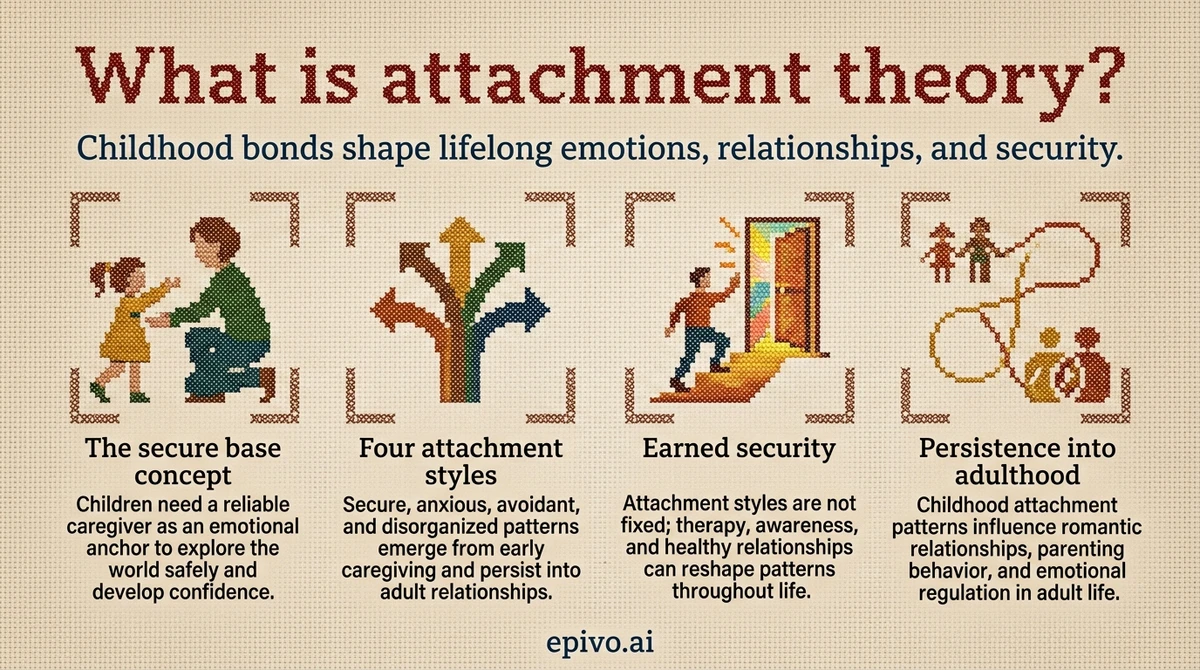
Bowlby proposed that a reliable caregiver provides a secure base. This is a stable point from which a child can explore the world, returning to it when frightened or distressed. When caregivers respond consistently and sensitively, children develop an internal working model of relationships. This mental template tells them whether other people can be trusted and whether they are worthy of care.
Published in his landmark three-volume work Attachment and Loss (1969), Bowlby's theory drew on ethology, evolutionary biology, and clinical observations of children separated from their parents. His central claim was radical for its time: the quality of early attachment is not a luxury. It is a developmental necessity.
To explore how these findings apply across the whole lifespan, visit Epivo's curriculum for structured courses in developmental psychology.
The four attachment styles
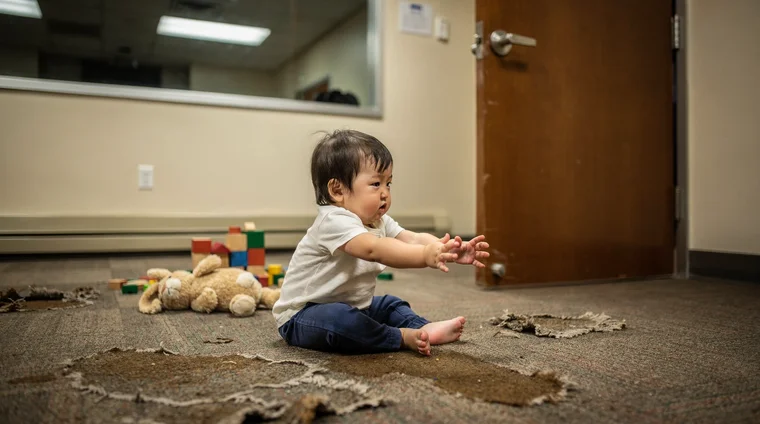
The empirical foundations of attachment theory were built by developmental psychologist Mary Ainsworth. In the late 1960s and 1970s, Ainsworth designed the Strange Situation — a structured laboratory procedure in which a toddler is briefly separated from their caregiver and observed on reunion. Her research, published with colleagues in Patterns of Attachment (1978), identified three initial styles. A fourth was added by later researchers.
Secure attachment
Securely attached children use the caregiver as a safe base. They explore freely, show distress on separation, and are quickly soothed on reunion. As adults, securely attached people tend to be comfortable with intimacy, communicate needs clearly, and recover from conflict without excessive anxiety.
Anxious-ambivalent attachment
Children with anxious-ambivalent attachment are clingy and difficult to soothe. They may appear angry or inconsolable on reunion, as if punishing the caregiver for leaving. In adulthood this often manifests as a preoccupied style: heightened worry about abandonment and a tendency to seek reassurance repeatedly.
Avoidant attachment
Avoidant children appear self-sufficient. They show little distress on separation and seem indifferent on reunion — though physiological measures show they are internally stressed. In adulthood, this style tends to appear as emotional distance, discomfort with dependency, and a preference for self-reliance over intimacy.
Disorganised attachment
A fourth pattern — disorganised attachment — was later identified in children whose caregivers were also sources of fear. These children show contradictory behaviours: approaching then freezing, or seeking comfort while simultaneously pulling away. This style is most strongly associated with adverse early experiences.
Understanding these patterns is a core topic in Epivo's developmental psychology course for professionals.
How attachment shapes adult relationships
One of the most significant developments in attachment research was the demonstration that childhood patterns do not simply fade. They persist — influencing romantic relationships, parenting behaviour, and even workplace dynamics.
In a landmark 1987 study, Cindy Hazan and Philip Shaver at the University of Denver surveyed adults about their relationship experiences and found striking parallels with Ainsworth's infant patterns. Their data suggested that approximately 55% of adults are securely attached, around 25% are avoidant, and roughly 20% are anxious. These figures have been broadly replicated in subsequent research, though proportions vary across cultures and populations.
Romantic relationships
Securely attached adults tend to report higher relationship satisfaction and more constructive conflict resolution. They are comfortable depending on partners and have partners depend on them. Anxiously attached adults often experience relationships as consuming — marked by jealousy, fear of rejection, and difficulty feeling settled. Avoidantly attached adults may value independence to the point of emotional withdrawal, keeping partners at a distance even when they wish for closeness.
Parenting and intergenerational transmission
Attachment patterns also show intergenerational continuity. Parents who have processed their own early experiences — who can reflect coherently on their childhood, including its difficulties — are more likely to raise securely attached children. This capacity for reflective functioning, studied extensively by Peter Fonagy, is one of the strongest predictors of attachment security in the next generation.
For professionals working in education, HR, or therapeutic settings, understanding attachment dynamics offers a powerful lens for interpreting behaviour and supporting change. Find out more at for professionals.

Did you know?
-
John Bowlby proposed that children have a biologically driven need for a 'secure base' — a reliable caregiver from whom they can explore the world and return to when distressed.
Bowlby, J. (1969). Attachment and Loss, Vol. 1: Attachment. Basic Books. -
Mary Ainsworth's Strange Situation experiment identified three core attachment styles — secure, anxious-ambivalent, and avoidant — later extended to four with the addition of disorganised attachment.
Ainsworth, M. D. S., et al. (1978). Patterns of Attachment. Lawrence Erlbaum Associates. -
Hazan and Shaver (1987) found that approximately 55% of adults show secure attachment, 25% avoidant, and 20% anxious — mirroring the distribution seen in studies of infants.
Hazan, C. & Shaver, P. (1987). Romantic love conceptualized as an attachment process. Journal of Personality and Social Psychology, 52(3), 511–524.
Can attachment styles change?
A common misconception is that attachment styles are fixed for life. Research suggests otherwise. While early patterns are influential, they are not deterministic.
Earned security
Researchers use the term earned security to describe adults who had difficult early experiences yet developed a coherent, balanced understanding of those experiences over time. These individuals — often through therapy, meaningful relationships, or reflective practice — show attachment patterns that function much like those of people who had secure childhoods. The key is not what happened, but whether the person has made sense of what happened.
Therapy and new relationships
Long-term therapy, particularly approaches informed by attachment theory such as Emotionally Focused Therapy (EFT) and Dynamic Interpersonal Therapy (DIT), can meaningfully shift attachment patterns. Consistently positive relationships — with partners, mentors, or therapists who respond reliably and sensitively — can update the internal working models formed in childhood.
Awareness as a starting point
Even before formal intervention, awareness of your own attachment tendencies is valuable. Recognising that anxiety in a relationship stems from an old pattern — not a present-day threat — creates a moment of choice. That space between trigger and response is where change begins.
Attachment theory is studied in depth in Epivo's developmental psychology curriculum, which covers adult attachment, parenting, and reflective functioning for professionals.

Frequently asked questions
- What is attachment theory in simple terms?
- Attachment theory is the idea that humans have a biological need to form close bonds with caregivers early in life, and that the quality of those bonds shapes how we relate to others throughout life. Developed by John Bowlby and extended by Mary Ainsworth, it explains why some people feel safe and connected in relationships while others feel anxious or distant.
- What are the four attachment styles?
- The four attachment styles identified in attachment theory are: secure (comfortable with closeness and able to self-soothe), anxious-ambivalent (preoccupied with abandonment and hard to reassure), avoidant (self-reliant and uncomfortable with dependency), and disorganised (inconsistent, often linked to frightening early caregiving). Most adults show a mixture, with one style dominant.
- How does attachment theory apply to adults?
- Adult attachment research, pioneered by Hazan and Shaver (1987), shows that the same patterns identified in infants appear in adult romantic relationships. Securely attached adults tend to have more satisfying relationships. Anxiously attached adults often struggle with worry about rejection. Avoidantly attached adults may pull back from intimacy. These patterns also influence parenting and workplace relationships.
- Can you change your attachment style as an adult?
- Yes. Research on 'earned security' shows that adults who had difficult early experiences can develop secure attachment through therapy, reflective practice, or consistently supportive relationships. Attachment styles are influential but not fixed. Awareness of your patterns is the first step, and long-term relationships with emotionally available people can gradually update those internal working models.
- Who developed attachment theory?
- Attachment theory was developed by British psychiatrist John Bowlby, whose three-volume work Attachment and Loss (1969–1980) laid the theoretical foundation. Mary Ainsworth built the empirical evidence base through the Strange Situation experiment, identifying the key attachment styles. Later researchers including Mary Main, Peter Fonagy, and Cindy Hazan extended the theory to adult relationships and parenting.
- What is a secure base in attachment theory?
- A secure base is Bowlby's term for a reliable caregiver from whom a child can explore the world and to whom they can return when frightened or distressed. The concept captures the core function of attachment: providing enough safety and predictability that the child feels free to engage with the environment. In adult relationships, partners can also serve as secure bases for each other.