
AI replaces tasks, not jobs — but the line matters
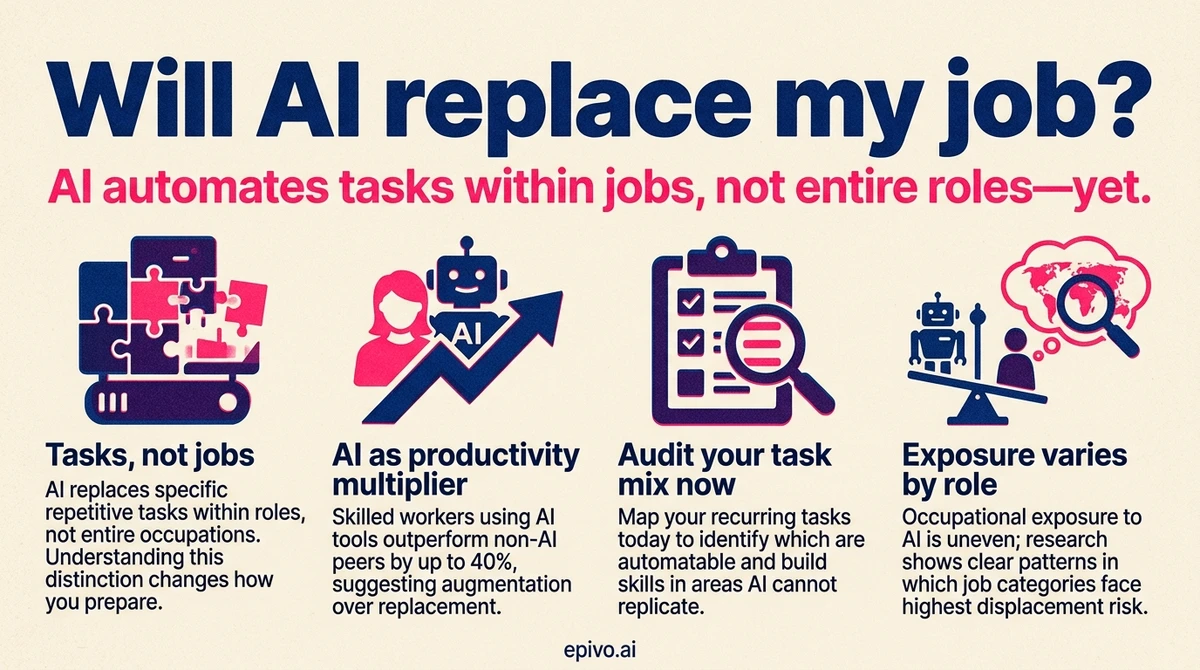
The most useful frame for thinking about AI and work is task decomposition. A job is not one thing — it is a bundle of tasks, each with different characteristics. Some are highly repetitive and rules-based. Some require judgment, context, and relationships. AI disrupts those two categories very differently.
Repetitive, well-defined tasks — processing invoices, drafting standard contracts, transcribing calls, generating first-draft reports, writing code to spec — are exactly what current AI systems do well. They are pattern-matching problems, and AI is an extraordinarily powerful pattern-matching machine. Understanding how AI learns helps explain why: it is trained on vast quantities of human-produced examples, so it is best at tasks that follow patterns humans have performed many times before.
Tasks that require genuine judgment under uncertainty, managing complex human relationships, navigating ambiguous organisational dynamics, or applying ethical reasoning to novel situations — these remain much harder to automate. Not impossible, but materially harder.
The implication is that most jobs will be partially automated: some tasks will be handled by AI tools, and the remaining human work will shift toward higher-order judgment and relationship-intensive activity. For some roles, that partial automation will be large enough to reduce headcount. For others, it will primarily show up as productivity gains, with the same number of people doing more.
The honest acknowledgement is that both things are true. AI creates genuine displacement risk for some roles, and genuine productivity leverage for others. Which applies to you depends on your specific task mix.
Which jobs are most exposed to AI — and which are least
Research gives us a reasonably clear picture of occupational exposure, even if precise predictions remain contested.
The foundational study is Frey and Osborne's 2013 Oxford analysis, which estimated that 47% of US jobs faced high risk of automation over the following two decades. That figure attracted enormous attention and considerable criticism — the methodology assumed entire jobs would be automated, not individual tasks. More recent research has refined this view significantly.
McKinsey Global Institute's 2023 analysis estimated that AI could automate tasks equivalent to 60–70% of employee time for some occupational categories. Roles most exposed include office and administrative support, customer service, data processing, paralegal and basic legal research, financial analysis, and some segments of software development. What these share is a high proportion of well-structured, information-processing tasks with defined inputs and outputs.
Goldman Sachs' 2023 AI report estimated that generative AI could expose the equivalent of 300 million full-time jobs globally to automation — predominantly white-collar, cognitive work rather than the manual labour typically associated with earlier waves of automation. This is a meaningful reversal: previous automation waves primarily displaced routine physical work; this one concentrates on routine cognitive work.
Roles that are least exposed share common characteristics: they involve unpredictable physical environments (plumbers, electricians, nurses doing hands-on care), complex social and emotional dynamics (therapists, senior managers, teachers in live classroom settings), or genuinely novel problem-solving where prior examples do not cleanly transfer. None of these roles are automation-proof. But the AI leverage within them is currently lower.
The honest picture is a spectrum of exposure, not a binary. Most professional workers sit somewhere in the middle: some tasks automated, others augmented, and a smaller set that AI handles poorly if at all.

The augmentation evidence: AI as productivity multiplier
Alongside the displacement risk, there is a growing body of evidence on AI augmentation — what happens when skilled workers use AI tools rather than being replaced by them.
The GitHub Copilot study is the most cited data point. A 2022 controlled experiment found that developers using Copilot completed tasks 55% faster than those who did not. Critically, quality did not drop. The tool handled boilerplate and routine code; the developer handled architecture, logic, and review. This is the augmentation pattern: AI compresses the time cost of the mechanical parts of skilled work, leaving more capacity for judgment-intensive parts.
A 2023 study of management consultants at BCG found similarly striking results. Consultants using GPT-4 outperformed those who did not on tasks involving idea generation, analysis, writing, and synthesis — by 40% on quality metrics and 25% on speed. The gains were largest for consultants whose baseline performance was lower: AI raised the floor more than it raised the ceiling.
A study of call centre agents at a major US firm found that AI-assisted agents resolved issues 14% faster and received higher customer satisfaction scores. Notably, the effect was again concentrated among less experienced agents — AI gave them access to patterns and responses that previously took years of experience to develop.
The pattern across these studies is consistent: AI augments workers who know how to use it, raises the floor of performance for less experienced workers, and shifts the value of human contribution toward judgment, context, and quality control. Workers who understand how to use AI at work are consistently outperforming those who do not.

What you can do: adapting now, not later
The most useful response to the question 'will AI replace my job' is not to wait for an answer — it is to act on what we already know.
Audit your own task mix. List the recurring tasks in your role. For each one, ask: is this primarily information-processing and pattern-following, or does it require judgment, relationship, or contextual reasoning that is genuinely hard to specify? The tasks in the first category are the ones to watch — and also the ones where AI tools can give you leverage today.
Develop AI fluency, not just familiarity. There is a difference between knowing that AI tools exist and knowing how to use them effectively. The productivity gains in the BCG and Copilot studies did not come automatically — they came from workers who understood how to brief AI tools clearly, verify their output critically, and integrate them into real workflows. This is a learnable skill, not a technological gift.
Invest in irreducibly human skills. Judgment under uncertainty, emotional intelligence, the ability to build trust with clients and colleagues, creative synthesis across domains — these are not just soft skills. They are the tasks that remain genuinely hard for AI to replicate, and they are increasingly the differentiating part of most professional roles. Becoming better at these is not a retreat from the future — it is positioning for it.
Understand your industry's trajectory. AI adoption is uneven. Some sectors — financial services, software, professional services — are moving fast. Others are slower. Knowing where your sector sits helps you calibrate urgency. But very few professional roles will be untouched within a decade.
Use AI tools now. Workers who have hands-on experience with AI tools are better placed to understand their capabilities and limits, to advocate for sensible adoption within their organisations, and to avoid both hype and unfounded fear. Waiting to engage is not a neutral position — it is falling behind the colleagues and competitors who are already learning.

Did you know?
-
Goldman Sachs estimated in 2023 that generative AI could automate tasks equivalent to 300 million full-time jobs globally — concentrated in white-collar cognitive work rather than manual labour.
Goldman Sachs — The Potentially Large Effects of Artificial Intelligence on Economic Growth (2023) -
A 2024 field experiment across Microsoft, Accenture, and a Fortune 100 company tracked nearly 5,000 developers and found GitHub Copilot users completed 26% more tasks per week — with the largest gains among less experienced developers.
Cui et al. — The Effects of Generative AI on High-Skilled Work (2024) -
A 2023 BCG study found management consultants using GPT-4 outperformed non-AI peers by up to 40% on quality and 25% on speed — with the largest gains among lower-baseline performers.
Boston Consulting Group — Navigating the Jagged Technological Frontier (2023)
Frequently asked questions
- Will AI replace my job completely?
- For most professionals, complete replacement is unlikely in the near term — but partial automation of tasks within your role is already happening. The risk depends on how much of your work is routine, well-defined information processing versus judgment-intensive or relationship-intensive activity. Roles with a high proportion of the former face greater exposure.
- Which jobs are most at risk from AI?
- Research consistently identifies office and administrative support, data processing, paralegal and routine legal research, customer service, basic financial analysis, and some software development tasks as highly exposed. Goldman Sachs (2023) and McKinsey estimate that white-collar cognitive work faces more disruption from generative AI than manual labour did from earlier automation waves.
- Which jobs are least likely to be replaced by AI?
- Roles with complex unpredictable physical environments (skilled tradespeople, hands-on healthcare), complex social dynamics (therapists, senior leadership, teachers), and genuinely novel problem-solving have lower automation exposure. No role is entirely safe, but the current leverage AI has in these areas is materially lower.
- Is AI augmenting workers or replacing them?
- Both — and which one applies depends on the role and how AI is deployed. The controlled studies (GitHub Copilot, BCG, call centre research) show strong augmentation effects when skilled workers use AI tools deliberately. But organisations under cost pressure may use automation to reduce headcount rather than increase output per person. The technology enables both paths.
- What skills should I develop to stay relevant as AI grows?
- Focus on two areas. First, AI fluency: the ability to use AI tools effectively, brief them clearly, verify their output, and integrate them into real workflows — this is the skill that separates high-performing AI users from low-performing ones in current research. Second, irreducibly human skills: judgment, contextual reasoning, empathy, complex negotiation, and creative synthesis across domains. These remain genuinely hard to automate.
- How do I know which parts of my job AI might automate?
- Audit your recurring tasks. Ask for each one: is this primarily pattern-following and information-processing with defined inputs and outputs, or does it require contextual judgment, relationship management, or reasoning through genuinely novel situations? The first category is where AI has the most leverage today. The second is where human contribution remains hardest to replicate.