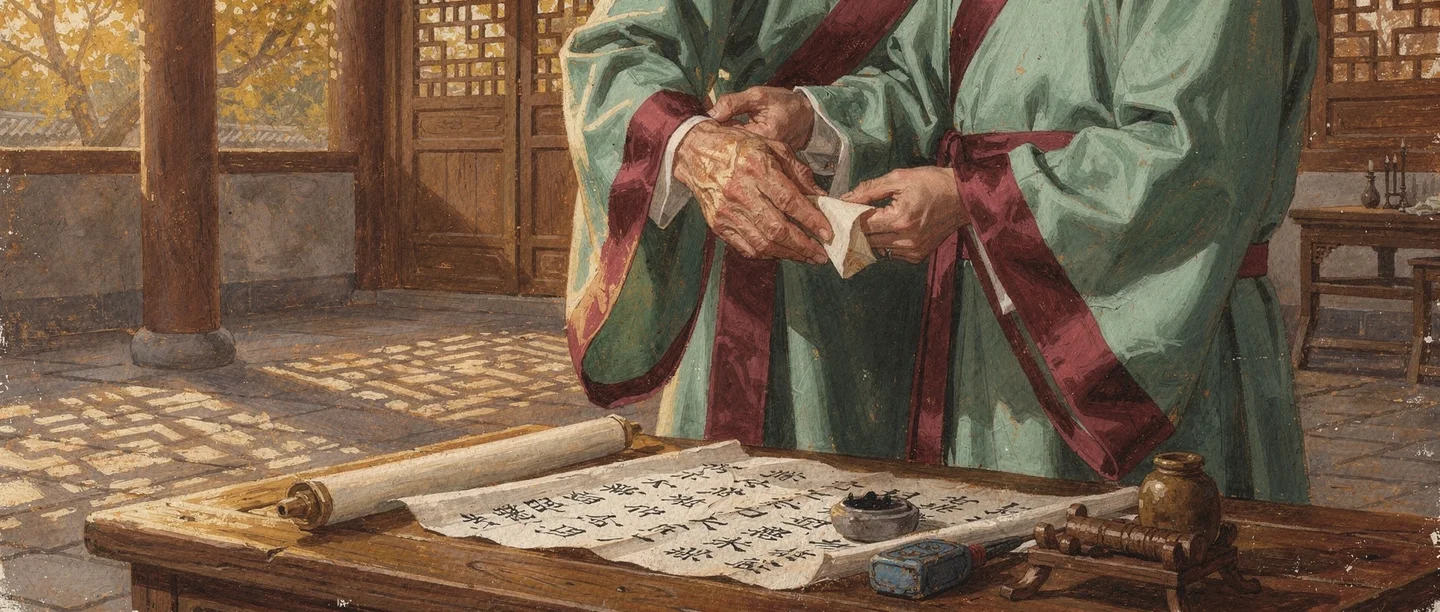
What is Confucian ethics and what are its core virtues?
Confucius (551–479 BCE) was a Chinese philosopher who believed that a good society begins with good individuals. His moral philosophy — recorded in the Analects by his students — is built on core virtues that every person should cultivate through lifelong practice.
Ren — benevolence
The central virtue is ren (仁), often translated as benevolence or humaneness. Ren means caring genuinely for other people. Confucius described it as "loving others" and considered it the foundation of all moral behaviour.
Yi — righteousness
Yi (義) means doing what is morally right, even when it is difficult. It involves making ethical judgements based on principle rather than self-interest. Confucius taught that a person of integrity chooses what is right over what is profitable.
Li — ritual propriety
Li (禮) refers to the norms, rituals, and social customs that structure daily life. In Confucianism, following li is not empty formality — it is a way of expressing respect and practising virtue in everyday interactions.
Zhi and xin — wisdom and trustworthiness
Zhi (智) is the wisdom to distinguish right from wrong. Xin (信) is trustworthiness — keeping your word and being reliable. Together with ren, yi, and li, these five virtues form the moral backbone of Confucian thought.
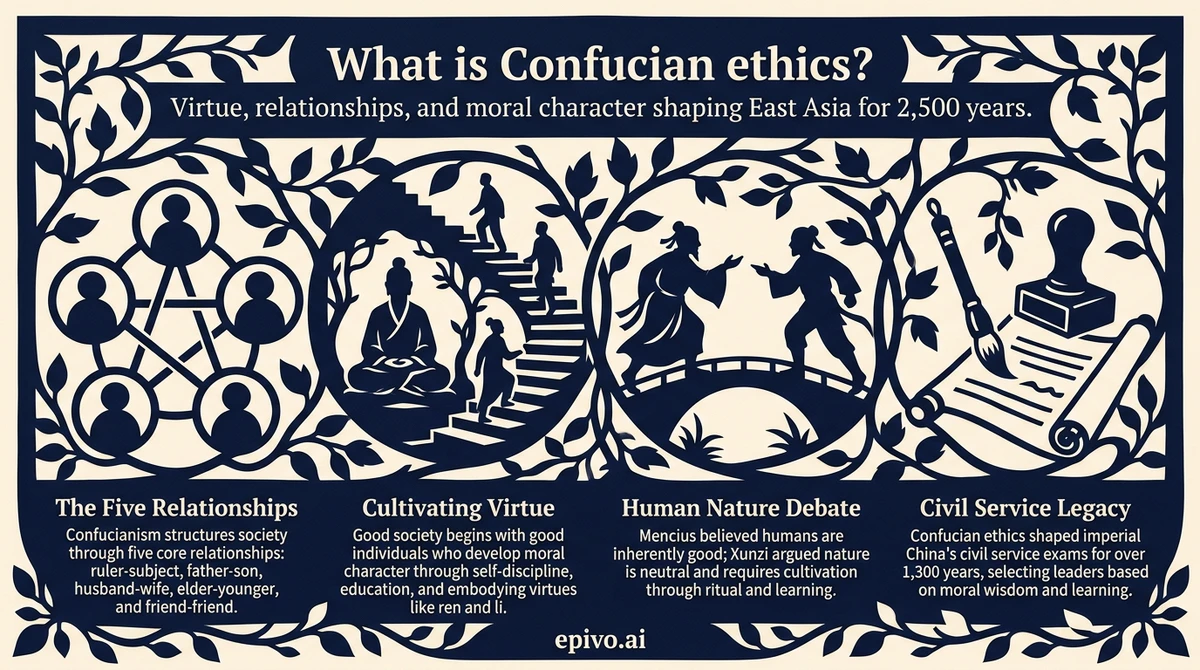
The five relationships and the Confucian vision of society
Confucian ethics is not just about personal virtue. It is a philosophy of how people should relate to each other. Confucius identified five fundamental relationships (wu lun) that structure a moral society.
The five relationships
These are: ruler and subject, parent and child, husband and wife, elder sibling and younger sibling, and friend and friend. Each carries mutual obligations. Parents must nurture; children must show filial piety (xiao) — deep respect and care for their parents and ancestors. Only the friend-friend relationship is between equals.
This framework is what scholars call role ethics — the idea that your moral duties depend on your position within relationships, not on abstract universal rules. In Confucian thought, you become a good person through your relationships, not apart from them.
The junzi — the exemplary person
The Confucian moral ideal is the junzi (君子) — the exemplary person. A junzi has cultivated all the virtues, fulfils their social responsibilities, and leads by moral example. Confucius believed that good governance depends on rulers who are junzi.
The Golden Rule
Confucius articulated his own version of the Golden Rule: "Do not do to others what you do not wish done to yourself" (Analects 15.24). This negative formulation focuses on restraining harmful behaviour rather than prescribing positive action. The Stanford Encyclopedia of Philosophy notes it is one of the earliest recorded statements of ethical reciprocity.
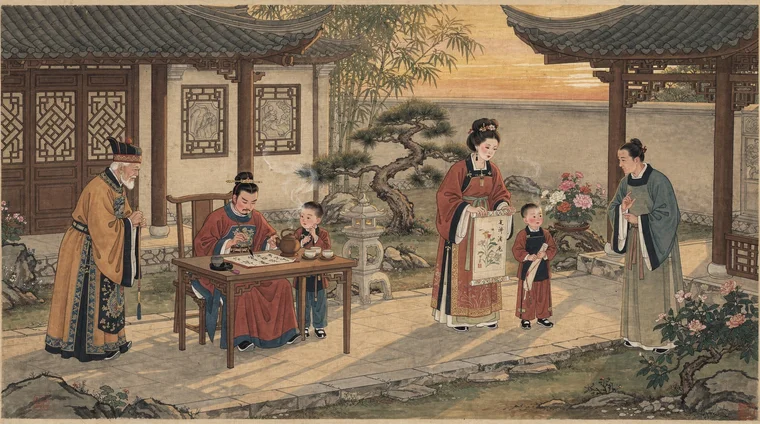
Image: Generated with AI (Epivo)
Mencius, Xunzi, and the debate about human nature
After Confucius, his most important followers took Confucian ethics in different directions through a fundamental disagreement: is human nature inherently good?
Mencius — human nature is good
Mencius (372–289 BCE) argued that all people are born with moral instincts — what he called the "four sprouts" of virtue. Seeing a child about to fall into a well, anyone would feel alarm and compassion. This proves, Mencius claimed, that benevolence is natural. The task of ethics is to cultivate the moral tendencies we already have.
Xunzi — human nature needs cultivation
Xunzi (310–235 BCE) disagreed. He argued that human nature tends toward selfishness. Virtue must be acquired through education, ritual practice, and disciplined effort. For Xunzi, the rites (li) are tools for transforming unruly nature into moral behaviour.
Why this debate matters
This disagreement parallels modern debates about whether morality is innate or learned. Both thinkers agreed on the Confucian goal — a harmonious, virtuous society — but proposed different paths to get there. The debate also shaped later Neo-Confucianism, where thinkers like Zhu Xi and Wang Yangming continued to wrestle with human nature and self-cultivation.
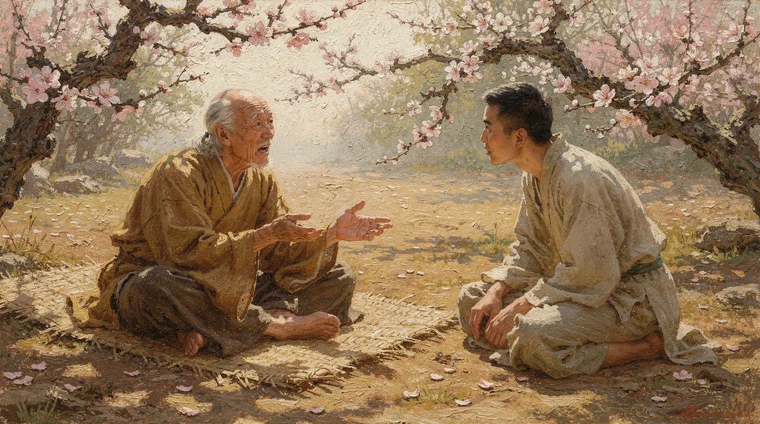
Image: Generated with AI (Epivo)
Did you know?
-
Confucius (551–479 BCE) lived during China's Spring and Autumn period. His teachings were recorded by his students in the Analects, which became one of the most influential texts in East Asian history.
Stanford Encyclopedia of Philosophy — Confucius -
Confucian ethics shaped the civil service examination system in imperial China for over 1,300 years (605–1905 CE), making moral philosophy the foundation of government recruitment.
Wikipedia — Confucianism -
Confucius stated his version of the Golden Rule around 500 BCE — roughly a generation before Socrates began teaching in Athens, making it one of the earliest recorded principles of ethical reciprocity.
Internet Encyclopedia of Philosophy — Confucius
How Confucian ethics shapes the world today
Confucian ethics is not a historical curiosity. Its influence on daily life, governance, and education across East Asia remains profound.
Family and social values
In China, Korea, Japan, and Vietnam, Confucian values continue to shape expectations about family loyalty, respect for elders, and educational achievement. The emphasis on education as a moral duty — not just a path to economic success — reflects Confucius's belief that learning and self-cultivation are the foundations of a good life.
Governance and leadership
The Confucian idea that leaders must earn legitimacy through moral conduct has influenced political thought across East Asia for centuries. Modern debates about meritocracy in Singapore and China draw explicitly on Confucian traditions. Critics argue that emphasis on hierarchy can justify authoritarian governance, while defenders point to the equally strong tradition of moral remonstrance — the duty to speak truth to power.
Confucian ethics and Western philosophy
Contemporary philosophers compare Confucian role ethics with Western virtue ethics, particularly Aristotle. Both emphasise character development and practical wisdom. However, Confucian ethics places far greater weight on social relationships and less on individual autonomy. This contrast shapes productive cross-cultural dialogue in modern ethical philosophy.
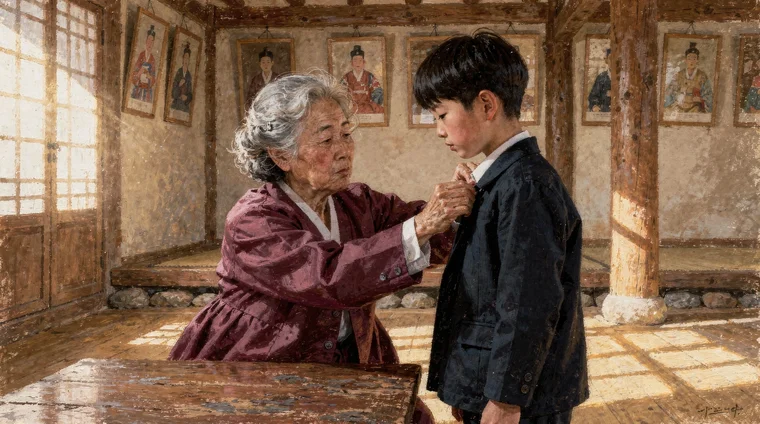
Image: Generated with AI (Epivo)
Frequently asked questions
- Is Confucian ethics a religion or a philosophy?
- Confucian ethics is primarily a moral philosophy — a practical guide to living well and treating others with integrity. Confucius focused on human relationships and social harmony rather than metaphysics or the afterlife. However, Confucianism has religious dimensions in some cultures, including ancestor veneration. Scholars classify it as both a philosophical and a cultural-religious tradition.
- What is the Confucian Golden Rule?
- Confucius stated: 'Do not do to others what you do not wish done to yourself' (Analects 15.24). This is sometimes called the Silver Rule because it is phrased negatively — focusing on what you should avoid doing rather than what you should actively do. It is one of the earliest known statements of ethical reciprocity in any civilisation.
- What is filial piety in Confucian ethics?
- Filial piety (xiao) is the virtue of respect, obedience, and care that children owe their parents. It extends to honouring ancestors and caring for elderly family members. Confucius considered filial piety the root of all virtue — the first relationship in which a person learns to be moral. It remains one of the most influential Confucian values across East Asia today.
- How is Confucian ethics different from Western ethics?
- Western ethics tends to focus on individual rights, universal rules, or consequences of actions. Confucian ethics is relational — it defines moral duties based on your role within specific relationships (parent, child, ruler, friend). It emphasises character cultivation, social harmony, and concrete human relationships rather than abstract principles. Scholars call this approach role ethics.
- Did Confucius believe people are naturally good?
- Confucius himself did not take a definitive position on whether human nature is inherently good. His follower Mencius argued that it is — that all people are born with moral instincts. Another important Confucian thinker, Xunzi, disagreed, claiming human nature tends toward selfishness and requires deliberate cultivation through education and ritual.