What is karma and where does the idea come from?
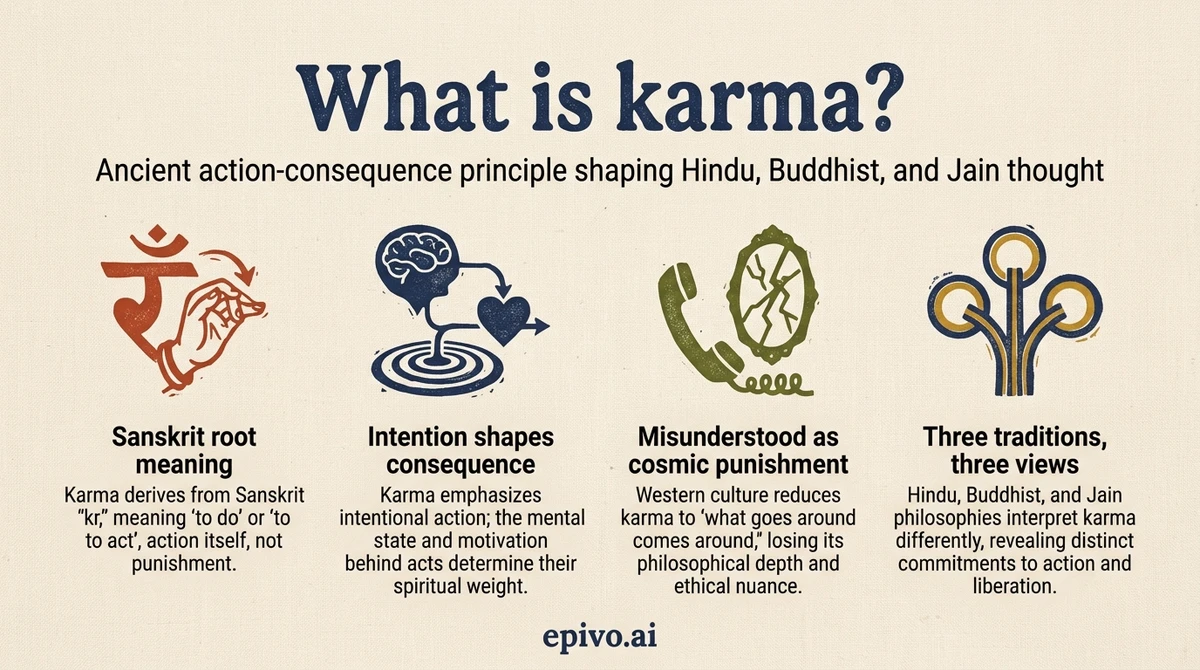
To understand what is karma, start with the word itself. It comes from the Sanskrit root kr, meaning "to do" or "to act." In its simplest form, karma refers to the law of cause and effect applied to human behaviour. Every action — physical, verbal, or mental — produces a result. Good actions lead to positive outcomes. Harmful actions lead to suffering.
This idea first appeared in ancient Indian texts over 3,000 years ago. The earliest references occur in the Rigveda, one of the oldest scriptures in Hindu philosophy. Karma became a fully developed concept in the Upanishads (around 800–200 BCE), where it was linked to the cycle of death and rebirth known as samsara.
Karma is not fate, luck, or divine punishment. It is a natural law — as impersonal as gravity. The Stanford Encyclopedia of Philosophy describes it as a moral causal principle: actions have consequences that extend beyond a single lifetime.
Karma and moral responsibility
What makes karma distinctive is its emphasis on intention. Accidentally stepping on an insect is different from deliberately harming one. The moral weight of an action depends on the state of mind behind it. This focus on intentional action makes karma a theory of moral responsibility, not a system of mechanical reward and punishment.
What is karma in Hinduism, Buddhism, and Jainism?
The question of what is karma receives different answers depending on which tradition you ask. These differences are significant and reveal distinct philosophical commitments.
The Hindu understanding of karma
In Hinduism, karma is inseparable from dharma (duty or righteous conduct) and samsara (the cycle of rebirth). Every soul (atman) accumulates karma across many lifetimes. Positive karma — earned through virtuous action, devotion, and fulfilling one's dharma — leads to a favourable rebirth. Negative karma leads to suffering in future lives. The ultimate goal is moksha: liberation from the cycle of rebirth altogether.
The Bhagavad Gita introduces the concept of nishkama karma — selfless action performed without attachment to results. Krishna teaches Arjuna that the path to liberation lies not in renouncing action but in acting without selfish desire.
The Buddhist understanding of karma
The Buddha redefined karma by placing intention (cetana) at its centre. In Buddhism, karma is not a substance or a cosmic ledger. It is the mental intention behind an action that determines its karmic quality. A generous act done with compassion produces positive karma. The same act done for selfish reasons produces less.
Buddhism also rejects the Hindu concept of an eternal soul. Since there is no permanent self, karma operates through a continuous stream of cause and effect — not through a soul carrying merit from life to life.
The Jain understanding of karma
Jainism offers the most distinctive interpretation. In Jain philosophy, karma is a physical substance — fine particles of matter that attach to the soul through action. Every act, thought, and word attracts karmic particles. The goal is to stop accumulating new karma and burn off existing karma through asceticism, non-violence (ahimsa), and meditation.
This material conception sets Jainism apart from both Hindu and Buddhist views, where karma is understood as a law or a mental process.
Why karma is widely misunderstood today
In popular Western culture, karma is often reduced to a slogan: "what goes around comes around" or "karma's gonna get you." This oversimplification distorts the original concept in several important ways.
Karma is not cosmic revenge
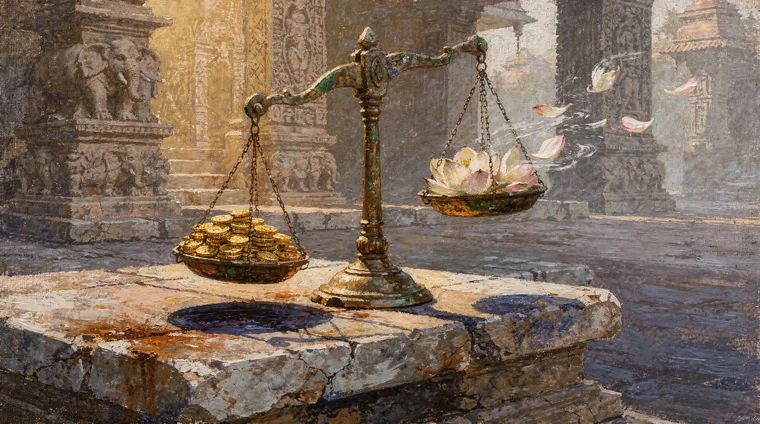
The popular idea that karma punishes bad people and rewards good people treats it as divine justice. In the original traditions, karma is an impersonal process — it has no agent, no judge, and no enforcer. It simply describes how actions produce consequences.
Karma is not fate
Another common misunderstanding treats karma as destiny — the idea that your current suffering is "deserved" because of past actions. Scholars have criticised this interpretation because it can justify inequality and blame victims for their circumstances. In its original context, karma emphasises that present action can always change your future.
Karma is not instant
Social media memes about "instant karma" have nothing to do with the philosophical concept. In Hindu and Buddhist traditions, karmic consequences may unfold across multiple lifetimes, not in minutes.
Why the distinction matters
Grasping what is karma in its original context is important for anyone studying philosophy, world religions, or ethics. The concept raises profound questions about free will, moral responsibility, and the relationship between action and consequence.
Did you know?
-
The word karma comes from the Sanskrit root 'kr' meaning 'to do' or 'to act.' It appears in some of humanity's oldest surviving texts, the Vedas, composed over 3,000 years ago.
Stanford Encyclopedia of Philosophy — Karma -
Karma is a central concept in four major world religions — Hinduism, Buddhism, Jainism, and Sikhism — which together have over 1.8 billion followers worldwide.
Encyclopaedia Britannica — Karma -
In the Bhagavad Gita, Krishna teaches that selfless action (nishkama karma) — acting without attachment to the fruits of one's actions — is the highest form of moral conduct.
Wikipedia — Karma
What is karma's significance for ethics and moral reasoning?
Beyond its religious context, karma offers a philosophical framework for thinking about ethics that remains intellectually powerful.
Action, intention, and consequence
Karma connects three elements that Western ethics often treats separately. Consequentialism focuses on outcomes. Deontological ethics focuses on duty and intention. Virtue ethics focuses on character. Karma integrates all three: intention, action, and consequence all matter.
Personal responsibility
Karma places moral responsibility squarely on the individual. You cannot blame fate, the gods, or other people for the consequences of your own actions. This emphasis on personal agency resonates with modern research on locus of control — people who believe they can influence outcomes tend to make better decisions.
Compassion and non-harm
All traditions that teach karma also emphasise ahimsa — non-harm. If every action produces consequences, then harming others harms yourself. This creates a practical ethical motivation: treating others well is not just morally right but also in your own long-term interest. The Buddhist emphasis on compassion and the Jain commitment to non-violence both flow from the logic of karma.
For students of humanities and ethics, karma provides a powerful lens for examining questions about justice, fairness, and what it means to live a good life.
Frequently asked questions
- Is karma the same as fate or destiny?
- No. Karma emphasises that your actions shape your future — it is the opposite of fatalism. You are not locked into a predetermined path. Every choice you make now influences what comes next. The concept is about agency and responsibility, not helplessness.
- Do all religions believe in karma?
- Karma is central to Hinduism, Buddhism, Jainism, and Sikhism. Christianity, Islam, and Judaism do not use the concept of karma, though they have their own frameworks for moral cause and effect, such as divine judgement or the idea that you reap what you sow.
- Can karma be changed or erased?
- Most traditions teach that karma can be transformed through present action. In Hinduism, devotion and selfless service can overcome past karma. In Buddhism, meditation and ethical conduct redirect the stream of karmic consequences. In Jainism, ascetic practice burns off accumulated karmic matter.
- Is 'instant karma' a real concept?
- Not in the traditional philosophical sense. In Hindu and Buddhist thought, karmic consequences may unfold over multiple lifetimes, not instantly. The popular idea of 'instant karma' — immediate punishment for wrongdoing — is a modern simplification with no basis in classical texts.
- How is karma different in Buddhism and Hinduism?
- Hinduism ties karma to an eternal soul (atman) that carries merit across lifetimes. Buddhism rejects the idea of a permanent self and focuses on mental intention as the driver of karma. Both agree that actions have consequences, but they disagree on what exactly carries those consequences forward.